
Blown forex accounts are defined by a single common cause: poor risk management, not poor strategy. More than 70% of retail forex traders lose money, and the pattern behind those losses is consistent. Traders enter the market with real knowledge of technical analysis, chart patterns, and economic indicators. They still blow accounts because they abandon stop losses, revenge trade after losses, and size positions far beyond what their capital can survive. Understanding why forex traders blow accounts starts with accepting that the market is not the problem. The discipline breakdown is.
Why forex traders blow accounts: leverage and position sizing
The most direct cause of account failure is leverage misuse. Between 74% and 90% of retail forex accounts lose money primarily because of over-leveraging and improper position sizing. That figure is not a warning buried in fine print. It is the documented outcome across regulated brokers who are required to publish it.
Leverage amplifies both gains and losses. A 100:1 leverage ratio means a 1% move against your position wipes your entire margin. Most retail traders treat leverage as a tool for faster profits. Professional traders treat it as a liability to manage carefully.

Position sizing is the practical fix. Risking more than 1-2% of account equity per trade statistically increases the odds of catastrophic failure during normal losing streaks. At 1% risk per trade, ten consecutive losses still leave you with 90% of your capital. At 10% risk per trade, just three losses cut your account by 27%. The math is unforgiving, and most retail traders never run it.
| Risk per trade | Capital remaining after 10 losses |
|---|---|
| 1% | ~90% |
| 5% | ~60% |
| 10% | ~35% |
| 20% | ~11% |
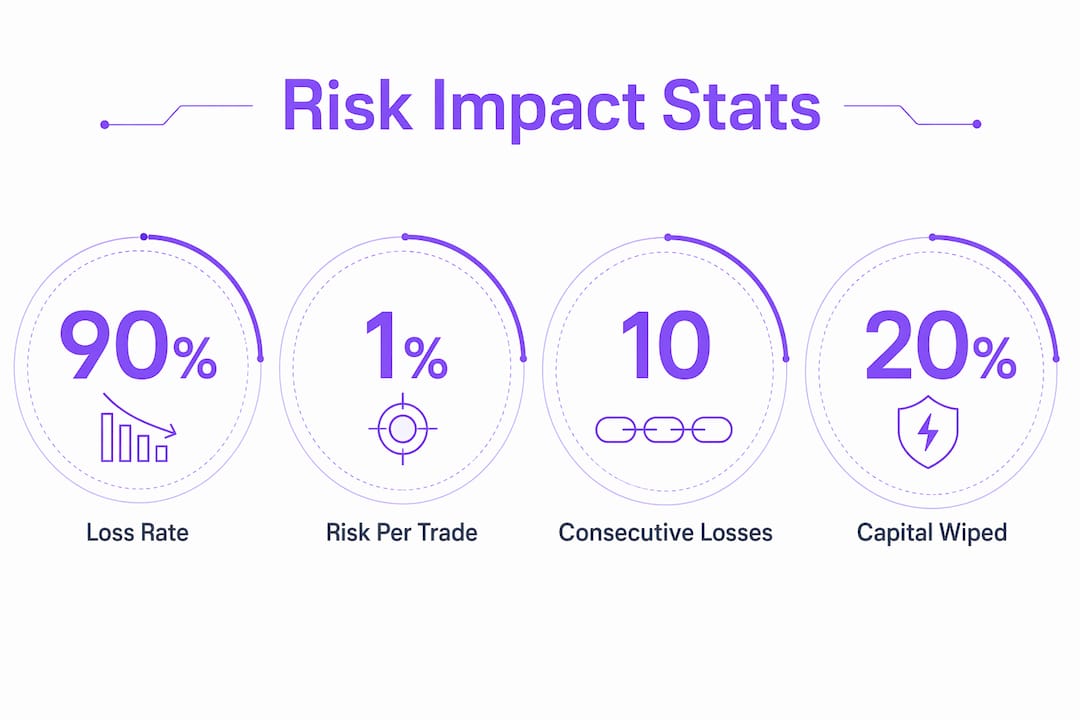
Two structural mistakes make this worse. First, traders use fixed lot sizes regardless of account balance, which means their actual risk percentage fluctuates wildly. Second, they average down on losing positions, which compounds exposure in the wrong direction. Proper position sizing using a percentage of account equity scales risk automatically as your balance changes, protecting capital during losing streaks without requiring constant manual recalculation.
Pro Tip: Set your position size calculator as a mandatory step before every trade entry. If you skip the calculation, you skip the trade. No exceptions.
How does emotional behavior cause forex account failure?
Emotional decisions are the accelerant that turns a bad trade into a blown account. Revenge trading and increasing position size after losses rapidly accelerate the decline to zero balance. The sequence is predictable: a trader takes a loss, feels the need to recover it immediately, doubles the next position, and loses again on a larger scale.
The impact of emotions on trading shows up most clearly in how traders handle stop losses under stress. Fear causes traders to move stops further away from entry to avoid being stopped out, which turns a controlled loss into a catastrophic one. FOMO pushes traders into entries they never planned, at prices that make the risk-to-reward ratio negative from the start.
"Traders really fail from lack of a systematic response to market unpredictability, not because markets are unfair or random. Success is found in preparation, process, and consistent system adherence."
Experienced traders manage emotional impulses better because they have built a systematic response to market events. Behavioral bias effects diminish with financial literacy and experience. That means the solution is not to eliminate emotion but to build a process that makes emotional decisions structurally harder to execute.
A pre-defined trading plan is the most effective tool here. When entry rules, exit rules, and stop loss placement are written down before the trade opens, the emotional brain has less room to override the rational one. Traders who follow a forex discipline checklist before each session report fewer impulsive decisions and more consistent execution.
What are the most common structural trading mistakes?
Structural mistakes are the recurring errors baked into how traders operate day to day. They are distinct from emotional decisions because they persist even when a trader feels calm. Common mistakes including no stop loss, moving stops, and overtrading are the leading contributors to forex account failures across all experience levels.
The most damaging structural errors follow a clear pattern:
- No stop loss or moved stop loss. Trading without a stop loss is not aggressive. It is a guarantee of unlimited downside on any single trade. Moving a stop loss further away after the market moves against you converts a planned small loss into an unplanned large one.
- Overtrading driven by daily profit targets. Setting a fixed daily dollar target forces trades that do not meet your criteria. Professional traders target 15-25% annual returns rather than unrealistic monthly doubling goals. Chasing daily targets is the fastest path to overtrading.
- Strategy switching before statistical validity. Every strategy goes through losing streaks. Switching strategies after five or ten losses means you never allow any system to prove its edge over a statistically meaningful sample. Traders who analyze their trade performance patterns consistently find that their best strategy was abandoned too early.
- Ignoring correlated positions. Opening long positions on EUR/USD and GBP/USD simultaneously is not two trades. It is one directional bet on the US dollar with double the exposure. Traders who ignore correlation unknowingly multiply their risk without realizing it.
Pro Tip: Review your open positions for currency correlation before adding any new trade. If two positions move together 80% of the time, treat them as one position for risk sizing purposes.
Systematic risk management corrects all four of these errors. The fix is not willpower. It is process design that removes the opportunity to make these mistakes in the first place.
How can traders practically prevent blowing their accounts?
Account survival comes down to three things: a fixed risk rule, a written trading plan, and a review routine. Blowing an account is typically a cumulative effect of a pattern of errors, not a single catastrophic decision. That means prevention is also cumulative.
The practical steps that work:
- Apply the 1-2% rule without exceptions. Risk no more than 1-2% of your account on any single trade. Calculate the position size before entry, every time. This single rule prevents the math of ruin from applying to your account.
- Write your trading plan before the session opens. Define your entry criteria, stop loss level, and take profit target before the market opens. Decisions made before emotional pressure arrives are almost always better than decisions made during a live trade.
- Set realistic return expectations. Targeting 15-25% annual returns aligns with professional standards. Targeting 50% per month forces risk levels that guarantee eventual blowup.
- Use technology to catch overtrading early. AI tools that detect overtrading signals flag when trade frequency exceeds your plan, giving you an objective warning before the damage compounds.
- Run a post-session review. Reviewing every trade against your plan builds the feedback loop that experience alone cannot provide quickly enough. Traders who use AI feedback for forex improvement identify emotional patterns in their trade history that are invisible in the moment.
| Approach | What it prevents |
|---|---|
| Fixed 1-2% risk rule | Catastrophic loss from single trades or short losing streaks |
| Written trading plan | Impulsive entries and emotionally moved stop losses |
| Realistic return targets | Overtrading driven by unrealistic daily or monthly goals |
| AI-based trade auditing | Revenge trading and FOMO pattern repetition |
| Post-session review routine | Repeating the same structural mistakes across sessions |
Even high win-rate strategies fail without proper position sizing because inevitable losing streaks will eventually hit. The math of ruin does not care how good your strategy is. It only cares how much you risk per trade.
Key Takeaways
Forex accounts blow up because of repeated behavioral and structural failures, not because markets are unpredictable, and fixing position sizing, stop loss discipline, and emotional responses is the direct path to survival.
| Point | Details |
|---|---|
| Leverage kills most accounts | Between 74% and 90% of retail accounts lose money primarily due to leverage misuse. |
| 1-2% risk rule is non-negotiable | Risking more than 2% per trade exponentially increases blowup risk during normal losing streaks. |
| Emotional decisions accelerate failure | Revenge trading and moved stop losses turn manageable losses into account-ending drawdowns. |
| Structural mistakes are the real enemy | No stop loss, overtrading, and strategy switching are recurring patterns behind most account failures. |
| Process beats prediction | Traders who follow a written plan and review routine survive far longer than those who rely on instinct. |
What I've learned after watching traders blow the same account twice
The most frustrating thing I see is traders who blow an account, fund a new one, and repeat the exact same pattern within three months. They change the currency pair. They change the time frame. They do not change the behavior.
The data confirms what experience shows: account failure is a cumulative pattern, not a single bad trade. Traders who survive long enough to become consistently profitable are not smarter or luckier. They built a process that made their worst impulses structurally harder to act on.
The uncomfortable truth is that most traders spend 90% of their preparation time on strategy and 10% on risk management. The ratio should be reversed. A mediocre strategy with excellent risk management will outlast a brilliant strategy with no position sizing discipline. Every time.
Losses are not the problem. Uncontrolled losses are. The traders I have seen turn their performance around all share one thing: they stopped trying to predict the market and started building a system that controlled what they could actually control. That shift, from prediction to process, is where real trading careers begin.
— Tony
Disciplineaiapp: built for the discipline gap, not the signal gap
Most traders already know what they should do. The gap is in doing it consistently when real money is on the line.

Disciplineaiapp addresses that gap directly. The platform combines AI analytics with behavioral coaching to identify emotional patterns like revenge trading and FOMO in your actual trade history. Features like automated trade auditing and market replay training give you a structured way to review decisions and build better habits over time. The AI flags overtrading, inconsistent position sizing, and stop loss violations before they compound into a blown account. Traders who want to close the gap between knowing the rules and following them can explore the full feature set at Disciplineaiapp.
FAQ
Why do most forex traders lose money?
Between 74% and 90% of retail forex traders lose money primarily due to leverage misuse and poor position sizing, not bad strategy selection.
What is revenge trading and why is it dangerous?
Revenge trading is the act of increasing position size after a loss to recover quickly. It accelerates account decline because it compounds risk at the exact moment a trader's judgment is most impaired.
How much should I risk per trade to avoid blowing my account?
Risk no more than 1-2% of your account equity per trade. At 1% risk, ten consecutive losses still leave 90% of your capital intact.
What role does trading psychology play in account failure?
Emotional bias effects diminish with experience, but untrained traders routinely move stop losses, overtrade, and abandon plans under stress. These psychological failures cause more account blowups than bad market calls.
Can a good strategy still blow an account?
Yes. Even high win-rate strategies fail without proper position sizing because a single losing streak at excessive risk levels can wipe out months of gains.