
Using AI feedback in forex trading is the process of applying large language models and machine learning tools to analyze your trade data, identify behavioral patterns, and enforce rule-based interventions that sharpen discipline and performance. This is not about prediction. It is about diagnosis. Tools like ChatGPT and Claude, combined with structured trade journals, give you a mirror that manual review cannot. Traders who use AI feedback for forex improvement consistently report gains not from better signals, but from eliminating the behavioral leaks that were silently draining their edge. This article walks you through the exact workflow: journal structure, rule implementation, feedback loops, and the pitfalls that derail most traders before they see results.
How to use AI feedback for forex improvement: start with your journal
AI feedback is only as good as the data you feed it. A journal that records only entry price and result gives an AI model almost nothing to work with. A journal that captures instrument, timeframe, direction, entry, stop, target, rationale, and emotional state at the moment of the trade gives an AI model everything it needs to find patterns you cannot see yourself.
The emotional state field is the most skipped and the most valuable. Recording how you felt at entry, whether confident, anxious, bored, or pressured, in real time rather than after the fact is what separates a trading log from a behavioral dataset. Weekly AI coaching sessions that use structured inputs including emotional state consistently identify the highest-leverage focus areas for improvement. That is the difference between a journal and a coaching tool.

Here is a comparison of journal formats and their compatibility with AI evaluation:
| Journal style | What it captures | AI compatibility |
|---|---|---|
| Basic log | Entry, exit, P&L | Low. No behavioral signal. |
| Annotated log | Setup type, result, brief notes | Medium. Limited pattern detection. |
| Structured journal | All trade fields plus emotional state | High. Full behavioral analysis possible. |
| AI-formatted template | Structured fields plus session context | Highest. Ready for direct LLM input. |
Pro Tip: Use AI tools like ChatGPT or Claude to generate a session-specific pre-trade checklist from your methodology. Paste your trading rules and ask the model to produce a checklist tailored to your session timing. This forces clarity before you ever place a trade.
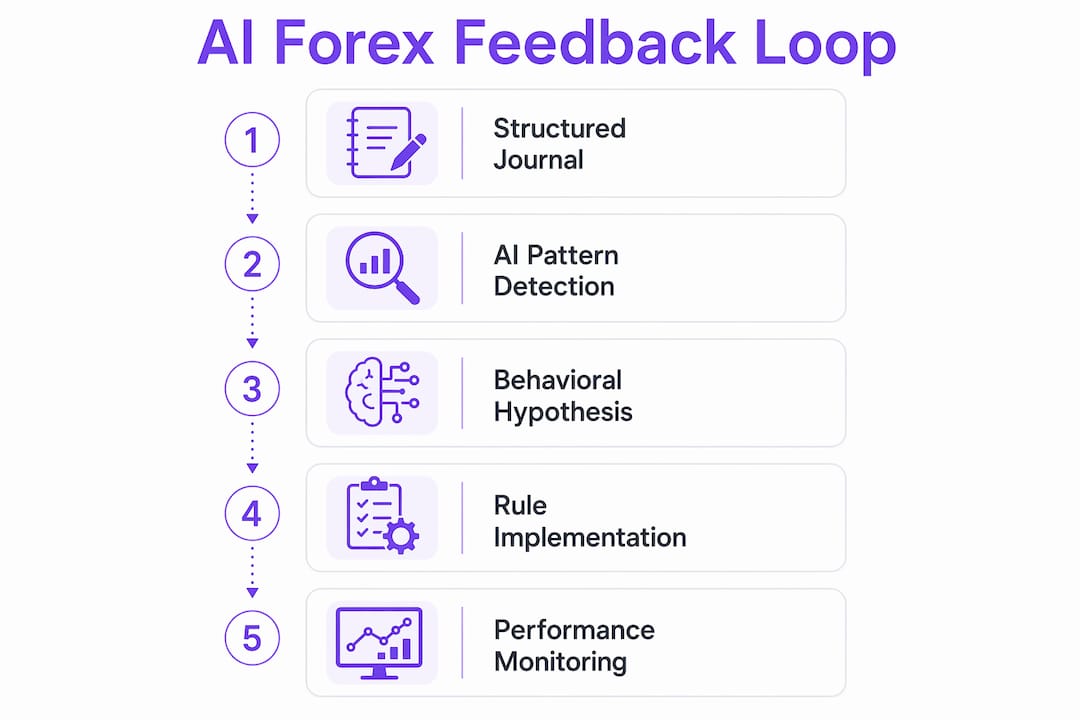
The structured journal is the precondition for everything that follows. Without it, AI feedback becomes guesswork dressed up as analysis.
How do you translate AI feedback into real behavior change?
Collecting feedback is not the same as changing behavior. Most traders read an AI summary, nod along, and trade exactly the same way the next day. Behavioral change happens only when AI feedback is translated into specific structural rules that interrupt negative patterns. The insight is not the intervention. The rule is.
Here is a step-by-step process for turning AI feedback into disciplined trading rules:
- Run your structured journal through your AI model. Paste the last 30 to 50 trades and ask the model to identify your three most costly behavioral patterns. Be specific in your prompt: ask for patterns tied to P&L impact, not just frequency.
- Pick one pattern to address. Not three. One. A large-scale AI coach analysis of 500 trades found that position size creep after winning streaks was the single biggest leak, invisible to the trader until the AI flagged it. One rule fix doubled monthly profits.
- Write a structural rule, not an intention. "I will be more careful after wins" is an intention. "After three consecutive winning trades, my position size resets to 0.5% of account for the next five trades" is a rule. Rules interrupt behavior mechanically. Intentions rely on willpower, which fails under pressure.
- Implement the rule for a minimum of 30 trades before evaluating. Testing over sufficient sample sizes is the only way to separate rule impact from market noise. Suggested minimums are 50 or more trades before implementation and 30 or more trades after for impact confirmation.
- Return to your AI model with the post-rule data. Ask whether the targeted pattern has reduced and whether any new patterns have emerged. This closes the loop.
Common behavioral leaks AI models reliably detect include revenge trading after losses, FOMO entries outside your defined setup criteria, and position size creep during winning streaks. Each of these has a structural fix. The AI's job is to find them. Your job is to implement one at a time.
Pro Tip: Frame every AI-suggested change as a hypothesis, not a verdict. Treat each rule as an experiment with a defined test window. This mindset prevents you from abandoning good rules too early or holding onto bad ones too long.
How do you set up an ongoing AI feedback loop?
A single AI review session is useful. A structured feedback loop is transformational. The difference is cadence and measurement. Recording emotional state in real time and reviewing through structured routines creates measurable psychology improvement over months, not just isolated insights.
A practical three-layer review structure looks like this:
- Daily layer. After each session, log your emotional state, any rule violations, and a one-sentence process rating. This takes three minutes and builds the raw data for weekly analysis.
- Weekly layer. Feed the week's structured entries to your AI model. Ask it to identify rule violations, emotional triggers, and any shifts in your execution quality. This is where patterns across multiple trades become visible.
- Monthly layer. Run a full psychological audit. Ask your AI model to compare this month's behavioral metrics against the previous month. Look for reductions in destructive patterns and improvements in process quality ratings.
"The key to consistent improvement is the combination of data, intervention, and measurement, not just collecting feedback." — Trading Journal Psychology Guide
Monitoring metrics worth tracking in your feedback loop include: number of rule violations per week, percentage of trades with a documented rationale, financial impact of trades taken outside your defined criteria, and your self-rated process quality score per session. These metrics give your AI model something concrete to evaluate beyond raw P&L. They also give you a performance picture that is independent of market conditions, which is exactly what discipline-focused improvement requires.
Platforms like Disciplineaiapp automate much of this layer structure, running trade audits and behavioral pattern detection without requiring you to manually format and paste journal entries each week.
What are the biggest pitfalls when using AI for trading feedback?
AI feedback loops can degrade. Understanding why is as important as building them correctly in the first place.
The most dangerous failure mode is misaligned evaluator incentives. A five-round experiment showed that when AI evaluators were given poor rubrics focused on maximizing returns, outcomes worsened with each iteration. The AI optimized for the wrong thing with increasing confidence. The evaluator or feedback rubric is as important as the AI model itself. A misaligned rubric degrades performance even when the underlying model is excellent.
A second pitfall is confirmation bias in LLM memory retrieval. When an AI model is given only your winning trades as context, it will find patterns that confirm your existing beliefs. Introducing contradictory data into memory retrieval, specifically ensuring losing trades and edge cases are included, reduces overconfidence and produces more honest feedback.
Practical safeguards to protect your feedback loop:
- Write explicit rubrics for your AI model. Tell it to prioritize behavioral consistency over P&L outcomes when evaluating your trades.
- Include your worst trades in every analysis batch, not just representative samples.
- Use confidence-weighted outputs and abstain rules. When an AI model is uncertain about a pattern, it should say so rather than force a label. Adding an "UNCERTAIN" output option reduces noisy decisions significantly.
- Combine AI feedback with human mentorship. A trading coach or peer review group catches blind spots that even well-designed AI prompts miss.
- Keep your rules simple. Complex rule sets are harder to test, harder to follow, and harder for AI models to evaluate cleanly.
The traders who get the most from AI feedback are not the ones with the most sophisticated prompts. They are the ones who maintain honest journals, use clear rubrics, and resist the temptation to over-engineer the system.
Key takeaways
AI feedback improves forex trading performance through structured journaling, rule-based behavioral intervention, and continuous measurement cycles, not through better predictions.
| Point | Details |
|---|---|
| Journal structure is the foundation | Capture instrument, rationale, and real-time emotional state for every trade to enable meaningful AI analysis. |
| One rule change at a time | Implement a single AI-identified fix and test it over 30 or more trades before evaluating impact or adding new rules. |
| Three-layer review cadence | Daily logs, weekly AI coaching, and monthly audits create the measurement cycle that confirms real improvement. |
| Evaluator rubrics matter | A misaligned AI feedback rubric degrades performance regardless of model quality. Write explicit behavioral criteria. |
| Guard against confirmation bias | Always include losing trades and edge cases in your AI analysis batches to prevent overconfident feedback. |
Why structure beats prediction every time
I spent two years trying to find a better entry signal. Better indicators, better timeframes, better confluences. My win rate barely moved. What actually changed my performance was the first time I pasted 60 structured journal entries into Claude and asked it to find my three biggest behavioral leaks. It came back with position size creep after winning streaks, a pattern I had never consciously noticed. I added one rule, tested it for six weeks, and my drawdowns dropped noticeably. Not because the market changed. Because I did.
The uncomfortable truth about AI in trading psychology is that most traders use it to look for confirmation of what they already believe. They ask AI to validate their setups rather than interrogate their behavior. That is the wrong direction entirely. The value is in the friction, in having a system that forces you to articulate your rationale, record your emotional state honestly, and then face the patterns that emerge over dozens of trades.
Patience matters here more than most traders expect. The first AI review session rarely produces a revelation. The third or fourth, after you have built a consistent journal and accumulated enough trades, is where the real signal appears. Stick with the process long enough to generate a meaningful sample. The discipline best practices that actually move the needle are almost always boring, repetitive, and slow. That is exactly what makes them work.
— Tony
How Disciplineaiapp puts this workflow into practice
Disciplineaiapp is built specifically for the workflow described in this article. It combines structured trade journaling, automated AI coaching, and psychological pattern detection in a single platform designed for forex traders who want to close the gap between what they know and how they actually trade.
The platform's automated trade auditing identifies emotional patterns like revenge trading and FOMO across your full trade history, not just the trades you remember to review. Its market replay training lets you practice discipline under simulated pressure before real capital is at risk. If you are ready to stop guessing at your behavioral leaks and start measuring them, Disciplineaiapp gives you the structure to do exactly that. Explore the full platform features to see how each tool maps to the feedback loop stages covered here.
FAQ
What is AI feedback in forex trading?
AI feedback in forex trading is the use of large language models or machine learning tools to analyze structured trade data, identify behavioral patterns, and generate rule-based recommendations for improving discipline and execution quality.
How many trades do I need before AI feedback is useful?
A minimum of 30 to 50 trades with consistent structured data gives an AI model enough signal to identify meaningful patterns. Fewer trades produce unreliable conclusions because sample size is too small to separate behavior from variance.
Can ChatGPT or Claude actually improve my trading?
Yes, when given structured journal inputs that include emotional state and rationale. Weekly AI coaching sessions using these inputs reliably surface behavioral patterns and focus areas that manual review misses.
What is the biggest mistake traders make with AI feedback?
The most common mistake is using AI to validate existing beliefs rather than interrogate behavior. Including only winning trades or favorable setups in your analysis creates confirmation bias and produces feedback that feels good but does not improve performance.
How do I prevent my AI feedback loop from degrading over time?
Write explicit behavioral rubrics for your AI model, include losing trades in every analysis batch, and use confidence-weighted outputs with abstain rules to reduce noisy decisions. Combine AI feedback with human mentorship to catch blind spots the model cannot see.