
Most crypto traders fail not because markets are unpredictable, but because emotional decisions override strategy in predictable, repeatable ways. Behavioral finance research calls this the execution gap: the distance between what a trader knows and what they actually do under pressure. Why crypto traders fail comes down to three core problems: emotional decision-making, poor risk management, and a lack of systematic discipline. Understanding these patterns is the first step toward trading with consistency rather than hope.
Why crypto traders fail: the emotional and psychological root causes
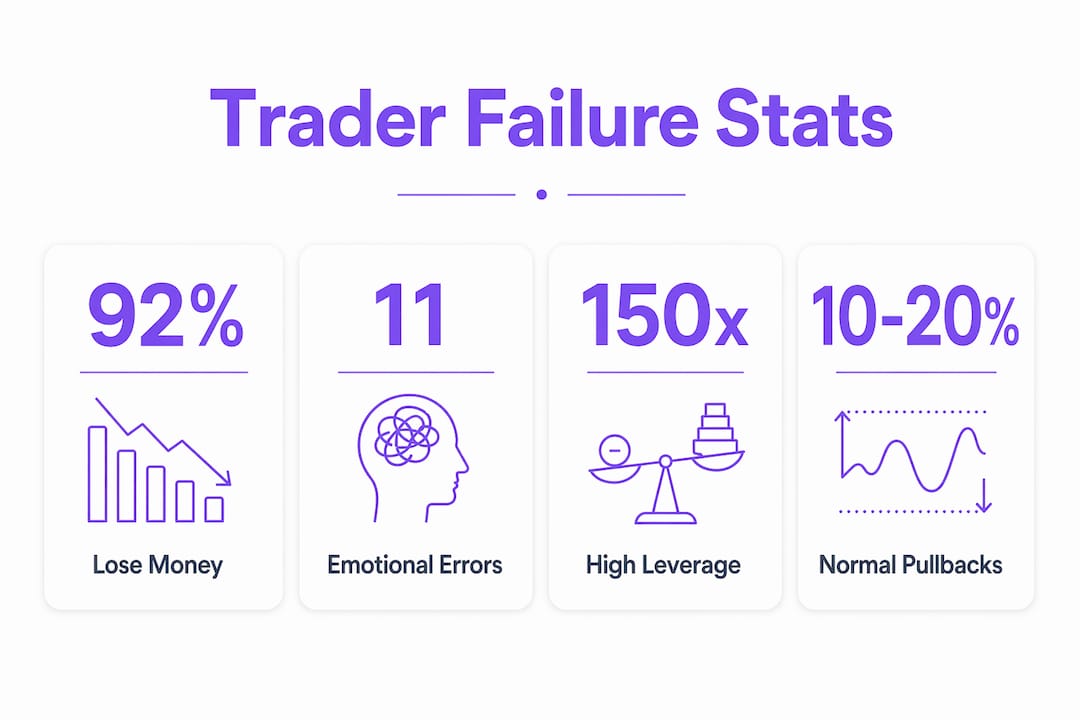
The single biggest driver of trading failure is not bad luck or market manipulation. 92% of retail crypto traders lose money within their first year, and the primary cause is emotional decision-making rather than a lack of technical knowledge. That number means the market is not the problem. The trader's own brain is.
Behavioral finance identifies several specific biases that destroy trader performance:
- Loss aversion: The brain registers losses 2.5 times more intensely than equivalent gains. Traders feel a $500 loss far more acutely than a $500 win, which distorts every exit decision they make.
- Action bias: When prices move sharply, the brain demands a response. Doing nothing feels dangerous, so traders act even when inaction is the correct move.
- Fear-driven selling: The amygdala, the brain's fear center, activates five times more strongly to losses than to gains. This biological response is fast and powerful enough to override rational analysis entirely.
- Confirmation bias: Traders seek out information that supports their existing position rather than information that challenges it.
The average crypto trader makes 11 emotional decisions per month that directly reduce returns. Each one feels justified in the moment. Collectively, they erode performance in a way that no technical setup can compensate for.
Pro Tip: Build a written pre-trade checklist that requires you to confirm your entry criteria, stop-loss level, and profit target before placing any trade. This forces rational evaluation before the emotional brain takes over.
How does poor risk management contribute to crypto trader failures?
Risk management is where knowledge gaps become financial losses. Many traders understand the concept of stop-losses but skip them in practice, believing they can monitor positions manually. That belief costs accounts.

| Common mistake | Effective alternative |
|---|---|
| Using 50x–150x leverage on volatile assets | Limit leverage to 2x–5x maximum on any single position |
| No predefined stop-loss before entry | Set stop-loss at entry, not after the position moves against you |
| Concentrated portfolio in one or two tokens | Spread exposure across uncorrelated assets |
| Ignoring Bitcoin correlation during altcoin trades | Check BTC trend before entering any altcoin position |
| Sizing positions based on conviction, not risk | Risk a fixed percentage (1%–2%) of total capital per trade |
Overleveraging and skipping stop-loss rules cause more account blow-ups than any other single factor. Leverage of 150x means a price move of less than 1% wipes out the entire position. Crypto regularly moves 10%–20% in a single session.
Concentrated portfolios create a second layer of risk. When altcoins follow Bitcoin lower during broad market weakness, a portfolio heavy in a single token has no buffer. Diversification is not about chasing returns. It is about surviving the drawdowns that every trader will face.
Pro Tip: Before entering any leveraged trade, calculate the exact dollar amount you lose if your stop-loss is hit. If that number makes you uncomfortable, reduce your position size until it does not.
Why do many crypto traders exit trades too early or chase losses?
Prospect Theory, developed by Daniel Kahneman and Amos Tversky, explains a pattern every trader recognizes but struggles to break. Traders take profits quickly to lock in the certainty of a gain, and they hold losing positions far too long hoping to reach break-even. The result is a systematic pattern of cutting winners early and letting losers run.
Loss aversion drives this behavior directly. The discomfort of watching a winning trade pull back is enough to trigger an early exit, even when the original thesis is still valid. Meanwhile, a losing trade feels tolerable as long as it has not been closed, because closing it makes the loss real.
This pattern creates a negative expectancy cycle:
- Winning trades are closed at 5%–10% gains because the trader fears giving back profit.
- Losing trades are held through 20%–30% drawdowns because the trader refuses to accept the loss.
- The math guarantees long-term failure regardless of how often the trader is right about direction.
Crypto markets regularly experience 10%–20% pullbacks as normal volatility within larger uptrends. Traders who panic sell during these pullbacks turn temporary dips into realized losses, then watch the asset recover without them. The solution is not more courage. It is pre-defined exits set before the trade is opened, so the emotional brain has no decision to make during the move.
The key to overcoming Prospect Theory is accepting discomfort deliberately: holding winners longer through normal pullbacks and cutting losers quickly at predefined levels. Trailing stops and laddered exits are the mechanical tools that make this possible without relying on willpower.
What role do market mechanics and knowledge gaps play in failures?
Most retail traders operate with incomplete information. They read candlestick charts and apply technical indicators, which is a starting point, not a complete picture. Professionals use order books, tape reading, and liquidity clusters to anticipate price moves before they happen. Retail traders react to moves after they have already occurred.
| Information type | Novice trader | Professional trader |
|---|---|---|
| Price data | Candlestick patterns, moving averages | Order flow, tape reading, volume profile |
| Market structure | Support and resistance levels | Liquidity clusters, institutional order blocks |
| Entry timing | Indicator crossovers | Positioning before momentum peaks |
| Risk signals | Price hitting stop-loss | Order book thinning, liquidity withdrawal |
Crypto markets move on liquidity and capital flow, not on fundamentals alone. A token with strong fundamentals can drop 40% if large holders are distributing. A token with weak fundamentals can rally 200% if liquidity is flowing in and retail attention is peaking. Traders who ignore this dynamic consistently buy tops and sell bottoms.
Understanding order flow and liquidity clusters does not require institutional tools. Free resources like Glassnode, Coinglass, and on-chain analytics platforms give retail traders access to data that was unavailable five years ago. The gap is not access. It is the willingness to learn and apply these concepts consistently.
How can crypto traders improve and avoid common pitfalls?
Improvement in trading comes from building systems, not from trying harder. Willpower is a finite resource. Rules are not. Here is a practical framework for addressing the most common crypto trading mistakes:
- Write your trading rules before you trade. Define entry criteria, stop-loss placement, and profit targets for every trade type you use. Entering trades without pre-defined exits forces emotionally compromised decisions in real time.
- Limit leverage to a level where a 20% adverse move does not end your account. Crypto volatility makes high leverage a near-certain path to liquidation over enough trades.
- Diversify across uncorrelated assets. Holding Bitcoin, Ethereum, and a selection of large-cap altcoins reduces the impact of any single token's collapse.
- Study order flow and market structure. Use tools like Glassnode and Coinglass to understand where liquidity sits and how institutional positioning affects price.
- Use technology for feedback. AI-powered platforms that audit your trades and identify emotional patterns give you data on your own behavior, which is the most valuable feedback loop available. Learning about AI in trading psychology shows how these tools are changing trader development in 2026.
- Reduce trade frequency. Overtrading is one of the most consistent factors affecting crypto success negatively. Fewer, higher-quality trades outperform high-frequency impulsive trading in nearly every analysis.
Building automated systems and pre-set rules removes the emotional brain from the equation. Successful traders treat trading as probability management, not prediction. The rules do the work. The trader's job is to follow them.
For traders new to structuring their approach, a beginner crypto trading guide covering entry discipline and position sizing provides a solid foundation before adding complexity.
Key takeaways
Most crypto traders fail because emotional decision-making, poor risk management, and incomplete market knowledge combine to create losses that no technical skill can offset.
| Point | Details |
|---|---|
| Emotions drive most failures | 92% of retail traders lose money in year one, primarily from emotional decisions rather than bad strategy. |
| Loss aversion distorts exits | Traders cut winners early and hold losers too long because losses feel 2.5x more painful than equivalent gains. |
| Leverage is the fastest path to zero | Using 50x–150x leverage on volatile crypto assets turns small adverse moves into full account liquidations. |
| Market mechanics knowledge matters | Professionals read order flow and liquidity clusters; relying only on chart patterns leaves traders reacting instead of anticipating. |
| Systems beat willpower | Pre-defined rules for entry, exit, and position size remove emotional decision-making from the equation permanently. |
The pattern I keep seeing that nobody talks about enough
Most traders I have watched over the years share one specific blind spot. They spend enormous time improving their entries and almost no time improving their exits. They obsess over finding the perfect setup, then abandon their exit plan the moment the trade moves against them by 3%.
The uncomfortable truth is that entry quality matters far less than most traders believe. A mediocre entry with a disciplined exit will outperform a perfect entry with an emotional exit every single time. The math is not close.
What I have found is that traders who struggle most are not undereducated about markets. They are overeducated about setups and completely underprepared for the psychological experience of being wrong. Losing a trade feels like a personal failure rather than a statistical outcome. That feeling is the real enemy.
The traders who eventually become consistent share one habit: they treat their own behavior as data. They review not just what the market did, but what they did and why. They catch patterns in their own mistakes, such as always exiting too early on Tuesday afternoons or always adding to losing positions after a news event. That self-awareness, built through systematic review rather than gut feeling, is what separates the 8% who survive from the 92% who do not.
The market does not care about your conviction. It rewards process.
— Tony
How Disciplineaiapp helps you trade with discipline, not emotion
Knowing why traders fail is one thing. Having a system that catches you when you are about to repeat the same mistake is another.
Disciplineaiapp is built specifically for the gap between knowing and doing. Its automated trade auditing identifies emotional patterns in your own trading history, including revenge trading, FOMO entries, and premature exits, and turns them into specific feedback you can act on. The market replay training feature lets you practice discipline under simulated market conditions before real money is at risk. Explore the full platform features to see how behavioral coaching and AI analytics work together to build the habits that make consistent trading possible.
FAQ
Why do most crypto traders lose money?
92% of retail crypto traders lose money within their first year primarily because of emotional decision-making rather than poor market knowledge. Predictable behavioral biases like loss aversion and action bias override rational strategy under pressure.
Why do crypto traders exit too early?
Prospect Theory explains that traders feel the pain of potential loss more acutely than the pleasure of equivalent gain, so they lock in small profits quickly to avoid watching them disappear. Pre-defined profit targets and trailing stops are the most reliable way to counter this pattern.
What is the biggest risk management mistake in crypto trading?
Overleveraging is the single most destructive risk management error. Leverage up to 150x can liquidate a position from a price move of less than 1%, and crypto routinely moves 10%–20% in a single session.
How does FOMO affect crypto trading outcomes?
FOMO, or fear of missing out, drives traders to chase pumps and enter positions at peak prices, which are exactly the points where risk is highest and reward potential is lowest. It is one of the most common crypto trading mistakes and one of the most expensive.
Can AI tools actually improve trading discipline?
AI tools that audit trade history and identify emotional patterns give traders objective data on their own behavior, which is more reliable than self-assessment. Platforms like Disciplineaiapp use this feedback loop to help traders recognize and correct the specific mistakes that are costing them money.