
Overtrading is defined as excessive trading activity that erodes net returns through compounding costs, emotional decision-making, and deteriorating trade quality. Traders who spot overtrading stock portfolio signals early protect themselves from a performance gap that research shows reaches 7.1 percentage points annually between high-turnover and passive investors. The standard industry term for this pattern is "excessive portfolio turnover," and it shows up in measurable signals long before account damage becomes obvious. Recognizing those signals is the first step toward restoring discipline and protecting returns.
What are the key signals that indicate overtrading in a stock portfolio?
The clearest overtrading indicator is a rising daily trade count paired with flat or declining profit and loss. When you trade more but earn less, frequency has replaced strategy as your decision driver. Tracking daily trades against daily profit and loss over a 30-day rolling period reveals this inverse relationship in a way that isolated weekly snapshots never will.
Two quantitative thresholds define a discipline failure:
- Transaction cost ratio above 30%: When commissions, spreads, and slippage consume more than 30% of gross profits, costs are destroying your edge before the market even has a chance to.
- C-grade trade rate above 30%: When more than 30% of your daily trades fall outside your written strategy criteria, you are no longer trading your plan. You are improvising.
- Frequency spikes beyond your personal baseline: A sudden doubling of your normal daily trade count, especially during low-volume sessions, signals emotional noise trading rather than opportunity.
- Excessive use of small timeframes: Constantly switching to one-minute or two-minute charts indicates impatience. It is a behavioral signal, not a market signal.
- Impulsive entries and exits: Entering trades without a defined stop or target, or exiting before a setup completes, are common stock portfolio overtrading signs that show up in trade logs before they show up in account balances.
The true costs of overtrading extend beyond commissions. Bid-ask spreads, slippage, and unfavorable short-term tax treatment are invisible frictions that accumulate silently. Traders who switched to zero-commission platforms often underestimated these hidden costs and increased their trade frequency as a result, accelerating the damage.
Pro Tip: Review your trade log every Friday and flag any trade you cannot match to a specific rule in your written strategy. If more than three trades in a week have no rule attached, you are already showing C-grade patterns.

How do psychological drivers and trader behavior contribute to overtrading?
Overtrading is rarely a knowledge problem. It is a behavior problem. Four primary emotional drivers cause the vast majority of excessive trading activity: boredom, FOMO (fear of missing out), revenge trading, and overconfidence. Each one loosens trading discipline in a different way, which is why a single generic fix rarely works.
- Boredom: Traders who need constant stimulation force trades during slow sessions. The market does not owe you action, but boredom makes it feel like it does.
- FOMO: Watching a stock move without you triggers impulsive entries at poor prices. FOMO-driven trades typically arrive late in a move and exit early in panic, compressing the reward while keeping the risk.
- Revenge trading: After a losing trade, the urge to recover losses immediately drives traders back into the market without a valid setup. This pattern compounds losses faster than almost any other behavior.
- Overconfidence: A strong winning streak creates the illusion that skill has replaced process. Traders begin deviating from their criteria because they believe they can read the market in real time.
"The busyness fallacy convinces traders that activity equals productivity. In markets, the opposite is usually true."
Social media amplifies all four drivers. Watching other traders post wins in real time creates artificial urgency and comparison pressure that has no relationship to your own strategy or market conditions. Men trade 45% more frequently than women, a gap linked directly to overconfidence bias that intensified after zero-commission trading removed the most obvious cost signal. Identifying which driver dominates your own behavior is the prerequisite for any effective fix.
What tools and metrics can traders use to detect overtrading signals effectively?
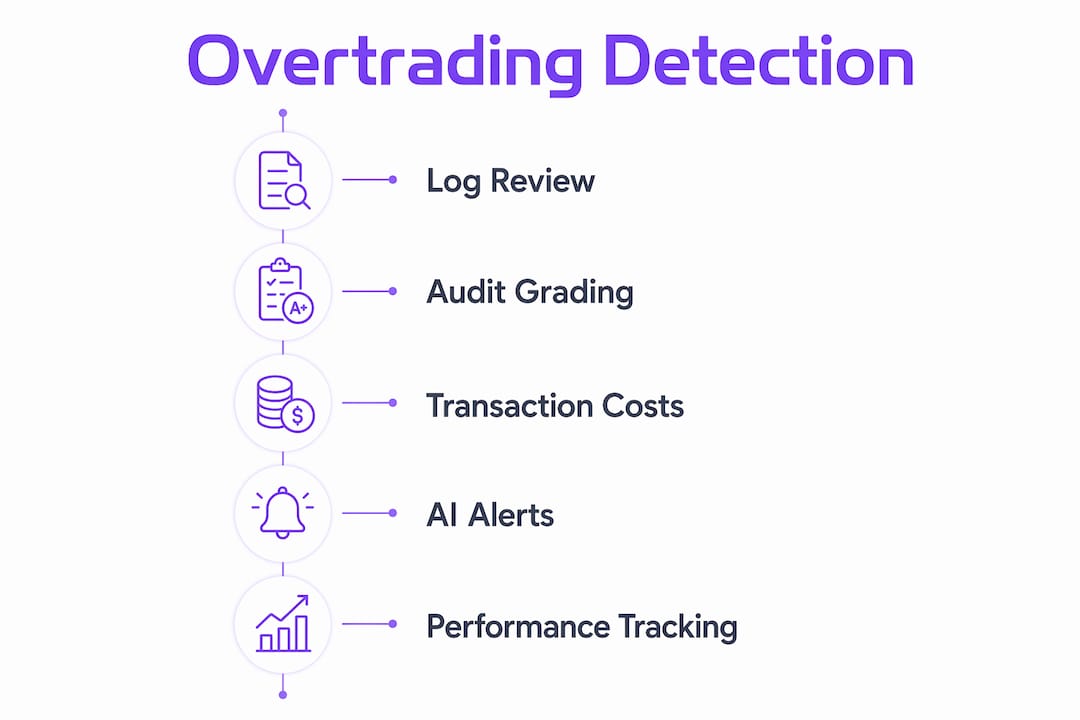
Detecting overtrading requires correlating multiple data points, not just reviewing your account balance at the end of the week. The most effective diagnostic method tracks daily trade count alongside daily profit and loss over a rolling 30-day window. When that chart shows trade counts rising while profit and loss trends flat or negative, you have a confirmed overtrading pattern, not a bad luck streak.
A trade audit grading system adds a qualitative layer to the quantitative data. Every trade receives a grade based on how closely it matched your written strategy at entry:
| Grade | Criteria | Action |
|---|---|---|
| A | Meets all written strategy rules at entry | Keep and analyze for refinement |
| B | Meets most rules, minor deviation | Review and note the deviation |
| C | Misses key rules or entered impulsively | Flag as overtrading signal; do not repeat |
When C-grade trades exceed 30% of total activity, the grading system has done its job. It has made the problem visible and measurable rather than vague and deniable.
AI-powered platforms take this further by detecting unusual trading patterns automatically. These systems flag frequency spikes, identify emotional trade sequences like revenge trading clusters, and surface behavioral patterns that manual review misses. Disciplineaiapp uses automated trade auditing to grade every trade against your strategy criteria and alert you when discipline metrics cross defined thresholds. That kind of continuous monitoring replaces the unreliable self-assessment most traders rely on.
Pro Tip: Set a hard rule: if your transaction cost ratio for the day exceeds 25%, stop trading for that session. You are not protecting profits at that point. You are just paying the market.
Monitoring trade performance patterns over time also reveals which market conditions trigger your worst overtrading episodes. Low-volatility afternoons, earnings seasons, and post-loss sessions each produce distinct behavioral fingerprints that become visible only when you track data consistently.
How can traders stop overtrading and restore portfolio performance?
Stopping overtrading requires structural rules, not willpower. Willpower depletes. Rules do not.
- Set a maximum daily trade limit. Choose a number based on your strategy's historical average, not your emotional appetite for action. If your best months averaged four trades per day, make five your hard ceiling.
- Implement mandatory rest days. Schedule at least one full no-trading day per week. Absence from the screen breaks the compulsive monitoring loop that feeds boredom and FOMO trading.
- Create blackout periods. Avoid trading in the first 15 minutes and last 15 minutes of the session unless your strategy explicitly requires it. These windows carry the highest emotional noise.
- Write your trade criteria before the session opens. If a setup does not match your written criteria at the time of entry, do not take it. No exceptions.
- Replace screen time with scheduled reviews. Set alerts for your key price levels and step away. Professional traders reduce decision errors by setting predetermined stops and targets, then removing themselves from constant monitoring.
The data on selective trading is stark. Elite traders earn roughly 80% of their annual returns from only 20% of their total trades. That means the majority of trades a high-frequency trader takes are diluting, not building, their annual performance.
| Behavioral intervention | What it targets | Typical effect |
|---|---|---|
| Daily trade cap | Boredom and overconfidence | Reduces C-grade trade rate |
| Mandatory rest days | Compulsive monitoring | Lowers revenge trading frequency |
| Pre-session written criteria | Impulsive entries | Raises A-grade trade percentage |
| Alert-based monitoring | FOMO and screen addiction | Reduces emotional exits |
| Max loss rule per session | Revenge trading | Prevents loss compounding |
Trading discipline practices that combine written rules with scheduled reviews consistently outperform approaches that rely on trader judgment in the moment. The goal is to make good behavior automatic and bad behavior structurally difficult.
Pro Tip: After any session where you broke a rule, write down the emotional state you were in at the time of entry. After three entries, you will see a pattern. That pattern is your primary overtrading trigger.
Key Takeaways
Overtrading destroys returns through compounding costs and deteriorating trade quality, and the signals are measurable long before the account damage becomes irreversible.
| Point | Details |
|---|---|
| Track frequency vs. profit | Monitor daily trade count against daily P&L over 30 days to confirm overtrading patterns. |
| Use the 30% thresholds | Flag sessions where C-grade trades or transaction costs exceed 30% of gross profits. |
| Know your emotional driver | Identify whether boredom, FOMO, revenge, or overconfidence is your primary trigger to apply the right fix. |
| Set structural rules | Hard daily trade caps and blackout periods work better than relying on in-the-moment willpower. |
| Audit every trade | A grading system that scores trades against written criteria makes discipline visible and measurable. |
The signal most traders ignore until it's too late
I have watched traders obsess over entry timing, indicator settings, and market news while completely ignoring the one metric that predicts their results better than any of those: trade count versus profit and loss over 30 days. Every time I have seen a trader plateau or blow up, that chart told the story weeks before the account did.
The traders who turned things around shared one habit. They stopped treating activity as evidence of effort. They started treating selectivity as a skill. One trader I worked with cut his daily trades from an average of twelve down to four after grading his trades for a single month. His win rate did not change much. His net profit nearly doubled because he stopped paying the market to let him lose.
The behavioral coaching piece matters as much as the data. Knowing you overtrade and knowing why you overtrade are two different problems requiring two different solutions. Revenge trading after a loss needs a max loss rule and a mandatory break. FOMO needs pre-session criteria written before the market opens. Boredom needs a no-trading rule during low-volume windows. The fix has to match the driver, or it will not hold.
Technology helps, but only if you use it honestly. Automated trade auditing removes the self-serving bias that makes traders remember their A-grade trades and forget their C-grade ones. The data does not lie. The question is whether you are willing to look at it.
— Tony
How Disciplineaiapp helps you detect and fix overtrading
Disciplineaiapp was built specifically for traders who know what overtrading looks like but struggle to catch it in real time. The platform's AI-powered features include automated trade grading, frequency monitoring, and behavioral pattern detection that flags revenge trading, FOMO sequences, and discipline breakdowns as they happen, not after the damage is done.
The market replay tool lets you review past sessions and identify exactly where your trade count spiked and why. That kind of structured trade review turns historical data into a behavioral coaching session. Disciplineaiapp does not just tell you that you overtraded. It shows you the emotional sequence that caused it and gives you a framework to interrupt that sequence next time.
FAQ
What is overtrading in a stock portfolio?
Overtrading is excessive trading activity that raises transaction costs and lowers net returns, typically identified by rising trade frequency paired with flat or declining profit and loss.
How do I know if my transaction costs signal overtrading?
When transaction costs exceed 30% of gross profits, your trading costs are destroying your edge. This threshold is a confirmed overtrading signal regardless of your win rate.
What are the four emotional drivers of overtrading?
The four primary drivers are boredom, FOMO, revenge trading, and overconfidence. Each requires a different behavioral intervention to correct effectively.
How many trades do elite traders actually need?
Elite traders generate roughly 80% of their annual returns from just 20% of their trades. Higher trade frequency beyond a strategy-defined baseline typically dilutes rather than builds performance.
Can AI tools help detect overtrading patterns?
AI platforms can flag frequency spikes, grade trades against written strategy criteria, and identify emotional trading sequences automatically, making behavioral patterns visible that manual review consistently misses.