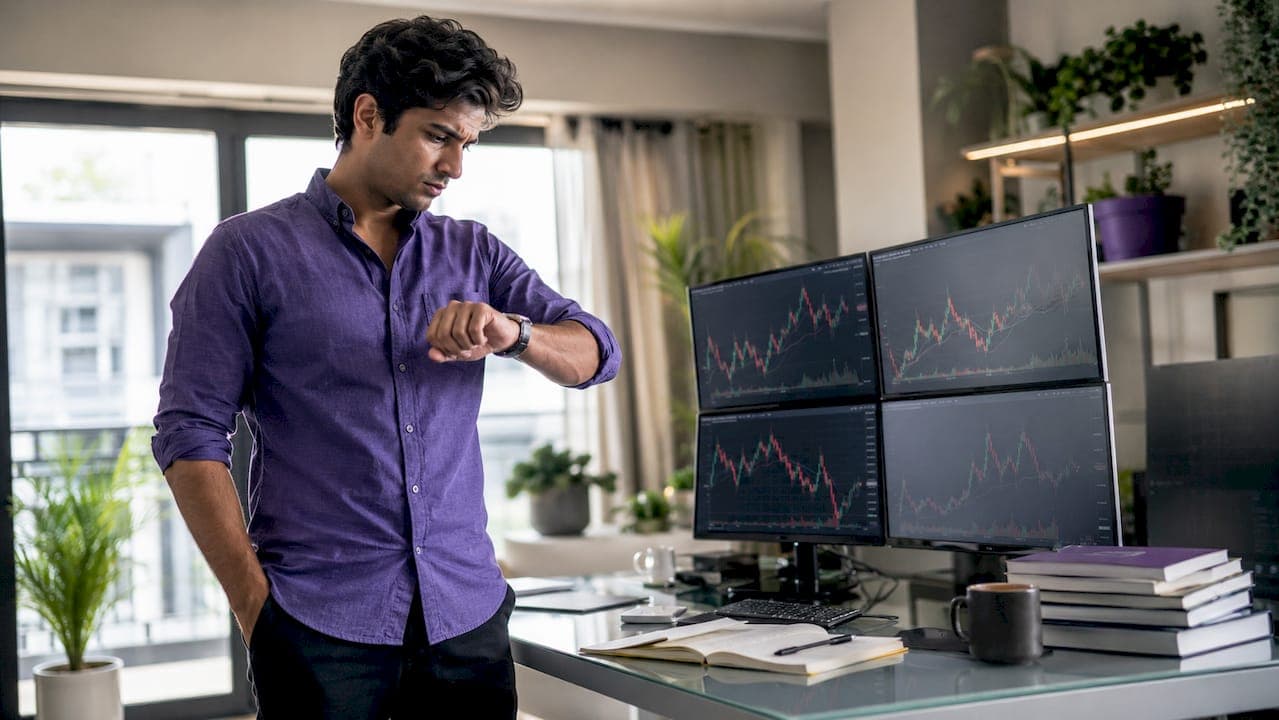
Overtrading is defined as executing more trades than your strategy, capital, and emotional state can support. It is the leading cause of slow account destruction for retail traders across forex, stocks, and crypto markets. Understanding how overtrading happens is not about willpower or moral failure. It is about recognizing the neurological, behavioral, and structural forces that push you past your edge, and building systems that stop them before they cost you real money.
How overtrading happens: the brain's role
Overtrading is primarily a brain design issue, caused by evolutionary reward mechanisms that were never built for financial markets. Your brain does not distinguish between hunting for food and scanning for trade setups. Both trigger dopamine release in the anticipation phase, not just the reward phase. That means the act of searching for trades feels good regardless of whether a valid setup exists.
Variable rewards and dopamine drive overtrading because unpredictable outcomes reinforce compulsive behavior. Markets deliver wins and losses on no fixed schedule, which is the exact pattern that creates the strongest behavioral loops in the human brain. Slot machines work the same way. The unpredictability is the hook.
Three emotional triggers accelerate this cycle:
- Revenge trading: After a loss, your brain seeks to recover the pain quickly. 73% of impulsive trades occur after a prior loss in the same session. That statistic means most overtrading is not ambition. It is emotional relief-seeking.
- FOMO: Fear of missing out pushes traders into setups they would normally skip. Crypto and forex markets are especially prone to this because price moves are visible in real time. If you want to understand how FOMO drives impulsive entries, the pattern is consistent across asset classes.
- Boredom: Boredom and fatigue during low-liquidity periods increase impulsive trades. Sitting in front of charts with nothing to do triggers the same restlessness as any other understimulated state.
Prefrontal cortex fatigue compounds all of this. After several hours of active decision-making, the brain's impulse control center loses effectiveness. Stress hormones like cortisol impair rational judgment further. The result is that your worst trading decisions tend to cluster in the afternoon or after a string of losses.
Pro Tip: Set a hard stop time for your trading session. Fatigue-driven trades made after your cognitive peak are statistically your worst performers.

Does a weak trading plan cause overtrading?
A lack of a clear trading plan leads traders to impulsively trade non-strategic setups. Without defined entry and exit rules, every price movement looks like a potential opportunity. That ambiguity is where overtrading breeds.
Poor preparation creates overtrading through four specific failure points:
- No setup grading system. When you treat every setup as equal, you take B-grade and C-grade trades alongside your A-grade setups. Each suboptimal trade dilutes your statistical edge and adds transaction costs. Quality trades trump quantity. Allowing only A-grade setups preserves your edge and curbs excess trading.
- Monitoring too many symbols. Watching 20 currency pairs or 50 stocks simultaneously creates information overload. The more symbols you track, the more "opportunities" your brain invents. Narrow your watchlist to the instruments where your edge is proven.
- Trading outside optimal hours. Friday sees the highest overtrading frequency during the trading week. Low-liquidity windows, like pre-market sessions or late Friday afternoons, produce more noise than signal. Trading in these windows increases your trade count without improving your results.
- No journaling practice. Without a trading journal, you cannot see patterns in your own behavior. Trade journaling and grading help traders self-diagnose overtrading and track improvement objectively. A journal turns invisible habits into visible data.
Pro Tip: Before each session, write down the maximum number of trades you will take and the exact setup criteria required. If a trade does not meet every criterion, it does not get placed.
What are the financial consequences of overtrading?
Overtrading is an edge-diluter. Adding marginal or poor setups reduces overall profitability and increases costs. The damage is rarely dramatic. It accumulates quietly across hundreds of small decisions.
How overtrading drains forex accounts follows a specific pattern. Each trade carries a spread cost, a commission, or both. A trader taking 10 trades per day instead of 3 does not just triple their opportunity. They triple their cost base while reducing their average setup quality. The math works against them from the first extra trade.
| Cost Type | Low-Volume Trader (3 trades/day) | High-Volume Trader (10 trades/day) |
|---|---|---|
| Spread costs per month | Low, manageable | High, compounding |
| Average setup quality | A-grade only | Mixed A, B, C |
| Emotional fatigue level | Controlled | Elevated by session end |
| Edge preservation | Strong | Diluted |
"Overtrading typically occurs in slow, gradual declines rather than dramatic losses, requiring detailed performance analysis to detect." — Forex Mechanics
This "death by a thousand cuts" effect is what makes overtrading so dangerous. A single bad trade is easy to identify and learn from. A pattern of slightly-below-average trades spread across weeks is nearly invisible without structured analysis. Overconfidence makes it worse. Traders who have had a winning streak often increase their trade frequency, believing their judgment has improved. Confirmation bias then filters out the losing trades from their mental review, leaving only the wins.
Emotional fatigue also degrades decision quality in real time. By the 8th or 9th trade of a session, your ability to assess risk accurately is measurably lower than it was at trade one. You can learn more about how to analyze trade performance patterns to see this effect in your own data.
What are the signs of overtrading?
Recognizing overtrading in your own behavior requires tracking specific patterns, not just reviewing your profit and loss statement. The signs of overtrading are behavioral before they become financial.
Watch for these indicators:
- High impulsive-to-planned trade ratio. If more than 30% of your trades were not in your pre-session plan, you are overtrading. Track this ratio weekly.
- More trades on losing days than winning days. Traders who take more trades after losses are in revenge mode. Compare your average trade count on red days versus green days.
- Daily loss limit violations. Hitting your daily loss limit and continuing to trade is a direct sign of overtrading. The limit exists precisely because your judgment degrades after significant losses.
- Post-loss impulsiveness. Notice whether your next trade after a loss comes within minutes. A rapid re-entry after a loss is almost always emotional, not strategic. Revenge trading and overtrading share the same emotional root.
- Boredom-driven entries. If you can honestly say you entered a trade because "nothing else was happening," that is a boredom trade. Boredom trades are overtrading by definition.
The most reliable detection method is a structured trading journal. Log every trade with a pre-entry note explaining why the trade met your criteria. Review weekly. If you cannot write a clear reason for a trade before you take it, you should not take it.
How to avoid overtrading: strategies that actually work
Discipline alone cannot prevent overtrading. Trading structure and external rules have a stronger impact than willpower. This is the most important shift in thinking you can make.
Here is a practical framework:
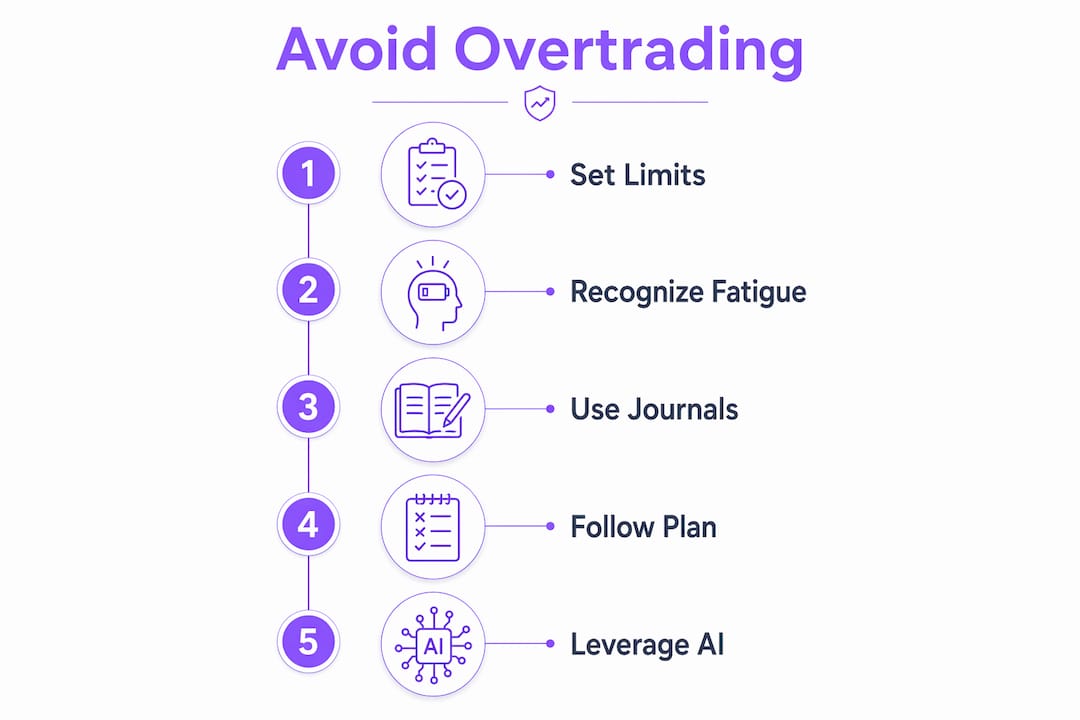
- Set daily trade and loss limits. Decide before the session opens: maximum 3 trades, maximum 1.5% account loss. When you hit either limit, the session ends. No exceptions.
- Use a trade approval delay. Before entering any trade, wait 5 minutes after identifying the setup. This single rule breaks the impulsive entry cycle. Using structured limits and cooldown periods significantly reduces overtrading by removing decisions from the emotional brain.
- Trade only during your proven high-quality windows. Identify the 2–3 hours per day where your win rate is highest. Trade only then. Close your platform outside those hours.
- Grade every setup before entry. Use a simple A, B, C grading system. Only A-grade setups get executed. B and C grades get logged for review but never traded.
- Use AI-powered behavioral tools. Platforms built around AI in trading psychology can flag emotional patterns in real time. They identify when your trading behavior deviates from your plan before the damage compounds.
| Prevention Method | Addresses | Effectiveness |
|---|---|---|
| Daily trade limits | Impulse volume | High |
| Cooldown periods | Post-loss revenge trading | High |
| Setup grading (A/B/C) | Edge dilution | High |
| Session time windows | Fatigue and boredom trades | Medium |
| AI behavioral alerts | Pattern detection | High |
For traders interested in stock trading discipline best practices, the same structural rules apply across asset classes. The brain does not change based on whether you trade EUR/USD or Apple stock.
Key takeaways
Overtrading destroys accounts gradually through transaction costs, edge dilution, and emotional fatigue, and only structured rules combined with behavioral tracking can stop it.
| Point | Details |
|---|---|
| Overtrading is neurological | Dopamine and variable rewards drive compulsive trading, not greed or laziness. |
| Emotional triggers are measurable | 73% of impulsive trades follow a prior loss, making post-loss behavior your highest-risk window. |
| Costs accumulate invisibly | Spread costs and diluted setups erode returns slowly, requiring journal analysis to detect. |
| Structure beats willpower | Daily trade limits and cooldown periods outperform discipline alone in preventing overtrading. |
| Detection requires data | Tracking your impulsive-to-planned trade ratio weekly is the most reliable self-diagnosis method. |
Why overtrading is a design problem, not a character flaw
I have watched traders with deep market knowledge blow accounts not because they lacked skill, but because they never addressed the structural conditions that made overtrading inevitable. The market is designed to keep you engaged. Platforms show you price movement constantly. News feeds refresh every minute. The environment itself is an overtrading machine.
What changed my thinking was accepting that willpower is a finite resource. You cannot out-discipline a system that is built to exploit your neurology. The traders I have seen improve consistently are not the ones who tried harder. They are the ones who built rules that made overtrading structurally difficult. Hard stops. Closed platforms. Pre-written trade criteria reviewed before the session, not during it.
The other shift worth making is toward patience as a performance metric. Sitting on your hands during a low-quality session is not inaction. It is capital preservation. The best traders I know measure their discipline by what they did not trade as much as by what they did. That mindset takes time to build, but it is the one that compounds.
— Tony
How Disciplineaiapp helps you trade less and earn more
Knowing the causes of overtrading is only half the work. Catching yourself in the act, before the damage compounds, is where most traders fall short.
Disciplineaiapp combines AI analytics with behavioral coaching to do exactly that. Its automated trade auditing flags impulsive entries in real time, comparing each trade against your stated plan. The platform's session limit enforcement stops you from trading past your daily thresholds, removing the decision from your emotional brain entirely. Market replay training lets you review past sessions to identify exactly where overtrading patterns emerged. Explore the full platform features to see how each tool maps directly to the behavioral triggers covered in this article.
FAQ
What is overtrading in simple terms?
Overtrading is executing more trades than your strategy and emotional state can support. It leads to higher costs, lower average trade quality, and gradual account drawdown.
Is overtrading harmful to long-term performance?
Overtrading is harmful because it dilutes your statistical edge and compounds transaction costs over time. The damage is slow and often invisible without detailed trade analysis.
What are the main signs of overtrading?
The clearest signs include taking more trades on losing days than winning days, entering trades within minutes of a loss, and trading outside your pre-session plan. Tracking your impulsive-to-planned trade ratio weekly reveals the pattern quickly.
How does overtrading drain forex accounts specifically?
Overtrading drains forex accounts through spread costs on every extra trade and by forcing entries in low-liquidity windows where price action is unreliable. Each suboptimal trade reduces your overall win rate while adding to your cost base.
Can AI tools help prevent overtrading?
AI tools can detect behavioral patterns like revenge trading and FOMO in real time, flagging deviations from your trading plan before they become costly. Platforms like Disciplineaiapp use automated auditing to make these patterns visible and measurable.