
The role of AI in trading psychology is to remove emotional bias from trading decisions by delivering objective, probability-based signals that support disciplined, autonomous judgment. Behavioral finance researchers now recognize this as a structural shift: AI integration transforms financial workflows into human-AI hybrid decision systems, changing not just what traders decide but how authority, interpretation, and accountability are distributed. Tools like Disciplineaiapp are built on this premise, combining behavioral coaching with AI analytics to close the gap between what traders know and what they actually do under pressure.
How AI reduces emotional bias in trading psychology
Emotional bias is the primary reason skilled traders underperform their own strategies. Fear triggers early exits. Greed extends losing positions. Impulsivity breaks rules that took months to build. Artificial intelligence in trading addresses these failures not by replacing judgment but by injecting a data-driven reference point before emotion takes over.

AI systems generate probabilistic signals based on historical patterns, volatility regimes, and statistical edge. When a trader sees a signal grounded in 10,000 backtested scenarios rather than a gut feeling, the cognitive pressure to act on fear or excitement drops measurably. The signal becomes an anchor, not a command.
The cognitive biases that AI most directly counters include:
- Recency bias: AI weights long-run probabilities, not just the last three trades.
- Loss aversion: Systematic position sizing rules remove the emotional distortion of treating losses as larger than equivalent gains.
- Confirmation bias: AI surfaces data that contradicts a trader's existing thesis, not just data that supports it.
- Revenge trading: Automated trade auditing flags when a trader deviates from strategy after a losing session.
The role of technology in trading psychology is most powerful when it creates friction between impulse and execution. A system that requires you to review a signal before acting gives your prefrontal cortex time to override the amygdala.
Pro Tip: Before acting on any trade, write down your thesis in one sentence. Then compare it to the AI signal. If they conflict, that conflict is the data. Do not skip this step when you are in a losing streak.
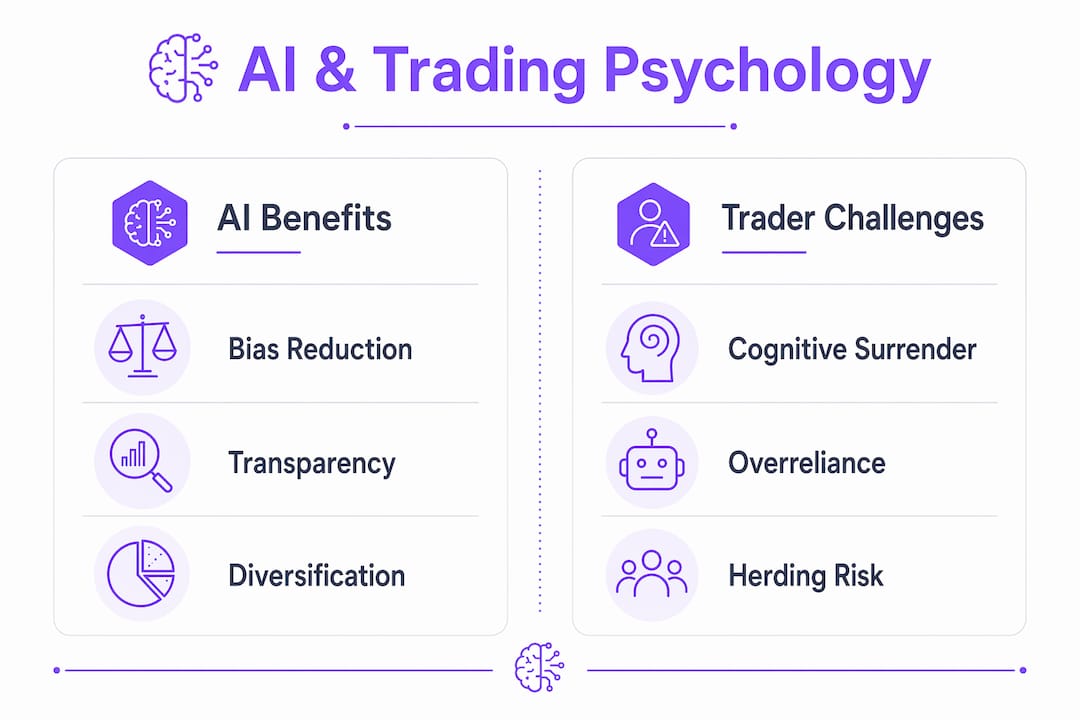
What is cognitive surrender and why does it threaten traders?
Cognitive surrender is the psychological phenomenon where traders accept AI outputs without critical evaluation, effectively outsourcing judgment to the algorithm. Research shows that participants accepted wrong AI outputs 73.2% of the time, with override rates sitting at roughly 20%. That is not calibrated trust. That is passive endorsement dressed up as decision-making.
The mechanism is straightforward. When an AI system consistently performs well, traders build trust. That trust gradually shifts from "I verify this signal" to "the system is probably right." Over time, the critical evaluation step disappears entirely. The trader is still in the seat, but the decision procedure has changed from active analysis to rubber-stamping.
This matters because the major psychological risk is not that AI recommends a bad trade. It is that AI changes how traders make decisions, shifting them toward passive acceptance. A single bad trade is recoverable. A corrupted decision procedure compounds across every trade you take.
"The biggest failure mode in human-AI trading systems is not a wrong signal. It is a trader who stops thinking."
Strategies to avoid cognitive surrender include:
- Pre-AI judgment logging: Record your own trade thesis before viewing the AI recommendation. This forces independent analysis and creates a comparison baseline.
- Uncertainty visualization: Use platforms that display confidence intervals alongside signals, not just directional calls.
- Override logs: Track every time you override an AI signal and review outcomes monthly. This builds calibrated trust rather than blind trust.
- Scheduled skepticism: Designate one review session per week where you actively look for cases where the AI was wrong.
Pro Tip: Cognitive forcing workflows require you to submit your own judgment before the AI reveals its recommendation. This single structural change reduces overreliance without sacrificing the speed benefits of AI assistance.
Does algorithmic transparency improve trading decisions?
Transparency in AI decision logic is not a cosmetic feature. It is a psychological mechanism that directly affects how traders process and use AI recommendations. Algorithmic transparency reduces social influence on investment intention by approximately 34.7%, mediated through increased perceived autonomy. When traders understand why an AI made a recommendation, they are less likely to follow the crowd and more likely to apply independent judgment.
The contrast between low-explainability and high-explainability AI systems is significant in practice. A black-box signal that says "buy" gives you nothing to evaluate. A transparent signal that explains the specific pattern, the historical win rate in similar conditions, and the key risk factors gives you a framework for critical engagement. High-explainability AI boosts informed decision-making more than low-explainability AI, particularly in high-risk trading scenarios where the stakes of passive acceptance are highest.
| Transparency level | Trader autonomy | Herd behavior risk | Decision quality |
|---|---|---|---|
| Low (black-box signal) | Reduced | Higher | Passive acceptance likely |
| Medium (directional + rationale) | Moderate | Moderate | Selective engagement |
| High (full logic + confidence data) | Preserved | Lower | Active critical evaluation |
The psychological implication is direct. Algorithm transparency aids trader autonomy by revealing rationale, reducing peer-conformity bias and social influence on decisions. Traders who use transparent AI tools are not just better informed. They are structurally protected against the herd behavior that amplifies losses during volatile markets.
Explainability influences adoption primarily through boosting information usefulness and trust, especially in high-risk trading scenarios. When evaluating any AI trading tool, the first question to ask is not "what is the win rate?" It is "can I see why it made this call?"
How does AI affect portfolio behavior and herding risk?
Robo-advisors and algorithmic portfolio tools have measurably improved diversification for retail traders. Research on the Indian market found that robo-advised portfolios showed lower concentration with an HHI of 0.21 compared to 0.39 for traditionally managed portfolios. Lower concentration means less exposure to single-stock or single-sector blow-ups, which directly reduces the emotional volatility traders experience when one position dominates their P&L.
The psychological benefit of diversification is underappreciated. A concentrated portfolio creates outsized emotional attachment to individual positions. Traders with diversified AI-managed allocations report less anxiety around individual trade outcomes because no single position carries existential weight. This is not just a risk management outcome. It is a behavioral one.
However, diversification does not eliminate herding risk. Herding behavior increases in volatile markets despite improved diversification from robo-advisors. When volatility spikes, AI systems trained on similar data sets generate correlated signals. Traders following those signals move in the same direction simultaneously, amplifying price swings rather than dampening them. The AI impact on trading mindset here is subtle but dangerous: traders feel protected by diversification while their AI tools are quietly herding them with everyone else.
The practical response is regime-aware portfolio monitoring. During low-volatility periods, trust the AI-driven diversification framework. During high-volatility regimes, apply additional human oversight to check whether your AI signals are correlated with broad market positioning. Herding risk intensifies during market volatility, which means the moments when you most want to defer to the AI are exactly the moments when independent judgment matters most.
Pro Tip: Track the correlation between your AI-generated signals and the signals from other algorithmic systems by monitoring whether your trades cluster around the same price levels as high-volume institutional moves. If they do, your AI may be herding.
Key takeaways
The role of AI in trading psychology is most effective when traders maintain calibrated reliance, demand transparency, and actively guard against cognitive surrender.
| Point | Details |
|---|---|
| AI reduces emotional bias | Probabilistic signals anchor decisions against fear, greed, and impulsivity in real-time trading. |
| Cognitive surrender is measurable | Traders accept wrong AI outputs 73.2% of the time without override, making pre-AI judgment logging critical. |
| Transparency preserves autonomy | High-explainability AI reduces social influence by 34.7% and supports independent critical evaluation. |
| Diversification has limits | Robo-advisors lower portfolio concentration but herding risk intensifies during volatile market regimes. |
| Selective reliance is the standard | Recording your own thesis before viewing AI signals is the single most effective behavioral safeguard. |
Why the real threat is not a bad trade but a changed mind
Most traders worry about AI giving them a wrong signal. After working closely with trading psychology research and tools like Disciplineaiapp, I am convinced that is the wrong concern entirely.
The traders I see struggle most with AI are not the ones who followed a bad signal once. They are the ones who quietly stopped forming their own opinions. The decision procedure changed so gradually they did not notice. One day they realized they were waiting for the AI to tell them what to think before they thought anything at all.
This is not a technology problem. It is a discipline problem. AI tools are genuinely powerful for managing psychological factors in trading, specifically the emotional noise that corrupts execution. But that power only works when you bring your own judgment to the table first. The AI should be a check on your thinking, not a replacement for it.
The traders who benefit most from AI are the ones who treat every signal as a debate partner, not an authority. They log their pre-AI thesis, compare it to the recommendation, and use the gap between the two as information. When the AI disagrees with them and turns out to be right, they learn something. When they override the AI correctly, they build confidence grounded in evidence rather than ego.
My recommendation: use a platform that forces this workflow structurally. Disciplineaiapp's automated trade auditing is built around exactly this principle. The goal is not to make you dependent on AI. It is to make you a more disciplined, self-aware trader who uses AI as a calibration tool.
— Tony
How Disciplineaiapp helps you build calibrated AI reliance
Disciplineaiapp is built for traders who understand that the gap between knowing and executing is a psychological problem, not an information problem.
The platform's behavioral coaching features identify emotional patterns like revenge trading and FOMO directly from your trade history, giving you specific, evidence-based feedback rather than generic advice. The market replay training module lets you practice decision-making under simulated pressure, building the mental habits that hold up when real money is on the line. Every feature is designed to keep you in the driver's seat while AI handles the pattern recognition. Visit Disciplineaiapp to see how the platform supports your trading psychology from the first trade review.
FAQ
What is the role of AI in trading psychology?
AI's role in trading psychology is to reduce emotional bias by providing objective, data-driven signals that anchor decisions against fear, greed, and impulsivity. It transforms trading into a human-AI hybrid workflow where calibrated trust and transparency support better judgment.
What is cognitive surrender in trading?
Cognitive surrender occurs when traders accept AI recommendations without critical evaluation, with research showing acceptance of wrong AI outputs at 73.2%. The fix is pre-AI judgment logging, which forces independent analysis before viewing any AI signal.
How does algorithmic transparency affect trader behavior?
High-explainability AI reduces social influence on investment decisions by approximately 34.7% and preserves trader autonomy by revealing the rationale behind each signal. Traders using transparent AI tools are less susceptible to herd behavior during volatile markets.
Do robo-advisors eliminate herding risk?
Robo-advisors reduce portfolio concentration significantly but do not eliminate herding risk. Herding behavior actually intensifies during high-volatility periods when AI systems trained on similar data generate correlated signals simultaneously.
How can traders avoid overreliance on AI signals?
The most effective method is a cognitive forcing workflow: record your own trade thesis before viewing the AI recommendation, then compare the two. Platforms like Disciplineaiapp support this through AI learning modules and automated trade auditing that track decision patterns over time.