
Leverage in trading is the ratio between your total position size and the margin you deposit to control it. The formula is straightforward: Leverage = Position Value ÷ Margin. Put funds down to control a much larger position so you can apply high leverage. That math works in both directions, though. A small adverse price move with high leverage can wipe out the entire margin.
Here's what every trader needs to understand about leverage from the start:
- Amplification is symmetrical. A 1% adverse move at 20:1 leverage produces a 20% loss on your equity, not a 1% loss.
- Margin is collateral, not a fee. It's held by your broker while the trade is open and returned when you close, minus any P&L.
- Effective leverage differs from stated leverage. Your broker may offer 50:1, but your actual exposure depends on position size relative to account equity.
- Liquidation happens before you expect it. Maintenance margin requirements mean you get stopped out before your initial margin reaches zero.
- Higher leverage is not better leverage. The goal is capital efficiency, not maximum exposure.
Table of Contents
- How margin and leverage work together
- How to calculate leverage ratio and required margin
- How to choose the right leverage level for your trading style
- How leverage shapes position sizing and risk management
- What experts say about sustainable leverage use
- Disciplineaiapp gives you the leverage tools your broker doesn't
- Key Takeaways
How margin and leverage work together
Margin is the collateral your broker requires to open and hold a leveraged position. It works inversely with leverage, where higher leverage corresponds to a smaller margin requirement relative to position size.
In U.S. markets, margin requirements vary by instrument and regulation. The National Futures Association and CFTC cap retail forex leverage at 50:1 for major pairs and 20:1 for minors. Crypto exchanges operating in the U.S. face a patchwork of state-level rules, and many cap leverage far below what offshore platforms advertise.
Two margin types matter here:
- Initial margin: The deposit required to open the position. At 10:1 leverage, that's 10% of position value.
- Maintenance margin: The minimum equity you must hold to keep the position open. This is always lower than initial margin, which is exactly why liquidation catches traders off guard.
Key margin concepts linked to leverage:
- Margin utilization percentage = (Margin Used ÷ Account Equity) × 100
- Higher margin utilization means less buffer before a margin call
- Cross margin pools your entire account as collateral; isolated margin caps risk to one position
- Margin calls occur when equity falls below the maintenance threshold, not when it hits zero
How to calculate leverage ratio and required margin
The math behind leverage calculation in trading is simple once you see it laid out with real numbers.
Core formulas:
- Leverage Ratio = Position Value ÷ Margin
- Required Margin = Position Value ÷ Leverage
- Effective leverage = Position Value ÷ Account Equity
- Margin Utilization % = (1 ÷ Leverage) × 100
Forex example: You want to trade 1 standard lot of EUR/USD, which equals $100,000 in notional value. Your broker offers 50:1 leverage.
Required Margin is calculated by dividing the position value by the leverage ratio.
If your account holds $10,000 and you use $2,000 as margin, your effective leverage is $100,000 ÷ $10,000 = 10:1, even though your broker allows 50:1. That gap between available and effective leverage is where most traders make their first serious mistake.
Crypto example: You want a $20,000 BTC position at 5:1 leverage.
Required Margin = $20,000 ÷ 5 = $4,000
Margin utilization on an account can be calculated as the margin used divided by total equity, expressed as a percentage.
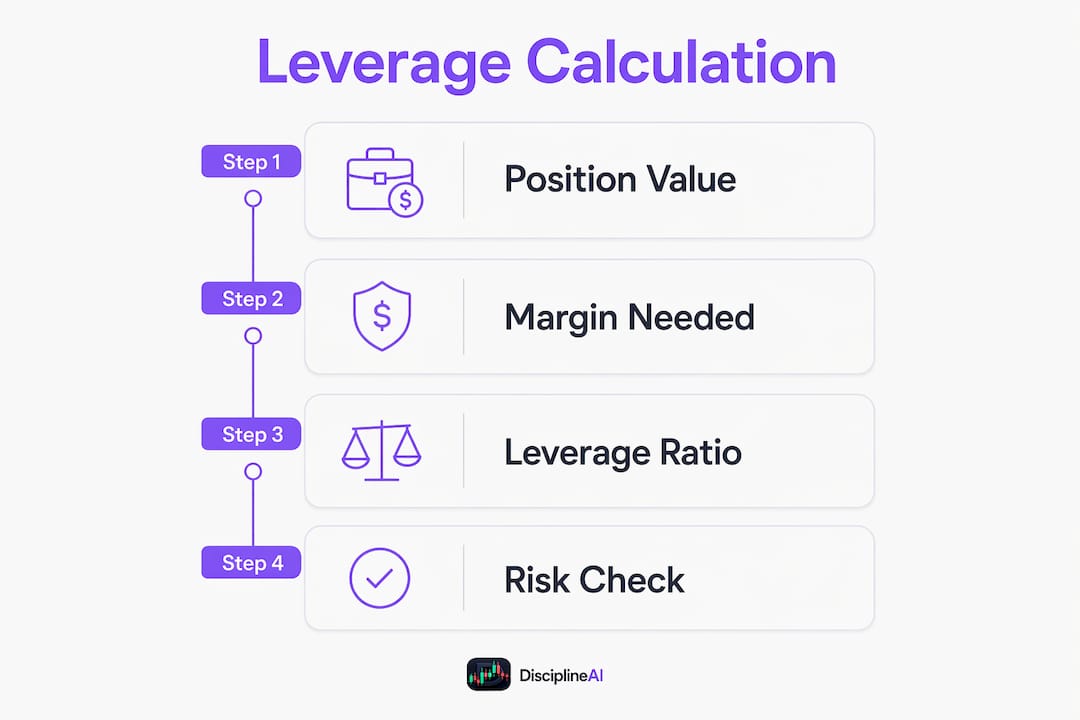
Steps to calculate your leverage and margin before any trade:
- Determine your desired position size in dollar terms
- Divide by your chosen leverage ratio to find required margin
- Divide position value by account equity to find effective leverage
- Calculate margin utilization to assess how much buffer remains
- Identify your liquidation price based on maintenance margin requirements
Pro Tip: Use the Myfxbook leverage calculator for forex positions — it handles currency conversion automatically and shows you both required margin and effective leverage in one pass.
A margin utilization above 50% is a warning sign indicating reduced buffer before a margin call. Staying well below this threshold is considered safer by risk managers.
How to choose the right leverage level for your trading style
The right leverage depends on three things: your stop loss distance, your risk tolerance, and the volatility of the instrument you're trading. Broker maximums are irrelevant to this calculation.

Risk-management frameworks generally advise keeping leverage at or below 10:1 for retail traders. Above 30:1 is considered high risk by most professional standards. For context, many experienced traders running trend-following systems operate at 2:1 to 5:1 effective leverage, not because they can't access more, but because survivability matters more than any single trade.
Factors that should drive your leverage selection:
- Stop loss distance: A wider stop requires lower leverage to keep dollar risk constant
- Asset volatility: BTC's daily volatility of roughly 3–4% demands far lower leverage than a major forex pair
- Account size: Smaller accounts need tighter leverage to avoid ruin from a single loss
- Trading timeframe: Scalpers can tolerate higher leverage on tight stops; swing traders cannot
- Regulatory limits: U.S. retail forex caps at 50:1 for majors; crypto rules vary by platform
For safe leverage in crypto specifically, the formula Max Safe Leverage = Max Drawdown% ÷ (Daily Volatility% + Maintenance Margin Rate%) gives a practical ceiling. With a moderate drawdown tolerance and typical BTC daily volatility plus maintenance margin rate, the calculated safe leverage is low. Many professionals cut that figure in half as an additional buffer.
Pro Tip: Never set your leverage based on what your broker offers. Set it based on your stop loss distance and the dollar amount you're willing to lose on the trade. The leverage ratio falls out of that math automatically.
How leverage shapes position sizing and risk management
Leverage doesn't just affect how much you can control. It determines how much you can lose, and at what speed. Position sizing is where leverage calculation in trading becomes genuinely protective rather than just mathematical.

The 1%–2% risk rule is the standard framework: size each trade so that if your stop loss is hit, you lose no more than 1%–2% of your account. On a $10,000 account with a 1% risk rule, maximum loss per trade is $100. If your stop is 50 pips away on a forex pair and each pip is worth $1 per mini lot, you can trade 2 mini lots. The effective leverage from 1% risk management often lands well below 1:1 in terms of account exposure, even when you're technically using a leveraged product.
Cross margin vs. isolated margin is a decision that belongs in your risk framework, not an afterthought. Isolated margin caps your loss to the margin allocated to one position, protecting the rest of your account from a single bad trade. Cross margin uses your entire account as collateral, which can keep a position alive longer but also means one trade can drain everything.
Risk management best practices for leveraged positions:
- Size every position from your stop loss distance and max dollar risk, not from available margin
- Keep margin utilization below 30%–40% to preserve buffer for adverse moves
- Use isolated margin on high-volatility assets like crypto altcoins
- Never add to a losing leveraged position to "average down"
- Account for overnight funding costs when holding leveraged positions beyond a session
- Review crypto risk management frameworks before trading perpetual futures
Common pitfalls that wipe accounts: running leverage at broker maximum, ignoring funding fees on perpetual contracts, using cross margin on volatile assets, and placing stops too tight for the asset's normal daily range.
What experts say about sustainable leverage use
The most consistent message from experienced traders is this: exchange-offered maximum leverage is a commercial feature, not a trading recommendation. The SEC has flagged that high-leverage products are designed to increase transaction volume for platforms, not to serve trader profitability.
Statistic callout: Maintenance margin levels commonly range from 0.5% to 1.25%, meaning liquidation triggers before your initial margin is fully depleted. At 10:1 leverage, a 10% adverse move can liquidate your entire margin before you have a chance to react.
Funding costs compound the problem on perpetual futures. Funding costs on perpetual futures accrue continuously and can significantly erode returns over extended holding periods. A leveraged long position held for weeks pays that cost continuously, which erodes returns even when the trade direction is correct.
During flash crashes and exchange outages, stop losses frequently fail to execute at their intended price. Slippage can push actual liquidation prices well beyond what the math suggests, making tight leverage and isolated margin the only reliable protection in volatile crypto markets.
Expert recommendations on leverage and risk:
- Treat leverage as a capital efficiency tool, not a profit amplifier
- Build your position size from stop loss distance first; let leverage be the output, not the input
- Maintain a meaningful buffer between current equity and liquidation price
- Adjust leverage downward when volatility spikes, not upward to chase bigger moves
- Understand that AI-driven trading psychology tools can help identify when emotional bias is pushing you toward excessive leverage
The traders who survive long enough to compound returns are almost never the ones running maximum leverage. They're the ones who treat margin for error as the primary metric.
Disciplineaiapp gives you the leverage tools your broker doesn't
Most brokers show you a leverage ratio and a margin requirement. What they don't show you is how that leverage interacts with your stop loss distance, your account equity, your historical win rate, and the current volatility regime. That's the gap Disciplineaiapp fills.

Disciplineaiapp's risk management suite calculates position sizing and required margin in real time, factoring in your defined risk per trade and stop loss placement rather than just the leverage multiple your exchange allows. The platform's AI-generated trade setups include confidence scores and execution guidance built around your actual risk parameters, not theoretical maximums. For traders who've been sizing positions by feel or running leverage at broker default, the difference in account longevity is significant.
The platform covers crypto, forex, and stocks, with behavioral coaching that flags when your leverage decisions are drifting outside your own stated risk rules. Explore the full trading intelligence features to see how position sizing, leverage calculation, and performance analytics work together in one place.
Key Takeaways
Leverage calculation in trading requires knowing your position value, margin, and account equity, then sizing every trade from your stop loss distance and maximum acceptable loss, not from broker maximums.
| Point | Details |
|---|---|
| Core leverage formula | Leverage = Position Value ÷ Margin; effective leverage = Position Value ÷ Account Equity. |
| Maintenance margin triggers early | Maintenance margin of 0.5%–1.25% means liquidation occurs before initial margin is fully used. |
| Safe leverage ceiling | Max Safe Leverage = Max Drawdown% ÷ (Daily Volatility% + Maintenance Margin Rate%); with moderate drawdown tolerance and typical BTC volatility, the safe leverage figure is low. Most professionals cut that calculation in half to increase survivability. |
| 1% risk rule keeps exposure real | Sizing trades to risk only 1% of account per trade often produces effective leverage well below 1× even on leveraged products. |
| Disciplineaiapp automates the math | The platform calculates position sizing and margin requirements from your stop loss and risk parameters, not just the leverage ratio your broker offers. |