
A trading performance review is the systematic process of measuring and analyzing your trading results using quantitative metrics to separate execution quality from financial outcomes. Most traders track profit and loss, then stop there. That single number tells you almost nothing about whether your process is sound or broken. Structured performance evaluation, the industry term for this practice, uses metrics like Profit Factor, Maximum Drawdown, and the Sharpe Ratio to reveal what P&L hides. 95% of traders who incorporate metric-driven review and backtesting report significant improvements in execution quality and strategy stability. That figure alone makes the case for building a review process.
What is trading performance review and why does it matter?
A trading performance review is a structured audit of your trades, measured against predefined rules and quantitative benchmarks. The goal is not to celebrate wins or explain losses. The goal is to identify whether your process produced the result, or whether luck did. This distinction is what separates professional traders from retail traders who spin their wheels for years without improving.
Many traders fail to improve because they conflate trade results with trade quality. A losing trade executed perfectly according to your rules is a better trade than a winning trade taken on impulse. Professional performance reviews force you to score the process, not just the outcome. That shift in focus is where real skill development begins.

The importance of trading reviews extends beyond strategy refinement. Regular evaluation builds the kind of data-driven confidence that holds up during drawdowns. When you know your process is statistically sound, a losing week does not trigger panic. That psychological stability is a direct product of consistent, structured review.
What key metrics define a strong trading performance evaluation?
The core metrics in any trading performance evaluation fall into four categories: profitability, risk, consistency, and efficiency. Each metric answers a different question about your system.
| Metric | What it measures | Benchmark |
|---|---|---|
| Profit Factor | Gross profit divided by gross loss | 1.3–2.5 (institutional grade) |
| Win Rate | Percentage of winning trades | Varies by strategy type |
| Maximum Drawdown | Largest peak-to-trough equity loss | Lower is better; context-dependent |
| Recovery Factor | Net profit divided by max drawdown | Above 2.0 recommended |
| Sharpe Ratio | Return per unit of risk taken | Above 1.0 is acceptable; above 2.0 is strong |
| Expectancy | Average profit per dollar risked | Must be positive for a viable system |
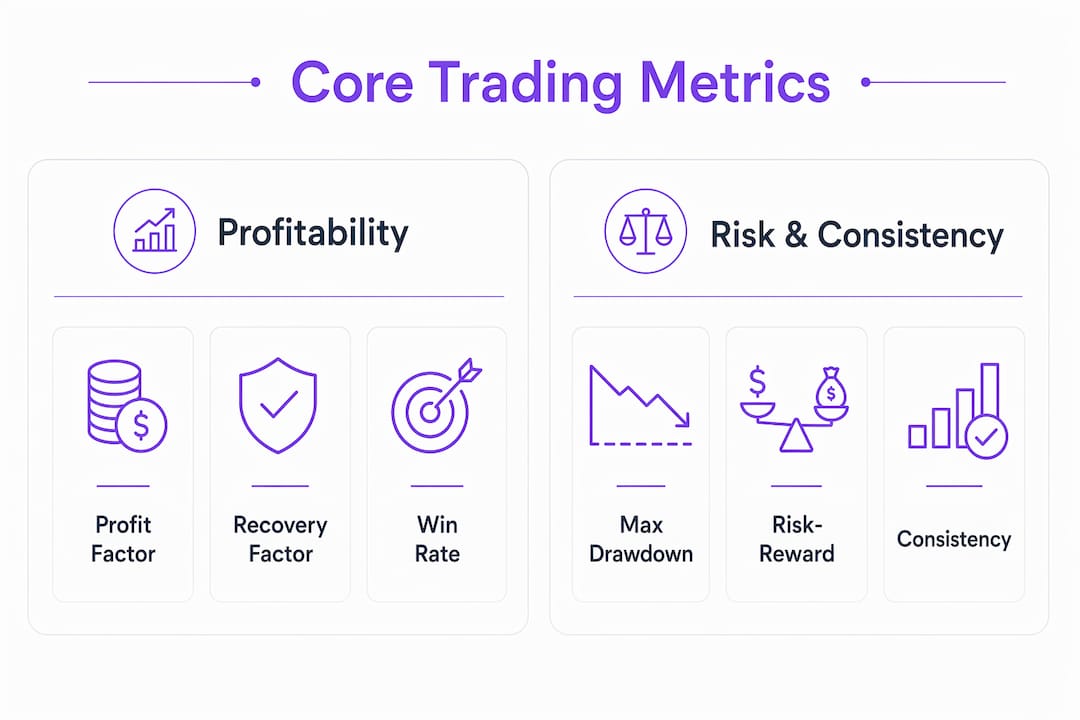
Institutional-grade standards recommend a Profit Factor between 1.3 and 2.5 and a Recovery Factor above 2.0. A Profit Factor below 1.0 means your system loses money in aggregate, full stop. A Recovery Factor below 2.0 signals that your system takes too long to recover from its worst losses.
Maximum drawdown is one of the most critical metrics for judging strategy sustainability. It tells you the worst-case scenario your account has already survived. Traders who ignore this metric often abandon profitable systems during normal drawdown periods because they have no reference point for what is statistically expected.
Metrics must be read together, not in isolation. A high Win Rate paired with a low Profit Factor signals that large losing trades are erasing many small winners. That combination looks good on the surface and destroys accounts over time.
Pro Tip: If your metrics look perfect, be suspicious. A win rate above 80% or a Profit Factor above 4.0 is typically a red flag for overfitting or an insufficient trade sample. Pros treat flawless numbers as a warning, not a celebration.
How do professional traders conduct reviews without emotional bias?
The most common review mistake is reviewing emotionally. Outcome bias and emotional reviews lead traders to make impulsive changes that harm long-term performance. Most traders review only after losing streaks, when regret and frustration color every judgment. That is the worst possible mental state for objective analysis.
Professional traders schedule reviews in advance, at fixed intervals, regardless of recent results. The review session is treated like a business meeting, not a therapy session. The agenda is calibration, not validation.
The most effective structure separates two distinct questions:
- Did I follow my rules? This is process quality. It scores execution, position sizing, entry criteria, and stop placement against your predefined plan.
- What was the financial result? This is outcome. It matters, but it is evaluated separately and over a statistically meaningful sample.
Professional traders also classify every trade into one of four categories to separate process from outcome: plan-compliant winners, plan-compliant losers, plan-deviant winners, and plan-deviant losers. This four-category system reveals far more than a simple win/loss count. A high volume of plan-deviant winners is actually a danger signal. It means you are being rewarded for breaking your rules, which trains exactly the wrong behavior.
Pro Tip: Build a weekly scorecard that rates your execution on a 1–5 scale for each trade criterion. Track your average score independently from your P&L. When your execution score rises and your P&L lags, you know the edge exists and the market conditions are the variable, not your skill.
What are the practical steps to perform a trading performance review?
A structured review operates at three levels: individual trade, session, and periodic aggregate. Professional traders integrate all three into a continuous feedback loop that drives systematic improvement.
-
Individual trade review. After each trade closes, record the setup type, your entry and exit rationale, whether you followed your rules, and the result in R units (risk multiples). R units normalize results across different position sizes and market conditions, making comparison meaningful.
-
Session review. At the end of each trading session, assess your behavioral patterns. Did you overtrade after a loss? Did you cut winners short? Did you skip valid setups due to fear? These behavioral patterns are invisible at the individual trade level but obvious when you review the full session.
-
Weekly tactical review. Weekly reviews focus on tactical consistency and behavioral control. Pull your execution scores, review your R-unit results, and identify any rule deviations. The question is whether your execution matched your plan, not whether you made money.
-
Monthly strategic review. Monthly reviews evaluate overall strategy health using aggregated data. Calculate your Profit Factor, Expectancy, Maximum Drawdown, and Recovery Factor for the period. Compare these against your benchmarks. Decide whether the strategy edge is intact or whether conditions have shifted enough to warrant adjustment.
-
Pattern analysis. Look for behavioral inconsistencies across your data. Common leaks include overtrading on Mondays, underperforming in low-volatility sessions, or consistently exiting winners too early in a specific setup type. These patterns only appear when you analyze performance data across a meaningful sample.
-
Adjustment decisions. Make rule changes only when a pattern appears across at least 20–30 trades. Single-trade observations are noise. Statistically significant patterns are signal.
The tools that support this process range from basic trading journals to analytics platforms that automate metric calculation and flag behavioral anomalies. The format matters less than the consistency of the practice.
How do traders apply review insights to sharpen strategy and execution?
Review insights only create value when they translate into specific, testable adjustments. The process of applying findings from a stock trader performance review follows a clear sequence.
-
Adjust entry criteria based on setup performance. If your data shows that one setup type has a Profit Factor below 1.0 across 30 trades, remove it from your plan. Do not average it with better setups. Isolate and eliminate the leak.
-
Refine position sizing rules. Reviews frequently reveal that traders size positions inconsistently, taking larger risk on lower-quality setups and smaller risk on high-conviction trades. Fixing this single behavioral pattern often improves Expectancy without changing any other variable.
-
Use drawdowns as calibration data, not failure signals. Drawdowns are a statistical necessity and part of any strategy's expectancy profile. Objective review helps you distinguish a normal drawdown from a structural breakdown in your edge. That distinction prevents you from abandoning a profitable system at the worst possible moment.
-
Build confidence through process data, not outcomes. Confidence in trading emerges from consistent process execution validated by objective data over time. When your execution scorecard shows high compliance week after week, you trust the process during losing periods. That trust is not blind faith. It is evidence-based.
-
Reduce overtrading by tracking session trade counts. Reviews that include session-level data often reveal that most losses cluster in the final hour of a session, after the trader has already hit their daily trade limit. Setting a hard stop on trade count, validated by review data, is one of the fastest ways to cut unnecessary losses.
Applying trading discipline best practices from your review data requires patience. The improvements compound over months, not days. The traders who stick with structured review cycles consistently outperform those who rely on intuition alone.
Key Takeaways
A trading performance review is the most direct path from inconsistent results to a statistically sound, repeatable trading process.
| Point | Details |
|---|---|
| Review process, not just P&L | Score rule adherence on every trade independently from the financial result. |
| Use institutional benchmarks | Target a Profit Factor of 1.3–2.5 and a Recovery Factor above 2.0 as baseline standards. |
| Schedule reviews in advance | Fixed weekly and monthly review cycles eliminate emotional, reactive analysis. |
| Classify trades in four categories | Plan-compliant vs. deviant, winner vs. loser reveals process quality that win/loss ratios hide. |
| Apply changes at scale | Make rule adjustments only after a pattern appears across 20–30 trades, not individual results. |
Why most traders skip the one thing that would actually help them
I have watched traders spend years refining entry signals while never once reviewing whether they actually followed their own rules. The entry signal is rarely the problem. The execution is. And you cannot fix what you do not measure.
The traders I have seen improve fastest share one habit: they review their trades the same way a surgeon reviews a procedure. Not to assign blame, but to find the gap between the plan and what actually happened. That gap is where the skill development lives.
The hardest part is emotional neutrality. Reviewing a bad week feels like punishment. Reviewing a good week feels unnecessary. Both reactions are wrong. The review is not about how you feel about the results. It is about what the data says about your process. When you internalize that distinction, the review stops feeling like a chore and starts feeling like the most useful hour of your trading week.
Consistency is the other barrier. Most traders review for two weeks after a loss, then stop when things improve. That is exactly backward. The monthly strategic review is most valuable when your equity curve is rising, because that is when you can confirm which behaviors are actually driving the edge. Reviewing only during pain teaches you nothing about what success looks like.
The traders who build lasting skill treat the review as non-negotiable. Not because they enjoy it, but because they understand that trading behavior analysis is the only honest feedback loop available to them. Markets do not tell you whether you traded well. Your data does.
— Tony
How Disciplineaiapp supports your trading performance review
Disciplineaiapp is built around the gap between knowing what to do and actually doing it consistently. The platform's automated trade auditing scores every trade against your predefined rules, so your execution scorecard builds itself without manual data entry.

The market replay feature lets you revisit past sessions and identify the exact moments where emotional patterns like FOMO or revenge trading entered your decision-making. The AI analytics layer flags behavioral inconsistencies across your trade history, giving you the kind of pattern data that normally takes months to compile manually. If you want a review process that runs on real data rather than memory, the platform features at Disciplineaiapp are built for exactly that purpose.
FAQ
What is a trading performance review?
A trading performance review is a structured process of measuring trading results using quantitative metrics like Profit Factor, Expectancy, and Maximum Drawdown to evaluate both strategy quality and execution discipline, separate from profit and loss alone.
How often should traders review their performance?
Weekly reviews focus on execution and behavioral control, while monthly reviews assess overall strategy health using aggregated data. Both frequencies serve different purposes and work best together.
What is a good Profit Factor for a trading strategy?
Institutional-grade benchmarks place a healthy Profit Factor between 1.3 and 2.5. A Profit Factor below 1.0 means the system loses money in aggregate, and a Profit Factor above 4.0 often signals overfitting rather than genuine edge.
How do traders avoid emotional bias during reviews?
Scheduling reviews at fixed intervals regardless of recent results, and scoring process quality separately from financial outcomes, are the two most effective methods for maintaining objectivity during a performance review.
What is the difference between a weekly and monthly trading review?
Weekly reviews examine execution consistency and behavioral patterns at the trade and session level. Monthly reviews analyze aggregated metrics like Expectancy and Recovery Factor to determine whether the overall strategy edge remains intact.