
Emotional trading is defined as taking action that violates your written trading plan because of an emotional impulse, not a market signal. The industry term for this behavior is emotionally driven decision-making, and it sits at the center of trading psychology research. Loss aversion makes losses feel roughly 2.25 times more painful than equivalent gains feel good. That asymmetry alone explains why most traders hold losing positions far too long and exit winning ones far too early. Understanding emotional trading explained through this psychological lens is the first step toward fixing it.
What is emotional trading and why does it wreck performance?
Emotional trading is not feeling fear or greed during a session. Every trader feels those things. The problem starts when those feelings override a pre-written plan and produce a trade that the plan never authorized. That distinction matters because it shifts the focus from eliminating emotions to controlling behavior.
The impact of emotions on trading performance is measurable and consistent. Traders who act on emotional impulses tend to overtrade, exit positions at the wrong time, and take on risk that their plan explicitly forbids. The result is a pattern of decisions that feel justified in the moment but look irrational in the trade log.

Trading psychology research treats emotional biases as fundamentally different from cognitive biases. Cognitive biases arise from flawed logic and can sometimes be corrected through education. Emotional biases arise from feelings and impulses. Education alone does not fix them. That is why understanding emotional trading requires a different solution: process design, not willpower.
Which emotional biases most affect traders?
Loss aversion is the most documented emotional bias in trading. It produces the disposition effect, a pattern where traders hold losing positions past their stop-loss and sell winning positions before the target is reached. Both behaviors are driven by the same emotional root: the pain of locking in a loss feels unbearable, while the fear of giving back a gain triggers premature exits.
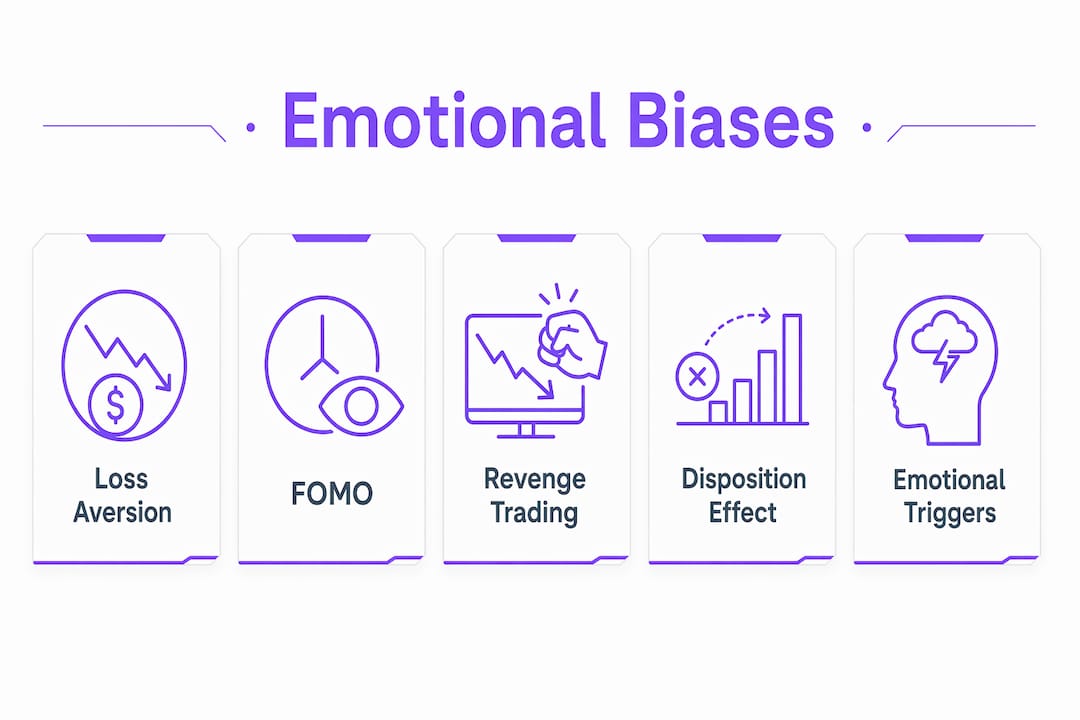
FOMO, or fear of missing out, is the second major bias. FOMO causes impulsive late entries after a trader hesitates, then chases a move that has already played out. The entry price is worse, the risk-reward ratio is compressed, and the probability of a losing trade rises. The emotional pattern is easy to recognize in hindsight but almost invisible in the moment.
Revenge trading is the third major pattern. After a loss, the emotional brain demands recovery immediately. The trader re-enters the market without a valid setup, driven by frustration rather than analysis. This is one of the most destructive emotional trading triggers on the list.
Common emotional biases to watch for:
- Loss aversion: Holding losers past stop-loss levels to avoid realizing a loss
- Disposition effect: Selling winners too early to lock in a gain before it disappears
- FOMO: Entering trades late after watching a move develop without you
- Revenge trading: Re-entering immediately after a loss to recover money fast
- Overconfidence: Increasing position size after a winning streak without plan approval
- Decision fatigue: Making poor entries late in a session when mental energy is depleted
Pro Tip: Write down the specific emotion you felt before each trade that broke your plan. Naming the emotion precisely, whether it is frustration, envy, or anxiety, makes the pattern visible faster than reviewing P&L alone.
How to track emotional triggers with a trading journal
A trading journal is the most direct tool for identifying emotional trading patterns. The key is timing. Logging a one-word emotional state immediately after entering and exiting a trade captures real-time data that memory cannot reliably reconstruct later. Waiting until end of day to record emotions produces rationalized accounts, not accurate ones.
Real-time emotional logging works because it captures the feeling that was actually present at the decision point. That data, collected over weeks, reveals which emotional states consistently precede losing trades. Once you see that pattern, you have a specific trigger to address rather than a vague sense that you "traded badly."
A practical journaling system for tracking emotional triggers includes these steps:
- Record the setup before entry. Write the plan-based reason for the trade in one sentence.
- Tag your emotional state at entry. Use a single word: calm, anxious, excited, frustrated, confident.
- Note any deviation from the plan. Did you move the stop? Did you size up without a rule allowing it?
- Tag your emotional state at exit. Same single-word format.
- Review weekly, not daily. Weekly review reveals patterns. Daily review produces noise.
The emotional patterns that emerge from this process are specific and repeatable. A trader might discover that every trade tagged "excited" at entry ends in a loss, or that "frustrated" entries always follow a revenge trade sequence. Those findings are more useful than any technical indicator.
Pro Tip: Set a phone reminder to complete your journal entry within two minutes of closing a trade. The two-minute window is when emotional memory is most accurate.
How professional traders reduce emotional interference through system design
The goal is not to eliminate emotions. That is not possible. The goal is to build systems that function despite them, making trading decisions mechanical and less influenced by the emotional brain's rapid impulses. Professional traders accomplish this through three main methods.
The first is the behavioral contract. A behavioral contract is a written set of pre-committed rules that cover every decision point in a trade: entry criteria, position size, stop-loss level, and exit target. When the rules are written before the market opens, the emotional brain has no decision to make during the session. The plan already decided.
The second method is mechanical circuit-breakers. Willpower depletes after several hours of trading. Professional traders use pre-set rules that force a pause or end the session after a defined loss limit or time period. These circuit-breakers prevent the fatigue-driven errors that cluster in the final hours of a trading session.
The third method is automation. A process-based system that automates plan execution removes the opportunity for emotion to override a decision at a critical moment. Automated stop-losses, pre-set alerts, and AI-driven trade auditing all serve this function.
| Approach | How it reduces emotional interference |
|---|---|
| Behavioral contract | Pre-commits all rules before the session; removes in-session decisions |
| Circuit-breakers | Enforces mandatory pauses after loss limits or time thresholds |
| Automated stops | Executes exit rules without requiring a real-time emotional decision |
| AI trade auditing | Flags deviations from the plan and identifies emotional behavior patterns |
Pro Tip: Write your behavioral contract the night before, not the morning of. Distance from the market reduces the emotional charge that distorts rule-setting.
Common emotional trading patterns and how to avoid them
Recognizing emotional trading pattern examples in your own behavior is harder than recognizing them in theory. The emotional brain is fast and convincing. It generates reasons that sound logical. The pattern only becomes visible when you compare the trade to the written plan.
-
The FOMO entry: You watch a setup develop, hesitate, then buy after the move is already 60% complete. The entry is late, the stop is wide, and the trade fails. The fix is a rule that prohibits entries after price has moved beyond a defined percentage from the setup trigger.
-
The revenge sequence: You take a loss, feel the urgency to recover it immediately, and enter a new trade within minutes without a valid setup. Trades taken within 10 minutes of a loss carry statistically lower win rates. A cooling-off rule of 15 to 30 minutes after any loss breaks this cycle. For more on the root causes of this pattern, the revenge trading breakdown from Disciplineaiapp covers the psychology in detail.
-
Holding past the stop: The position moves against you. Instead of exiting at the pre-set stop, you move the stop lower and tell yourself the trade will recover. Loss aversion is driving this decision, not analysis. Pre-set automated stops remove the option to override.
-
Fatigue trading: Late in the session, after several hours of active trading, decision quality drops sharply. Willpower is a finite resource that depletes with use. A hard session-end time, written into the plan, prevents the worst decisions of the day.
-
Overconfidence after a streak: Three winning trades in a row produce a feeling of invincibility. The trader sizes up on the next trade without a rule permitting it. The loss that follows is larger than any of the three wins. A fixed position-sizing rule, applied regardless of recent results, prevents this.
The common thread across all these patterns is that a written rule, applied consistently, would have prevented each one. The trading discipline practices that professional traders use are not complicated. They are simply written down and followed.
Key takeaways
Emotional trading is defined as acting against a written plan because of an emotional impulse, and the only reliable fix is a process-based system that removes real-time emotional decisions.
| Point | Details |
|---|---|
| Core definition | Emotional trading means breaking your written plan due to feelings, not market signals. |
| Loss aversion drives most errors | Losses feel 2.25 times more painful than gains, causing traders to hold losers and exit winners early. |
| Real-time journaling works | Log a one-word emotional state at entry and exit to reveal patterns that memory distorts. |
| Circuit-breakers prevent fatigue errors | Pre-set session limits and loss thresholds stop poor decisions caused by willpower depletion. |
| Automation enforces the plan | Automated stops and AI auditing remove the option to override rules at emotional decision points. |
Why I think most traders are solving the wrong problem
Most traders I have observed spend their energy trying to feel less. They meditate, they breathe, they tell themselves to stay calm. None of that is wrong, but it misses the actual problem. Emotions are not the enemy. Acting on them without a filter is.
The traders who improve fastest are the ones who stop trying to control their feelings and start building systems that make feelings irrelevant. A pre-set stop-loss does not care whether you feel anxious. An automated exit rule does not negotiate with your loss aversion. The system executes the plan regardless of what the emotional brain is screaming.
Honest journaling is the part most traders skip. Writing down "I was frustrated and that is why I took that trade" feels uncomfortable. That discomfort is exactly why it works. The AI in trading psychology space is moving toward tools that automate this self-awareness, flagging emotional patterns before they compound into account damage.
Build the system first. The discipline follows from the structure, not the other way around.
— Tony
How Disciplineaiapp helps you manage emotional trading
Disciplineaiapp is built specifically for the gap between knowing what to do and actually doing it under pressure.
The platform's core features include automated trade auditing, which flags every deviation from your written plan in real time, and emotional pattern tracking that identifies behaviors like revenge trading and FOMO across your trade history. The market replay tool lets you review past sessions and pinpoint the exact emotional decision points that cost you money. Disciplineaiapp combines AI analytics with behavioral coaching so that your trading process gets stronger with every session, not just your market knowledge.
FAQ
What is the definition of emotional trading?
Emotional trading is taking a trade action that violates your written trading plan because of an emotional impulse such as fear, greed, or frustration. The key distinction is acting against the plan, not simply feeling an emotion.
What are the most common emotional biases in trading?
The most common emotional biases are loss aversion, the disposition effect, FOMO, and revenge trading. Loss aversion is the most foundational, making losses feel roughly 2.25 times more painful than equivalent gains.
How do I track emotional triggers in my trading journal?
Log a single-word emotional state immediately after entering and exiting every trade. Real-time logging captures the actual feeling at the decision point, which weekly review then turns into identifiable patterns.
Can emotional trading be eliminated completely?
Emotional trading cannot be eliminated because emotions cannot be removed from human decision-making. The effective approach is building process-based systems, such as automated stops and behavioral contracts, that prevent emotions from overriding the plan.
What is revenge trading and how do I stop it?
Revenge trading is re-entering the market immediately after a loss to recover money, without a valid plan-based setup. A written cooling-off rule of 15 to 30 minutes after any loss, enforced automatically, breaks the cycle.