
Change of Character (CHoCH) trading is defined as the first structural break against the prevailing market trend, signaling a potential reversal before it fully develops. Unlike most reversal indicators, CHoCH reflects actual institutional order flow shifts rather than lagging signals from tools like RSI or MACD. Within Smart Money Concepts (SMC), CHoCH sits alongside Break of Structure (BOS) as one of two core market structure signals every serious trader needs to read correctly. Getting this distinction right separates traders who catch reversals early from those who fight the trend at the worst possible moment.
What is the difference between CHoCH and BOS in trading?
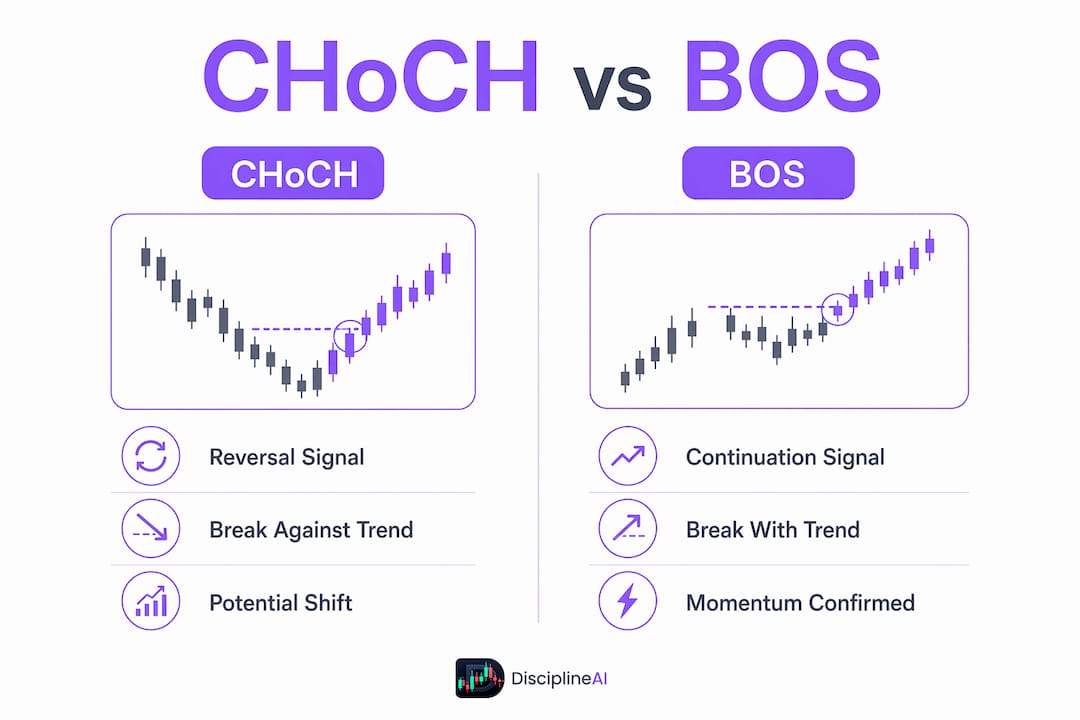
CHoCH and BOS are opposite signals built from the same structural logic, but they point in completely different directions. BOS confirms that the current trend is continuing. CHoCH warns that the trend may be ending.
In an uptrend, BOS occurs when price breaks above a previous swing high, confirming bullish momentum. CHoCH occurs when price breaks below the most recent higher low. That break is the first sign that buyers are losing control. In a downtrend, the logic flips: BOS breaks below a swing low, while CHoCH breaks above the most recent lower high.

| Feature | BOS | CHoCH |
|---|---|---|
| Signal type | Trend continuation | Potential reversal |
| Direction | With the trend | Against the trend |
| Risk level | Lower | Higher |
| Trader action | Follow momentum | Wait for confirmation |
| Confirmation needed | Less critical | Strongly recommended |
The practical difference matters for position sizing and timing. BOS trades align with institutional momentum, so the probability of continuation is higher. CHoCH trades are counter-trend by nature, which means the risk of a false signal is real. Conservative traders treat CHoCH as an early warning flag, not a standalone entry trigger. That discipline alone prevents most of the costly mistakes beginners make with reversal trading.
A CHoCH also initiates a chain shift in market structure. When an uptrend's higher lows break (bearish CHoCH), the market can transition into a downtrend with new lower lows confirmed by BOS in the new direction. This chain is the mechanical link between trend continuation and full reversal.
How does a Change of Character form and what conditions support it?
A genuine CHoCH does not appear out of nowhere. The formation follows a specific sequence, and understanding that sequence is what separates high-quality setups from traps.
The most reliable CHoCH setups begin with a liquidity sweep. Institutional players push price into a cluster of retail stop-losses, triggering those orders and filling their own positions at favorable prices. A CHoCH without a prior liquidity sweep is often a trap. The sweep is the setup; the CHoCH is the confirmation.
After the sweep, watch for a candle body close beyond the structural swing point. Wick breaks do not count. A wick can pierce a level and snap back, creating a false signal. A full candle body close beyond the swing high or low is the structural confirmation that price has genuinely shifted.
Higher timeframe alignment is the third condition. A CHoCH on a 15-minute chart means very little if the 4-hour chart is still in a strong uptrend. Signal quality improves significantly on the 4-hour and daily timeframes, where institutional activity is more visible and noise is filtered out.
Key conditions that support a high-quality CHoCH:
- A clear liquidity sweep preceding the structural break
- Candle body close (not just a wick) beyond the swing point
- Higher timeframe bias aligned with the CHoCH direction
- A nearby order block or fair value gap for potential retest
- Reduced momentum into the swing point before the break
Pro Tip: If the CHoCH forms after a sharp, extended move with no retest, the probability of a false signal increases. The best setups show exhaustion candles or a tight consolidation before the structural break.
What are effective CHoCH trading strategies and entry techniques?
The most reliable change of character trading approach uses a top-down, multi-step protocol. Skipping steps is where most traders lose money.
-
Confirm the higher timeframe trend. Start on the 4-hour or daily chart. Identify whether the market is in an uptrend, downtrend, or range. Your CHoCH trade should align with a potential shift from that dominant structure.
-
Identify the liquidity sweep. Look for price pushing into a swing high or low where stop-losses cluster. A sharp wick into that zone followed by a fast rejection is the classic sweep pattern.
-
Wait for the CHoCH break. After the sweep, watch for a candle body close beyond the most recent structural point. In a bearish CHoCH, that means a close below the last higher low. Do not enter on the wick.
-
Find the order block or fair value gap. The order block is the last bearish candle before a bullish move (or last bullish candle before a bearish move). A fair value gap is an imbalance in price where a three-candle sequence leaves an unfilled gap. Both zones act as magnets for price retests.
-
Enter on the retest with confirmation. Wait for price to pull back into the order block or fair value gap. Look for a rejection candle, a lower-timeframe BOS in the new direction, or a strong engulfing pattern before entering.
-
Place your stop loss beyond the structural swing. Stop losses belong beyond the swing point or the liquidity sweep level. Placing stops too tight inside the structure gets traders shaken out before the move develops.
For a bullish CHoCH entry, the setup mirrors this process in reverse. Price sweeps a swing low, breaks above the most recent lower high, and then retests an order block or fair value gap before continuing higher.
Pro Tip: Combine CHoCH with a confirming BOS in the new direction before committing full position size. The sequence of CHoCH followed by BOS is the highest-confidence reversal signal in SMC trading. AI-driven pattern detection can flag this sequence across multiple timeframes faster than manual scanning.
Trade management after entry is straightforward. Move your stop to breakeven once price clears the first structural target. Take partial profits at the nearest swing high or low. Let the remainder run toward the higher timeframe target.
What risks and challenges come with CHoCH trading?
CHoCH trading carries a specific set of risks that BOS trading does not. Traders who ignore these risks consistently lose money on reversal setups that look perfect on paper.
The biggest risk is the false reversal. Price breaks a structural level, triggers entries, and then reverses back into the original trend. This happens most often when the CHoCH occurs without a preceding liquidity sweep. Trading isolated CHoCH signals without confluence is high risk and frequently results in losses.
Common CHoCH trading mistakes and how to avoid them:
- Trading without higher timeframe context. A CHoCH on a 5-minute chart against a strong 4-hour uptrend is noise, not a signal. Always define bias on the higher timeframe first.
- Entering on wick breaks. Wicks sweep liquidity but do not confirm structure. Wait for a candle body close.
- Ignoring invalidation levels. Every CHoCH trade needs a clear level where the setup is wrong. If price reclaims the structural break point, the CHoCH has failed.
- Oversizing on early-stage reversals. CHoCH is an early warning, not a confirmed trend change. Reduce position size until BOS in the new direction confirms the reversal.
- Chasing the entry. If price moves far from the order block or fair value gap without retesting, the setup is gone. Wait for the next one.
Timeframe confusion causes many trading errors. A CHoCH visible on a low timeframe chart can be nothing more than a pullback within a dominant higher timeframe trend. The top-down approach is non-negotiable: use the higher timeframe to define direction, then drop to the lower timeframe for execution timing.
Pro Tip: Use CHoCH as a caution signal first. Reduce exposure, tighten risk parameters, and wait for BOS confirmation before treating the reversal as confirmed. This approach keeps you in the trade when it works and limits damage when it fails. Pairing this discipline with crypto risk management principles makes the difference between surviving drawdowns and blowing accounts.
Key Takeaways
CHoCH trading is most effective when combined with liquidity sweep confirmation, higher timeframe alignment, and BOS validation before full position entry.
| Point | Details |
|---|---|
| CHoCH vs. BOS | CHoCH signals a potential reversal; BOS confirms trend continuation. Never confuse the two. |
| Liquidity sweep first | A CHoCH without a prior liquidity sweep is usually a trap, not a genuine reversal signal. |
| Candle body confirmation | Only a candle body close beyond the swing point validates a CHoCH. Wick breaks do not count. |
| Higher timeframe alignment | CHoCH signals on the 4-hour and daily charts carry far more weight than lower timeframe signals. |
| BOS confirmation adds confidence | Waiting for BOS in the new direction after CHoCH significantly increases trade probability. |
Why I think most traders misuse CHoCH signals
Most traders I see treat CHoCH as a trigger. They spot the structural break, enter immediately, and then wonder why they keep getting stopped out. The signal is not the entry. It is the alert.
The traders who actually profit from change of character setups use CHoCH to shift their attention, not their capital. They see the CHoCH, note the potential reversal, and then wait. They wait for the liquidity sweep to complete. They wait for the order block retest. They wait for a lower timeframe BOS to confirm the new direction. That patience is what separates profitable reversal traders from the majority who get chopped up.
The multi-timeframe discipline is the hardest part. Every trader knows they should check the higher timeframe. Almost no one does it consistently under pressure. When a CHoCH forms on the 15-minute chart and looks perfect, the temptation to enter is real. The top-down approach is not just a technical rule. It is an emotional discipline that requires you to override the impulse to act.
My honest experience is that CHoCH trading rewards patience more than any other SMC technique. The setups that work are rarely urgent. They form, they retest, they give you time. If you feel rushed, that is usually a sign the setup is not there.
— Tony
How Disciplineaiapp supports CHoCH and market structure trading
Disciplineaiapp is built for traders who want data-driven support when reading complex market structure signals like CHoCH and BOS.

The platform's AI engine analyzes market structure, liquidity events, and trend conditions across multiple timeframes to identify potential CHoCH setups before they fully develop. Traders receive AI-generated confidence scores, execution guidance, and stop loss placement support tied directly to structural levels. The Disciplineaiapp features include trade journaling and AI trade autopsies, so every CHoCH trade gets reviewed and learned from. For traders who want to deepen their understanding of SMC concepts, the Discipline AI learning center offers structured strategy resources built around real market structure mechanics.
FAQ
What does CHoCH mean in trading?
CHoCH stands for Change of Character and is defined as the first structural break against the prevailing trend. It signals a potential reversal before the new trend is confirmed.
How is CHoCH different from BOS?
BOS (Break of Structure) confirms trend continuation in the same direction, while CHoCH breaks against the trend as an early reversal warning. BOS carries lower risk; CHoCH requires additional confirmation before trading.
Is CHoCH reliable on lower timeframes?
Lower timeframe CHoCH signals generate more false positives due to market noise. Signal reliability increases significantly on the 4-hour and daily timeframes where institutional activity is clearer.
What confirms a valid CHoCH setup?
A valid CHoCH requires a prior liquidity sweep, a candle body close beyond the structural swing point, and higher timeframe alignment. Waiting for a subsequent BOS in the new direction adds further confirmation.
Where should I place my stop loss on a CHoCH trade?
Stop losses belong beyond the structural swing point or the liquidity sweep level that preceded the CHoCH. Placing stops inside the structure increases the chance of being stopped out before the move develops.