
Revenge trading is defined as placing emotionally driven trades immediately after a loss, with the goal of recovering money rather than following a tested strategy. Breaking revenge trading stock habits is achievable, but it requires more than willpower. Research shows revenge trades carry a 22% win rate and cost traders an average of $4,200 per month in losses. That number reflects a pattern rooted in neuroscience, not character flaws. The fix is structural and cognitive, not motivational.
What is revenge trading and why does it happen neurologically?
Revenge trading is not simply anger at the market. It is a shame-based neurological response triggered when a high-conviction trade fails. The brain interprets the loss as a threat to identity, not just capital. That distinction matters because shame activates the amygdala differently than frustration does.
When the amygdala fires in response to shame, cortisol floods the bloodstream. Cortisol spikes degrade prefrontal cortex function, which is the part of the brain responsible for rational decision-making. The result is a trader who feels sharp but is neurologically impaired. Willpower lives in the prefrontal cortex. When cortisol shuts it down, willpower is simply not available.
Treating a shame response with a generic time break is like treating a broken leg with a bandage. The underlying injury is still active. A condition-based reset, not a clock, is what interrupts the shame loop.
This is why the standard advice to "just step away for a few minutes" fails so consistently. A five-minute walk does not reset cortisol levels or restore prefrontal cortex function. The shame loop requires specific cognitive interruption, not passive waiting. Without that interruption, traders return to their screens in the same neurological state they left.
The compounding effect makes this worse over time. Each revenge trade that loses deepens the shame response. Deeper shame triggers a stronger cortisol spike. A stronger cortisol spike produces worse decisions. Traders who do not recognize this cycle often escalate position sizes, trying to recover faster, which accelerates the damage.
- Shame activates the amygdala, not just the emotional centers tied to frustration
- Cortisol impairs the prefrontal cortex, making rational analysis unreliable
- Generic time breaks do not reset the physiological state
- Each failed revenge trade compounds the shame and escalates the next bad decision
- Recognizing the shame response is the first step toward interrupting the cycle
How do you interrupt revenge trading with condition-based resets?
The most effective method to break revenge trading stock habits is a condition-based reset, not a time-based one. A 30-minute cooldown rule reduced revenge trades by 93% in documented trading data. That result came from enforced platform lockouts, not voluntary breaks. The distinction is critical.
The three-step condition-based reset
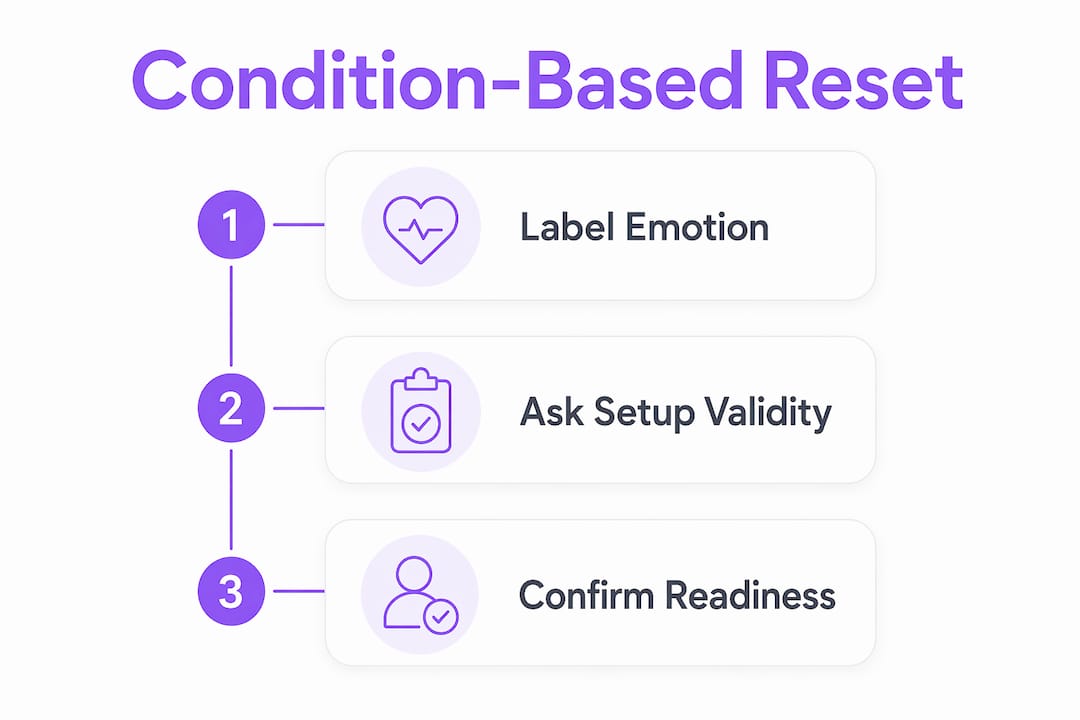
The reset works in three stages. First, label the emotion precisely. Saying "I feel shame about that loss" out loud or in writing activates affect labeling, a technique that reduces amygdala activity and partially restores prefrontal cortex function. Second, ask three checkpoint questions before placing any new trade: Does this setup meet my written criteria? Am I trading to recover, or because the setup is genuinely valid? Has my nervous system returned to baseline? Third, assess physical signals of reset, including steady breathing, no jaw tension, and the ability to articulate the trade thesis clearly.
Structural rules that remove emotional choice
Structural interventions outperform willpower because they remove the decision entirely. Platform lockout features, daily maximum loss limits, and a two-losses-stop rule are not signs of weakness. They are engineering solutions to a physiological problem.
| Rule | Purpose | Practical Example |
|---|---|---|
| Daily max loss limit | Caps total damage per session | Stop trading after losing 2% of account |
| Two-losses-stop rule | Prevents escalation after consecutive losses | Exit platform after second losing trade |
| Position size limit | Blocks oversized revenge trades | Never exceed 1% risk per trade |
| 30-minute platform lockout | Enforces condition-based cooldown | Automated timer locks trading interface |
Position sizing is the most overlooked structural safeguard. Revenge traders almost always increase size after a loss, trying to recover faster. A hard rule capping position size at a fixed percentage of account value removes that option entirely.
Pro Tip: Write your daily max loss limit and two-losses-stop rule on a physical card and place it next to your monitor. Physical reminders work when digital ones are easy to dismiss.
Accepting losses as fixed business expenses is the mindset shift that makes these rules stick. A business owner does not try to recover rent costs by taking on bad clients. A trader should not try to recover a stop-out by taking on bad trades. Reframing losses this way lowers the emotional charge attached to each one.
What daily routines actually stop impulsive stock trading?
Consistent daily routines are the foundation of overcoming revenge trading. The goal is to make disciplined behavior automatic, so emotional states have less influence over individual decisions. Three practices produce the most measurable results.

Honest trade journaling is the most direct behavioral tool available. Journaling emotional states and trade rationale helps traders identify revenge trades after the fact and recognize the patterns that precede them. The journal entry should answer four questions: What was my emotional state before the trade? Did the setup meet my written criteria? Was I trading to recover a loss? What would I do differently?
Pre-session planning sets the emotional baseline before the market opens. Write down your maximum loss for the day, your two or three valid setups, and the specific conditions that would trigger a cooldown. Traders who pre-plan their emotional responses make better decisions under pressure because the decision is already made.
- Write your max daily loss limit before the session starts
- List only setups that meet your written criteria
- Define the exact conditions that trigger your cooldown protocol
- Review yesterday's journal entry before placing any trade
- Track weekly win rate and average loss size, not just daily profit and loss
Pro Tip: Review your journal entries from your worst trading days once per week. The patterns that caused those days are almost always present in your current behavior, just in smaller doses.
AI-assisted behavioral tools like Disciplineaiapp take journaling further by analyzing trade data for emotional patterns automatically. Instead of relying on self-reporting alone, the platform flags trades that match revenge trading signatures, such as rapid re-entry after a loss or position size increases following a stop-out. That kind of objective feedback is difficult to argue with.
Adjusting your trading environment reduces emotional triggers before they become a problem. Turn off profit and loss displays during active sessions if real-time numbers increase anxiety. Mute financial news during trading hours. Remove social media from your trading workspace. The goal is to reduce the number of inputs that can activate the shame response.
Common challenges when breaking bad trading habits
Most traders who try to stop impulsive stock trading hit the same obstacles. Recognizing them in advance reduces the chance they derail the process.
- Confusing shame with anger. Shame says "I am a bad trader." Anger says "The market is wrong." Shame requires affect labeling and a condition-based reset. Anger often passes faster. Misidentifying the emotion leads to applying the wrong tool.
- Skipping reset steps under pressure. The condition-based reset feels slow when the market is moving. Traders skip the checkpoint questions and tell themselves the setup is valid. This is the most common failure point.
- Underestimating physiological recovery time. A 5-minute break does not restore cortisol levels. The 30-minute lockout rule exists because that is the minimum time needed for meaningful physiological recovery after a significant loss.
- Relying on willpower as the primary defense. Treating emotional state as real-time data rather than a personal failing changes the entire approach. Willpower is a limited resource. Structural rules are not.
- Failing to adjust rules after a revenge trading day. A bad day is data. Review what rule failed or was skipped, then tighten the specific safeguard that broke down. Do not treat it as a character judgment.
Recovery from a revenge trading day follows a clear sequence. First, stop trading immediately. Second, complete a full journal entry while the emotional state is still fresh. Third, identify which structural rule was bypassed and why. Fourth, adjust that rule before the next session. The goal is not perfection. The goal is a shorter gap between the mistake and the correction.
Key Takeaways
Breaking revenge trading stock habits requires structural safeguards and condition-based resets, not willpower, because cortisol impairs the prefrontal cortex and makes rational decision-making unreliable after a loss.
| Point | Details |
|---|---|
| Revenge trading is shame-driven | The root cause is a neurological shame response, not anger, requiring specific cognitive interruption. |
| Structural rules outperform willpower | Platform lockouts, daily loss limits, and position size caps remove emotional choice from the equation. |
| Condition-based resets work | A 30-minute enforced cooldown with checkpoint questions reduced revenge trades by 93% in documented data. |
| Journaling identifies patterns | Recording emotional state and trade rationale reveals the triggers that precede revenge trades. |
| Losses are business expenses | Reframing losses as fixed costs lowers emotional charge and reduces the urge to recover immediately. |
What I've learned from watching traders fight this cycle
The traders who successfully exit the revenge trading mindset share one trait. They stop treating their emotional state as an obstacle and start treating it as information. A spike in urgency after a loss is not a character flaw. It is a signal that cortisol is elevated and the prefrontal cortex is offline. That reframe changes everything.
What I've seen fail consistently is the "just be more disciplined" approach. Discipline is not a personality trait you either have or lack. It is a system you build. The traders who struggle most are often the ones who believe they should be able to override their own neuroscience through sheer determination. That belief keeps them stuck in the same loop.
The trading psychology fundamentals that actually move the needle are boring and repetitive. Write the rule. Enforce the rule. Review what happened when the rule broke. Adjust. Repeat. There is no shortcut that bypasses that sequence.
Small journaling habits compound faster than most traders expect. A trader who honestly reviews three revenge trades per week will identify their core trigger within a month. Once the trigger is named, it loses most of its power. That is not motivational language. That is how affect labeling works neurologically.
The emerging role of AI in trading psychology is the most underappreciated development in this space right now. Automated behavioral analysis removes the self-reporting bias that makes manual journaling unreliable. When a platform flags a trade as a revenge trade based on objective criteria, the trader cannot rationalize it away. That objectivity is where real change happens.
— Tony
Disciplineaiapp: built for traders who want structural discipline
Traders who understand the neuroscience of revenge trading still need the right tools to act on that knowledge consistently. Disciplineaiapp combines AI analytics with behavioral coaching features that identify emotional patterns like revenge trading and FOMO in real time.
The platform's automated trade auditing reviews your trade history and flags entries that match revenge trading signatures, including rapid re-entry after a loss and position size escalation. The market replay feature lets you revisit emotional trades in a controlled environment, so you can analyze your decision-making without real capital at risk. Disciplineaiapp turns the condition-based reset from a manual process into a built-in system. Traders who want to build lasting discipline without relying on willpower can explore the full platform and see how behavioral analysis changes the game.
FAQ
What is revenge trading in stocks?
Revenge trading is placing emotionally driven trades immediately after a loss to recover money, rather than following a tested strategy. It is driven by a shame response that impairs rational decision-making through cortisol spikes.
How do I avoid revenge trading after a big loss?
Apply a condition-based reset: label the emotion, ask checkpoint questions about setup validity, and confirm your nervous system has returned to baseline before re-entering. An enforced 30-minute platform lockout supports this process structurally.
Why does willpower fail to stop impulsive stock trading?
Cortisol released after a loss degrades prefrontal cortex function, which is where willpower originates. Structural safeguards like daily loss limits and platform lockouts work because they remove the decision before cortisol can interfere.
How does journaling help with overcoming revenge trading?
Journaling forces traders to record emotional state, setup rationale, and trigger conditions for each trade. Reviewing those entries weekly reveals the specific patterns that precede revenge trades, making them easier to interrupt.
Can AI tools help break bad trading habits?
Yes. AI-assisted platforms like Disciplineaiapp analyze trade data for behavioral patterns automatically, flagging revenge trades based on objective criteria rather than self-reporting. That objectivity removes the rationalization that keeps traders stuck.