
A stock trader coaching system is a structured mentorship program that uses real trade data, personalized feedback, and rule-based training to fix execution errors and build lasting trading discipline. Unlike a general trading course, coaching targets your specific mistakes rather than teaching generic theory. Programs from providers like Traders MBA and 2nd Skies Trading show that the core goal is not to hand you trade signals. The goal is to build a repeatable process you can execute independently, every single session.
What is a stock trader coaching system vs. a trading course?
A trading course teaches concepts. A stock trader coaching system diagnoses your actual behavior and repairs it. That distinction changes everything about how you improve.
Traditional courses deliver information: chart patterns, indicators, order types. You absorb the content, pass a quiz, and move on. Coaching systems start differently. Effective coaching begins with a diagnostic phase where you submit raw historical trade data so a coach or AI tool can identify your specific "performance leaks." Generic advice without your actual data is considered ineffective by programs like 2nd Skies Trading.
The diagnostic phase typically runs inside an 8-week structured program that moves through three stages: diagnosis, repair, and edge-building. Each stage builds on the last. You are not just learning what to do. You are unlearning what is costing you money.
- Diagnostic phase: Audit of historical trades to find recurring execution errors, emotional patterns, and rule violations
- Repair phase: Targeted drills and rule-based checklists to replace bad habits with consistent behavior
- Edge-building phase: Refining your personal strategy using verified data from your own trading history
Pro Tip: Before joining any coaching program, export at least 60 days of your trade history. Programs that cannot analyze your actual data are selling education, not coaching.
AI tools have made the diagnostic phase faster and more precise. Platforms like Disciplineaiapp use automated trade auditing to flag emotional patterns such as revenge trading and FOMO across hundreds of trades in minutes. That kind of behavioral pattern analysis would take a human coach hours to complete manually.
What are the core pillars of an effective coaching system?
The best coaching programs are built on four pillars. Each one targets a specific failure point that causes retail traders to lose money consistently.
| Pillar | Objective | Expected Outcome |
|---|---|---|
| Market Structure Analysis | Read price action accurately before entering | Fewer entries against the dominant trend |
| Rule-Based Entry and Exit Execution | Follow a checklist, not a feeling | Reduced impulsive trades and missed exits |
| Quantitative Risk Management | Limit loss to 1% of account equity per trade | Capital preserved through losing streaks |
| Behavioral Performance Review | Identify emotional patterns in trade history | Fewer revenge trades and FOMO-driven entries |
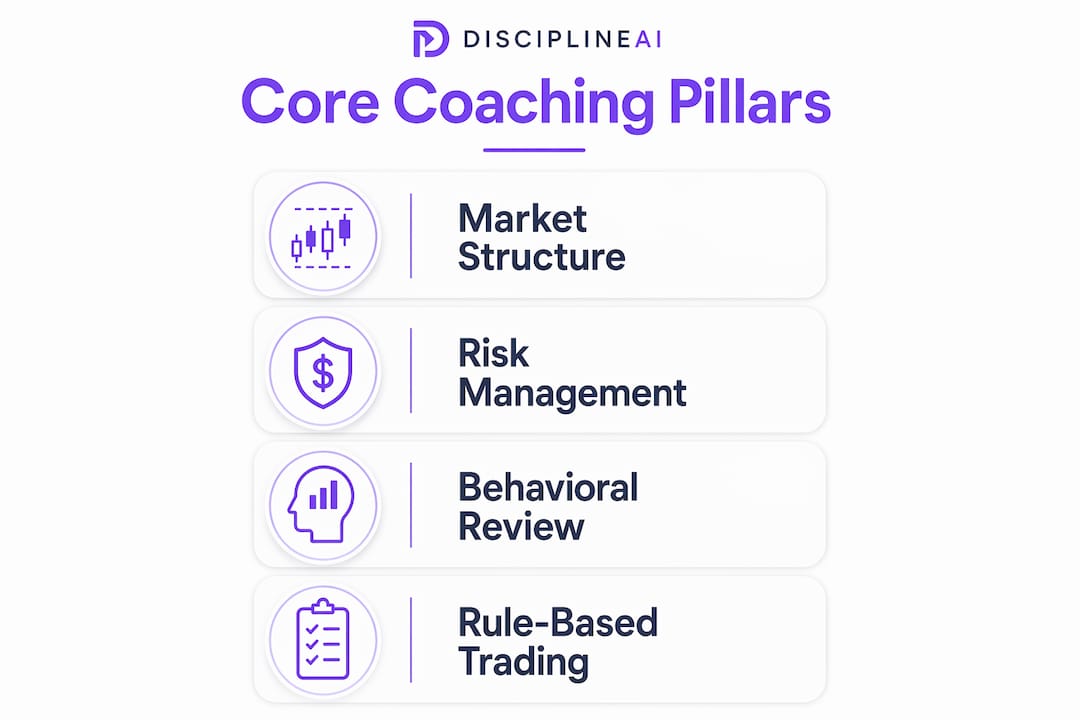
Risk management is the pillar most traders underestimate. Limiting risk to 1% of account equity per trade is a standard best practice in professional coaching programs. At 1% risk, you can absorb 20 consecutive losing trades and still have 80% of your capital intact. That survivability is what keeps you in the game long enough to improve.
Behavioral performance review is the pillar most courses skip entirely. Coaching systems track whether you followed your own rules, not just whether the trade was profitable. A winning trade taken outside your rules is still a process failure. Catching that pattern early prevents it from becoming a habit.

Pro Tip: Track your rule-compliance rate separately from your win rate. A trader with a 55% win rate but 40% rule compliance is building a fragile edge. A trader with a 45% win rate and 90% rule compliance is building a real one.
Rule-based coaching systems rely on mathematically defined entry and exit criteria with rigid risk parameters. The math removes the emotion. When your checklist says no, the answer is no, regardless of how strong the setup feels.
How does a personalized trading coach accelerate your growth?
Personalized coaching compresses the learning curve by targeting your specific weaknesses instead of covering every possible topic. A coach who reviews your actual trades can identify in one session what might take you two years to notice on your own.
The role of a personalized coach covers several distinct functions:
- Tailored feedback: Reviewing your trade journal and identifying patterns specific to your psychology and strategy
- Strategy refinement: Adjusting your entry and exit rules based on what your data shows actually works for you
- Active trade support: Providing real-time guidance during live market sessions, particularly valuable for beginners
- Accountability: Holding you to your own rules when emotional pressure makes breaking them feel justified
Cost is a real factor. One-on-one mentorship programs range from $2,000 to $6,500 depending on the level of personalization. Miami Trading Academy, for example, offers 16-session one-on-one mentorship at approximately $2,400, while private diagnostic-focused programs run closer to $6,500 for 8 sessions. That price range reflects the depth of individual attention, not just the number of hours.
The long-term goal of any quality coaching program is to make itself unnecessary. Sustainable growth happens when traders transition from relying on real-time coach feedback to running their own automated or semi-automated behavioral reviews. A coach who keeps you dependent on their signals has failed you. The best programs build your independence from day one.
Disciplineaiapp supports this transition directly. Its automated trade auditing runs the same diagnostic process a coach would perform manually, so you can review your own behavioral patterns between sessions or after the program ends. That continuity is what separates traders who sustain improvement from those who regress after coaching stops.
What are the proven benefits of a stock trader coaching system?
The measurable benefits of trader mentorship programs fall into three categories: behavioral discipline, capital preservation, and long-term confidence.
Behavioral discipline means fewer emotional mistakes per session. Emotional volatility causes most retail trader losses, and coaching replaces gut-feeling decisions with strict rule-based checklists. When you have a written checklist for every entry and exit, the decision is made before the market opens. Pressure cannot override a rule you committed to in writing.
Capital preservation follows directly from disciplined risk management. Traders who limit exposure to 1% per trade and follow exit rules consistently lose less during drawdowns. Smaller drawdowns mean faster recovery and more psychological stability during losing streaks.
"Most traders fail not because they lack information, but because they lack a consistent framework and a self-review process." — Traders MBA
That insight reframes the entire question of stock trading education. You do not need more chart patterns. You need a process for reviewing whether you followed the ones you already know. Coaching systems deliver that process. Courses rarely do.
Confidence grows as a byproduct of consistency. When you can look back at 50 trades and see that you followed your rules 85% of the time, you trust your process. That trust is what allows you to hold a winning trade to its target instead of exiting early out of fear. The role of AI in trading psychology has made this kind of objective self-review available to individual traders without a full-time coach.
Traders MBA and 2nd Skies Trading both emphasize that coaching builds independence rather than reliance on external signals. That philosophy is the clearest indicator of a quality program. If a coaching system is selling you tips, it is not coaching you.
Key takeaways
A stock trader coaching system works because it diagnoses your real execution errors, builds rule-based habits around them, and transitions you toward independent, disciplined trading.
| Point | Details |
|---|---|
| Coaching vs. courses | Coaching analyzes your actual trade data; courses teach general theory without personalized feedback. |
| Four core pillars | Market structure, rule-based execution, risk management, and behavioral review form the foundation of effective programs. |
| Risk management standard | Limiting risk to 1% of account equity per trade protects capital through losing streaks. |
| Cost and commitment | Programs range from $2,000 to $6,500 and run 8–16 sessions depending on personalization level. |
| Independence is the goal | The best coaching systems build self-review habits so traders improve without ongoing coach dependency. |
Why most traders get coaching backwards
I have reviewed a lot of trader journeys, and the pattern is consistent. Most people come to coaching after blowing up an account or hitting a wall after months of inconsistent results. They arrive looking for better setups or a smarter entry signal. That is the wrong question.
The traders who get the most out of coaching are the ones who come in willing to audit their behavior, not just their strategy. I have seen traders with genuinely good strategies lose money for years because they could not follow their own rules under pressure. The strategy was never the problem. The execution was.
What coaching does well, when it is done right, is force you to confront the gap between what you know and what you actually do. That gap is where most retail trading losses live. A first trading platform checklist matters less than a first behavioral audit. Tools matter less than habits.
The programs worth your money are the ones that start with your data, not their curriculum. If a program cannot tell you specifically what is wrong with your trading after reviewing your history, it is selling education. Seek programs that prioritize diagnostic review, build rule-based checklists around your specific weaknesses, and push you toward independence. Realistic expectations matter too. Eight to sixteen weeks of focused coaching will not make you a professional trader. It will give you a framework that compounds over years.
— Tony
How Disciplineaiapp supports your trading discipline
Disciplineaiapp is built for traders who understand that execution, not prediction, is where performance is won or lost.
The platform combines AI-powered trade analysis with behavioral tracking to deliver the same diagnostic feedback a professional coach provides, automatically and after every session. Its automated trade auditing identifies emotional patterns like revenge trading and FOMO across your full trade history. The market replay training feature lets you practice rule-based execution in realistic conditions without real capital at risk. If you are serious about building the kind of discipline that compounds over time, explore Disciplineaiapp and see how AI-driven coaching can replace guesswork with a repeatable process.
FAQ
What is a stock trader coaching system?
A stock trader coaching system is a structured program that analyzes your real trade data, identifies execution errors, and uses personalized feedback to build rule-based trading habits. It differs from a course by targeting your specific behavior rather than teaching general theory.
How long does a trader coaching program typically last?
Most coaching programs run 8–16 sessions over 8 to 16 weeks. Programs like those offered by Traders MBA structure this time across diagnostic, repair, and edge-building phases.
Is stock trading coaching worth the cost?
For traders with consistent execution problems or emotional trading patterns, coaching delivers measurable improvements in discipline and capital preservation that outweigh the $2,000–$6,500 investment. The key is choosing a program that starts with your actual trade data.
How do i know if a coaching program is legitimate?
Legitimate programs begin with a diagnostic audit of your historical trades rather than a fixed curriculum. Programs from providers like 2nd Skies Trading and Traders MBA require raw trade data submission before offering any personalized guidance.
Can AI replace a human trading coach?
AI tools like Disciplineaiapp can replicate the diagnostic and behavioral review functions of a human coach at scale and speed no individual coach can match. Human coaches still add value for nuanced strategy refinement, but AI handles the pattern recognition and accountability layer continuously.