
Trading discipline is the consistent practice of executing your trading plan objectively, independent of emotional impulses such as fear or greed. It is the single most critical variable separating the top 3% of consistently profitable traders from the 97% who struggle. That gap is not about strategy, market access, or capital. It is about behavior. Traders who understand what is trading discipline and build systems around it gain a structural edge over those who rely on intuition alone. Disciplineaiapp exists precisely to close that gap, combining AI analytics with behavioral coaching to help traders execute with consistency.
What is trading discipline from a psychological perspective?
Trading discipline is defined in behavioral finance as the ability to override neurological impulses and act according to a predefined plan. The challenge is biological. Humans neurologically feel losses about twice as intensely as equivalent gains. That finding, rooted in Kahneman and Tversky's prospect theory, explains why traders cut winners early and hold losers far too long. The brain treats a $500 loss as roughly twice as painful as a $500 gain feels rewarding.
This wiring produces predictable errors. A trader who is up 20% on a position closes it early because the fear of losing that gain overrides the logic of the original plan. A trader who is down 30% holds on because realizing the loss feels unbearable. Neither decision reflects the trading plan. Both reflect the nervous system.
"Discipline is not about suppressing emotion. It is about acknowledging the emotion and then acting according to your plan anyway. The plan was written when you were calm. The emotion arrives when you are not. Trust the plan."
Discipline counters these biases by creating a fixed decision framework that does not bend under pressure. The trader who has written rules for entry, exit, and position size does not need to decide in the moment. The decision was already made. That pre-commitment is the core mechanism of trade execution discipline, and it is what separates reactive trading from professional trading.
Why discipline is not willpower, and why systems matter more

Most traders treat discipline as a character trait, something you either have or you do not. That framing is wrong, and it is expensive. Discipline is a system built on rules and routines that removes reliance on willpower and makes rule-following the path of least resistance. Willpower is muscular. It fatigues. Discipline is architectural. It holds even when you are tired, frustrated, or on a losing streak.
The distinction matters practically. A trader who relies on willpower to avoid moving a stop-loss will eventually move it. The pressure of a live position is too great. A trader who uses a hard stop entered at trade initiation removes the decision entirely. The system acts. The trader does not have to.
Structural controls that support a trading discipline framework include:
- Pre-market routine: A 45–90 minute session reviewing the prior day's trades, setting the day's watchlist, and confirming bias before the open
- Hard stop-loss orders: Entered at trade initiation, not adjusted after entry
- Daily max loss limits: A preset dollar or percentage threshold that triggers an automatic shutdown of trading for the day
- If-then rules: Written conditional responses to common scenarios, such as "If I miss my entry by more than 5 ticks, I do not chase the trade"
- Position size caps: Fixed rules that prevent oversizing during high-conviction moments
Pro Tip: Write your if-then rules before the trading session, not during it. The moment you are in a live trade is the worst time to decide how you will respond to adversity.
Execution discipline erodes faster than strategy because human psychology systematically favors rule-breaking under pressure without active maintenance. That erosion is not a moral failure. It is a design flaw in how most traders structure their practice. The fix is not more willpower. It is better architecture.
How can traders measure and maintain trading discipline?
Profit and loss is an outcome, not a discipline measure. A trader can follow every rule perfectly and still lose money in a given week. A trader can break every rule and still profit by luck. Using P&L to assess discipline produces the wrong feedback loop. Discipline measurement is best done by scoring behavioral trade events, not by P&L, because disciplined behavior includes consistent rule-following even in losing trades.
A discipline scoring framework assigns points to specific execution events. Each trade gets evaluated on whether the entry matched the plan, whether the stop was honored, whether the position size was correct, and whether the exit followed the rule or the emotion. Over time, those scores reveal patterns that P&L cannot.
| Behavior event | Disciplined outcome | Undisciplined outcome |
|---|---|---|
| Stop-loss placement | Set at entry, never moved against position | Moved wider after price approaches |
| Entry timing | Taken only when all criteria are met | Taken on partial setup or impulse |
| Position sizing | Fixed per plan regardless of conviction | Oversized on "high confidence" trades |
| Exit execution | Closed at target or stop per plan | Closed early on fear or held past stop |
| Post-trade review | Logged with emotion and rationale noted | Skipped or logged only on winning trades |
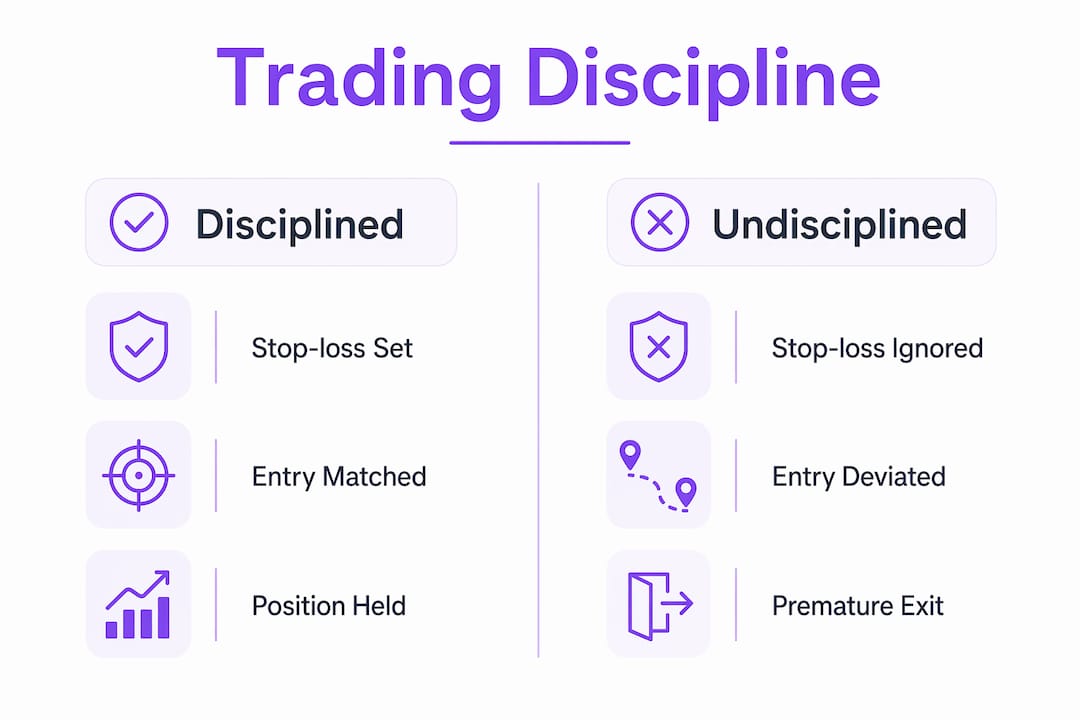
Pro Tip: Score every trade on discipline, not on outcome. A disciplined losing trade is a win for your process. An undisciplined winning trade is a warning.
A live journal that logs every intraday decision, emotion, and lesson is the most powerful tool for improving trading discipline. The journal creates a feedback loop that P&L cannot. It shows you not just what happened, but why you made each decision and what you were feeling when you made it. Disciplineaiapp automates this process with AI-driven trade auditing that identifies emotional patterns like revenge trading and FOMO across your full trade history.
Discipline scoring frameworks that track specific trade behaviors correlate with long-run profitability and provide leading indicators of discipline erosion before it shows up in your account balance. That is the key advantage of behavioral tracking. You see the problem forming before it costs you money.
What are practical habits that build trading discipline?
Building day trading discipline requires a structured daily practice, not occasional effort. The habits that work are specific, repeatable, and designed to reduce in-the-moment decision-making.
-
Run a pre-market routine every session. A 45–90 minute pre-market routine paired with live journaling builds measurable behavioral change within 7 sessions. The routine should include reviewing prior trades, identifying key levels, and writing the day's rules before the open.
-
Set a hard daily max loss limit. Decide before the session opens the maximum dollar amount you will lose that day. When that number is hit, the trading day ends. No exceptions. This single rule prevents the catastrophic drawdown days that destroy accounts and confidence.
-
Write if-then rules for your most common emotional triggers. If you know you tend to revenge trade after a stop-out, write the rule: "If I take a loss that hits my stop, I wait 15 minutes before entering another trade." The rule replaces the impulse.
-
Use automated hard stop-loss orders on every trade. The automated hard stop-loss, entered at trade initiation, eliminates the highest-cost failure without requiring willpower. It is the single most effective structural control available to any trader.
-
Log every trade immediately after execution. Record the entry rationale, the emotion at entry, the exit rationale, and the emotion at exit. Do not wait until end of day. Memory distorts. Real-time logging captures the truth.
-
Review your discipline score weekly, not just your P&L. Look at how many trades followed the plan completely. Track the percentage over time. A rising discipline score predicts improved profitability before the P&L reflects it.
-
Use technology to enforce accountability. Platforms that provide behavioral coaching in trading create an external accountability layer that self-reporting alone cannot replicate. When a system flags your emotional patterns, you cannot rationalize them away.
Consistency during drawdowns is where discipline is actually built. Any trader can follow rules when they are winning. The trader who follows rules during a three-day losing streak is the one who survives long enough to profit.
Key Takeaways
Trading discipline is the behavioral foundation that determines long-term profitability, and it is built through systems, scoring, and structured routines, not willpower alone.
| Point | Details |
|---|---|
| Discipline defined | Consistent execution of a trading plan regardless of emotional pressure or market conditions. |
| Neuroscience of trading | Losses feel twice as intense as gains, making rule-based systems necessary to counter bias. |
| Systems over willpower | Hard stops, daily loss limits, and if-then rules remove in-the-moment decisions that erode discipline. |
| Measure behavior, not P&L | Discipline scoring tracks rule-following per trade and predicts profitability before the account reflects it. |
| Daily habits compound | A structured pre-market routine and live journaling produce measurable behavioral change within 7 sessions. |
Why I think most traders are solving the wrong problem
Traders spend years searching for better strategies, better indicators, and better setups. The uncomfortable truth is that most traders already know enough to be profitable. What they lack is the behavioral infrastructure to execute what they know consistently.
I have watched traders with genuinely good systems blow up their accounts because they could not follow their own rules under pressure. The strategy was not the problem. The architecture was. They had no pre-market routine, no discipline scoring, no external accountability. They were relying on willpower in a high-pressure environment where willpower always loses eventually.
The traders who improve fastest are not the ones who find a better edge. They are the ones who build better systems around the edge they already have. That means writing rules before the session, logging every trade in real time, and reviewing discipline scores weekly. It means treating a disciplined losing trade as a success and an undisciplined winning trade as a red flag.
The role of AI in trading psychology is not to predict markets. It is to hold up a mirror to your behavior so you can see what you are actually doing versus what you think you are doing. That gap is where most trading accounts bleed out. Close the gap, and the results follow.
— Tony
How Disciplineaiapp helps you build lasting trading discipline
Knowing the principles of trading discipline is the first step. Applying them consistently under live market conditions is where most traders need support.
Disciplineaiapp combines AI analytics with behavioral coaching to give traders the external accountability layer that self-discipline alone cannot provide. Its automated trade auditing identifies emotional patterns like revenge trading and FOMO across your full trade history, not just the trades you remember. The market replay feature lets you review past sessions and practice execution without real capital at risk. The platform's trade execution analytics score your behavior per trade, giving you a discipline metric that predicts performance before your P&L does. For traders serious about closing the gap between knowledge and execution, Disciplineaiapp is built for exactly that purpose.
FAQ
What is trading discipline in simple terms?
Trading discipline is the consistent practice of following your trading plan on every trade, regardless of how you feel in the moment. It is the behavioral skill that separates consistently profitable traders from those who struggle.
How does trading discipline differ from trading strategy?
A strategy defines what trades to take. Discipline determines whether you actually take them according to the rules. A trader can have an excellent strategy and still lose money by failing to execute it consistently.
Why is discipline harder to maintain than to understand?
Neurological wiring makes losses feel twice as intense as equivalent gains, which creates emotional pressure to break rules at exactly the wrong moments. Execution discipline erodes faster than strategy because psychology systematically favors rule-breaking under pressure.
How do you measure trading discipline objectively?
Score each trade on specific behavioral events: whether the stop was honored, the entry matched the plan, and the position size was correct. Discipline scoring frameworks that track these behaviors correlate with long-run profitability and reveal erosion before it appears in your account balance.
What is the fastest way to improve trading discipline?
A structured pre-market routine of 45–90 minutes combined with live trade journaling produces measurable behavioral change within 7 sessions. Adding automated stops and a daily max loss limit removes the highest-risk decisions from the emotional moment entirely.