Forex trading discipline is a learned system of behaviors, not a fixed personality trait, and the evidence for its teachability is stronger than most traders realize. Research shows 70-80% of retail forex traders lose money, and the separating factor between those traders and profitable ones is not strategy complexity. It is structured, rule-based process adherence. Why forex discipline is teachable comes down to one core truth: discipline emerges from designed habits, external accountability structures, and environment engineering. Tools like pre-trade checklists, habit loop frameworks, and automated execution systems make this skill transferable to any trader willing to build the right systems.
What does research say about discipline as a teachable skill?
Behavioral science reframes discipline entirely. Rather than treating it as a character trait some traders are born with, cognitive science defines discipline as a cost-benefit calculation the brain performs in real time. When breaking a rule feels cheaper than following it, the brain chooses the break. This means discipline failures are system design problems, not personal failures.
The performance data backs this up. Disciplined traders achieve a 58% win rate compared to 42% for traders relying on motivation alone. That 16-percentage-point gap compounds significantly over hundreds of trades, which is why the difference between a profitable year and a losing one often has nothing to do with market analysis.
"Emotional control contributes as much to success as strategy selection; disciplined traders develop clear process identities." — FXStreet
Traders who practice emotional regulation and structured routines perform up to 30% better under high-pressure conditions. That improvement does not come from trying harder. It comes from pre-committed decision frameworks that remove the need for in-the-moment willpower. The implication is direct: if discipline produces measurable performance gains and those gains come from systems rather than character, then anyone can learn to build those systems.
How do systems and habit formation make forex discipline teachable?

The neuroscience here is specific and useful. Habits encoded in the basal ganglia operate without conscious effort or emotional motivation. Once a behavior becomes habitual, willpower is no longer required to execute it. This is why experienced traders can follow their rules calmly during volatile sessions while newer traders freeze or overtrade. The experienced trader is not more disciplined by nature. They have repeated the same process enough times that it runs automatically.
This is the foundation of teachable forex discipline. You are not trying to build character. You are engineering habits. The practical mechanisms include:
- Pre-commitment techniques: If-then planning locks in responses before emotional triggers occur. "If price hits my stop, I exit immediately" removes the decision entirely.
- Checklists: Moving trade decisions from emotional judgment to pre-committed standards is how aviation and surgery reduced error rates, and it works the same way in trading.
- Risk caps and fixed exits: Hard stop-loss limits and pending orders act as guardrails against revenge trading, removing the option to act impulsively.
- Expert Advisors (EAs): Automated execution tools enforce consistent entries and exits without emotional interference, making rule-following the path of least resistance.
The key principle is friction design. A well-designed trading system makes following the rules easier than breaking them. When the cost of discipline drops below the cost of deviation, the brain naturally chooses compliance. That is not motivation. That is engineering.
Pro Tip: Set your stop-loss and take-profit levels as pending orders before entering any trade. Once they are placed, close your trading platform. This single habit removes the two most common emotional override points from your trading session.
What practical discipline strategies can traders implement today?
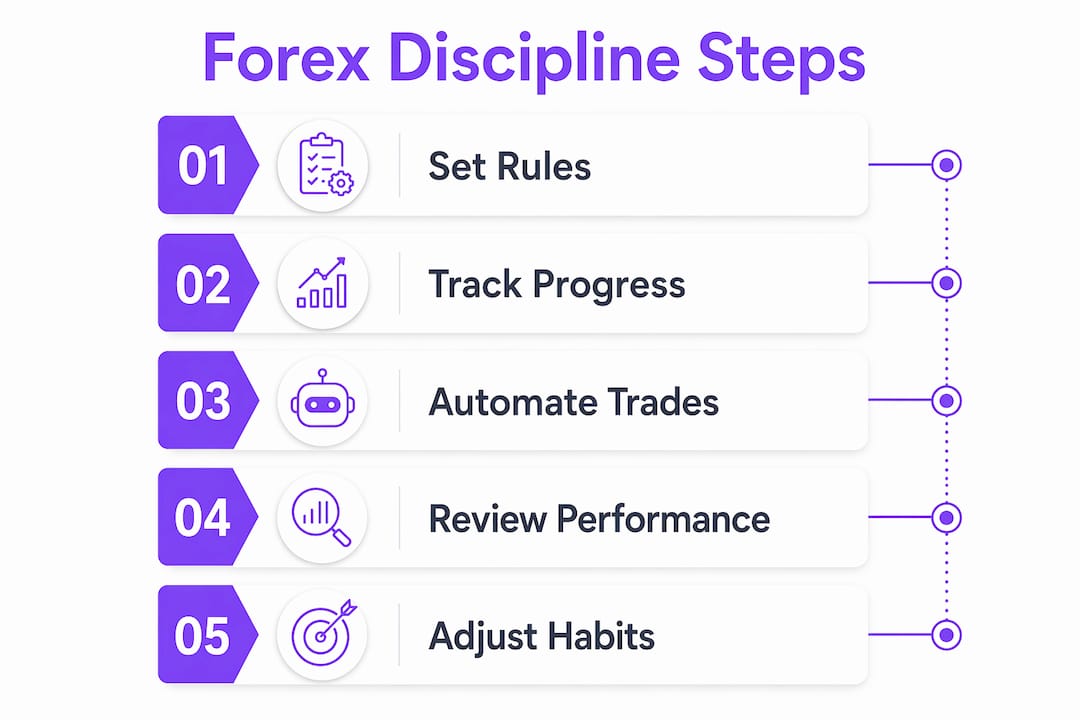
Building forex trading discipline requires structure across three areas: pre-session preparation, in-session execution, and post-session review. Each area has specific, teachable methods.
-
Build a daily pre-trading routine. A consistent pre-session ritual signals to your brain that trading mode has begun. This reduces decision fatigue before you place a single order. Reviewing economic calendars, checking open positions, and confirming your daily risk limit takes under 10 minutes and dramatically reduces impulsive entries. Pairing this with day trading routine practices that cover pre-trade, in-trade, and post-trade management creates a full behavioral framework.
-
Score your discipline, not just your P&L. A trading journal that tracks plan adherence separately from profit gives you a cleaner signal. A trade can be a loss and still score 10 out of 10 on discipline. A trade can be a win and score 2 out of 10. Measuring process adherence independently of outcome is how you identify whether your system works or whether you are just getting lucky.
-
Use accountability structures. Goal adherence rates jump from 43% to 76% with weekly accountability. That 33-percentage-point improvement is not trivial. An accountability partner, a trading group, or a structured review process creates social pressure that reinforces rule compliance when internal motivation fades.
-
Recover from rule breaks with guilt, not shame. The distinction matters practically. Guilt leads to analytical correction; shame leads to avoidance and revenge trading. When you break a rule, the productive response is "I deviated from my system, here is what I will adjust." Not "I am a bad trader." One response fixes the system. The other compounds the damage.
-
Apply position sizing and loss caps daily. Setting a maximum daily loss limit before the session starts removes the temptation to "trade back" losses. Combine this with fixed position sizing so no single trade can meaningfully distort your psychology or your account.
Pro Tip: Track your discipline score for 30 consecutive trading days before evaluating your strategy's profitability. If your discipline score averages below 7 out of 10, your strategy data is not yet valid. You are testing your emotions, not your system.
Why does teaching discipline outperform hoping traders learn it naturally?
Most traders enter the market believing that knowledge equals execution. They read books, study charts, and build strategies, then discover that knowing what to do and doing it under pressure are completely different problems. This gap explains why checklists and structured routines exist as formal discipline tools rather than optional extras.
The contrast between taught discipline and hoped-for discipline is stark:
| Approach | Mechanism | Outcome |
|---|---|---|
| Hoping for natural discipline | Relies on willpower and motivation | Fades under stress; inconsistent results |
| Teaching discipline through systems | Habit formation, automation, accountability | Consistent execution independent of emotional state |
| Character-based belief | Assumes discipline is fixed at birth | Leads to self-blame rather than system correction |
| Environment design | Reduces friction for rule compliance | Makes discipline the default behavior |
Willpower is a finite resource. Under stress, after losses, or during extended trading sessions, it depletes. Traders who rely on motivation to stay disciplined will eventually fail not because they lack character, but because the human brain is not designed to sustain high-effort self-regulation indefinitely. Designing your environment removes this constraint entirely.
The traders who succeed long-term treat discipline as an engineering problem in system design. They identify where their rules break down, reduce the friction of following those rules, and add external structures that enforce compliance when internal resources run low. This is a teachable process. It can be documented, practiced, and refined. You can also review performance patterns that cost you to identify exactly where your discipline leaks occur.
Key takeaways
Forex discipline is teachable because it is a product of system design, habit formation, and structured accountability, not innate character.
| Point | Details |
|---|---|
| Discipline is system-driven | Cognitive science defines discipline as a cost-benefit calculation, not a personality trait. |
| Performance gap is measurable | Disciplined traders achieve a 58% win rate versus 42% for motivation-dependent traders. |
| Habits replace willpower | Behaviors encoded in the basal ganglia execute automatically, removing the need for constant self-control. |
| Accountability accelerates learning | Weekly accountability structures improve goal adherence from 43% to 76%. |
| Recovery method matters | Responding to rule breaks with guilt rather than shame produces analytical correction, not revenge trading. |
Discipline is an engineering problem, not a character test
I have watched traders spend years trying to "be more disciplined" through sheer force of will, and almost none of them succeed that way. What actually works is treating discipline like a systems architect would treat a workflow. You find the failure points, reduce the friction, and automate what you can.
The traders I have seen make the most consistent progress are not the ones with the strongest personalities. They are the ones who design their trading environment so that following the rules is genuinely easier than breaking them. They use hard stops placed before entry. They close their platforms between sessions. They score their process daily and review it weekly. These are not heroic acts of self-control. They are low-friction habits that compound over time.
The other shift that matters is moving your identity away from outcomes and toward process. When you define yourself as "a trader who follows the system," a losing trade does not threaten your identity. It is just data. That psychological separation is what allows you to stay analytical when the market moves against you, and it is built through repetition, not inspiration. Crypto traders dealing with FOMO-driven decisions face the same challenge, and the same system-based fixes apply. If you are curious about that specific pattern, the piece on FOMO in crypto trading covers it directly.
Focus on your process adherence metrics for the next 30 days. Not your P&L. Your discipline score. The performance will follow.
— Tony
How Disciplineaiapp helps you build real trading discipline
Disciplineaiapp is built specifically for traders who understand the gap between knowing what to do and actually doing it under pressure.
The platform combines AI analytics with behavioral coaching to identify emotional patterns like revenge trading and FOMO before they damage your account. Features include automated trade auditing, pre-trade checklists, market replay training, and discipline scoring that tracks your process adherence independently of profit and loss. The AI-powered discipline system at Disciplineaiapp reduces the cognitive load of staying consistent by automating the accountability structures that research shows drive the biggest performance gains. You can also explore the full platform features to see how checklist automation and behavioral analytics work together to build lasting trading habits.
FAQ
Can discipline really be taught in forex trading?
Yes. Behavioral science confirms discipline is a product of habit formation and system design, not a fixed trait. Traders who implement structured routines and accountability tools consistently outperform those relying on motivation alone.
What is the fastest way to build forex trading discipline?
The fastest method combines pre-trade checklists, a daily discipline score, and an accountability partner. Research shows weekly accountability alone improves goal adherence from 43% to 76%.
Why does willpower fail forex traders under pressure?
Willpower depletes under stress and extended decision-making. Habits encoded in the basal ganglia operate automatically without requiring emotional energy, which is why system-based discipline outperforms effort-based discipline over time.
How does a trading journal improve discipline?
A journal that scores plan adherence separately from profitability gives you clean data on whether your system is working. It separates process quality from outcome luck, which is the only way to improve execution over time.
What role does automation play in forex discipline strategies?
Automation tools like Expert Advisors and pending orders enforce consistent entries, exits, and risk caps without requiring in-the-moment decisions. They remove the two most common points where emotional override occurs.