
Crypto trading discipline habits are structured behaviors and rules that traders follow to manage risk, reduce emotional errors, and improve long-term performance. Most traders lose money not because their analysis is wrong, but because they break their own rules under pressure. Stop-loss orders, risk management percentages, and trade journals are not optional extras. They are the core infrastructure that separates traders who last from those who blow up. FOMO and revenge trading are the two most common discipline failures, and both are preventable with the right routines.
1. What are the top crypto trading discipline habits?
Strong trading discipline starts with a clear set of rules you follow on every single trade, without exception.

Risk no more than 1% of equity per trade
Risk no more than 1% of your account on any single trade. On a $10,000 account, that means a maximum $100 risk per trade. This rule prevents one bad trade from destroying weeks of progress. It also forces you to size positions correctly rather than betting on conviction.
Use stop-losses on every trade
A stop-loss turns emotional holding into a planned exit. Without stop-losses, a single bad trade can erase weeks of gains. Place your stop before you enter, not after the trade moves against you. That sequence matters because it removes the temptation to negotiate with yourself mid-trade.
Cap leverage between 1:5 and 1:10 early on
High leverage is the fastest way to blow a retail account. Keeping leverage between 1:5 and 1:10 during your early trading stages limits catastrophic loss while still allowing meaningful returns. Once you have proven consistent profitability over many trades, you can reassess. Until then, lower leverage is a discipline rule, not a preference.
Trade a predefined plan, not emotions
Write your trade criteria before the market opens. Define your entry trigger, stop level, and target. Then execute only what the plan says. Deviating from a plan mid-session is almost always driven by emotion, not analysis. Discipline systems work by externalizing decision points so you cannot negotiate with yourself during high-emotion moments.
Keep a detailed trade journal
Record every trade with your rationale, entry and exit points, and your emotional state at the time. Research shows that neutral emotional states produce winning trades 68.4% of the time, while revenge trading states produce winners only 18.3% of the time. That gap is not a coincidence. Tagging your emotional state turns a subjective feeling into a data point you can act on.
Pro Tip: Label each journal entry with a simple emotional tag: Neutral, Anxious, Overconfident, or Revenge Trading. Review those tags weekly and you will see patterns that no backtest can reveal.
Practice demo trading before going live
Demo trading is not just for beginners. Use it to test any new strategy before risking real capital. The goal is to build confidence in a system's logic before your emotions get involved. Skipping this step is one of the most common discipline failures among intermediate traders.
Start with small live positions and scale gradually
Your first live trades should be smaller than your demo trades. Real money triggers emotional responses that a simulator cannot replicate. Start small, prove your discipline holds under real conditions, then scale. This approach protects capital while you build the psychological muscle that consistent trading requires.
Take losses quickly instead of hoping for reversals
Holding a losing trade and hoping for a reversal is not a strategy. It is an emotional response. Define your exits and risk limits before entry, and honor them without exception. Traders who take losses quickly preserve capital and mental energy for the next setup.
Take profits in tranches
Exiting a full position at one price is rarely optimal. Scale out in two or three tranches: take partial profits at your first target, move your stop to breakeven, and let the remainder run. This approach locks in gains while keeping exposure to larger moves. It also removes the emotional pressure of watching a winner turn into a loser.
Limit open positions to what you can monitor
Opening more positions than you can track is a discipline failure disguised as opportunity. Each open trade demands mental bandwidth. When you hold too many at once, you start making lazy decisions. Set a hard cap on simultaneous positions and stick to it regardless of how many setups appear.
How disciplined routines manage crypto's psychological demands
Crypto markets never close. That 24/7 availability is one of the biggest psychological threats traders face. Without structure, you end up trading at 2 a.m. on a bad setup simply because the market is open.
Creating artificial market open and close times is one of the most effective ways to reduce decision fatigue. Professional traders who work in traditional markets benefit from a natural stop. Crypto traders must build that stop themselves. Pick a trading window, commit to it, and shut the screens when it ends.
A structured daily routine should include three phases:
- Pre-session: Review the market, check your watchlist, and confirm your plan for the session.
- Execution: Trade only setups that match your predefined criteria.
- Post-session: Journal every trade, tag your emotional state, and note any rule breaks.
Mandatory cool-off periods after two consecutive losses are non-negotiable. Stepping away for at least 15 minutes prevents revenge trading and stops a bad run from becoming a catastrophic one. The rule is simple: two losses in a row means you stop and reset before placing another trade.
Pro Tip: Set a hard daily loss limit before each session. When you hit it, close the platform and do not return until the next session. This single rule prevents more damage than any other.
Fear and greed are not personality flaws. They are predictable responses to uncertainty. The solution is not to eliminate them but to commit to rules that override them. Viewing trading as probabilistic execution over many trades, rather than reacting to single outcomes, is the mindset shift that makes discipline sustainable. Measure your performance over blocks of 20–100 trades, not individual results.
What risk management principles form the foundation of trading discipline?
Risk management is not a separate skill from discipline. It is discipline applied to capital protection.
| Risk Rule | Recommended Level | Purpose |
|---|---|---|
| Per-trade risk | Max 1–2% of portfolio | Prevents single-trade blow-ups |
| Leverage cap | 1:5 to 1:10 for retail | Limits catastrophic loss exposure |
| Portfolio drawdown limit | 10–20% before reducing exposure | Protects capital during losing streaks |
| Position sizing | Reduce during volatility spikes | Adjusts risk to market conditions |
| Stop-loss placement | Before trade entry, always | Removes emotional exit decisions |
Portfolio-level drawdown caps of 10–20% are the guardrail that keeps traders in the game during rough periods. When your account drops to that threshold, you reduce position sizes or stop trading entirely until you recover. This rule feels painful in the moment and saves accounts in the long run.
Volatility-based position sizing is the next level of risk discipline. When Bitcoin or Ethereum makes unusually large daily moves, your standard position size carries more risk than usual. Shrinking positions during volatility spikes keeps your actual dollar risk consistent even when price swings are not.
How to build a trade journal that actually improves your discipline
A trade journal only works if you use it consistently and honestly. Most traders record entries and exits but skip the emotional data. That omission is exactly why their journaling produces no improvement.
Record these fields for every trade:
- Entry and exit price
- Position size and risk amount
- Trade rationale (what triggered the entry)
- Emotional state at entry (Neutral, Anxious, Overconfident, Revenge Trading)
- Outcome and whether you followed your rules
Post-trade reviews reveal patterns that no backtest can expose. When you review a month of trades and see that 80% of your losses came from trades you entered while anxious, that is a behavioral finding. It tells you exactly where to focus your discipline work.
Tracking rule adherence separately from profit and loss is a practice most traders overlook. A trade can be profitable and still represent a discipline failure if you broke your entry rules. Separating these two metrics helps you identify behavioral failures without confusing them with strategy problems.
AI-enhanced journaling tools now automate much of this pattern detection. Platforms like Disciplineaiapp use automated trade auditing to flag emotional patterns like FOMO and revenge trading directly from your trade data. That turns a manual review process into a continuous feedback loop. For traders who want to understand trading behavior analysis, this kind of systematic tracking is the starting point.
Pro Tip: Review your journal weekly, not just monthly. Weekly reviews catch bad habits before they become expensive patterns.
Key Takeaways
Crypto trading discipline habits are the foundation of consistent profitability because they replace emotional decisions with predefined rules that protect capital and build long-term performance.
| Point | Details |
|---|---|
| Risk 1% per trade | Cap each trade at 1% of your account to prevent single-trade blow-ups. |
| Use stop-losses every time | Place stops before entry to remove emotional exit decisions under pressure. |
| Create daily structure | Set artificial open and close times to reduce decision fatigue in 24/7 markets. |
| Journal emotional states | Tag every trade with your emotional state to identify patterns that cost you money. |
| Measure rule adherence | Track discipline separately from P&L to find behavioral failures without blaming strategy. |
Why most traders underestimate discipline until it's too late
I have watched traders with genuinely good analysis blow their accounts repeatedly. The analysis was not the problem. The execution was. Discipline is the skill that makes every other trading skill profitable. Without it, a strong edge becomes irrelevant because you will not follow it consistently when it matters most.
The uncomfortable truth is that most trading losses come from emotional impulses and rule-breaking, not from bad analysis. A trader who follows a mediocre system with perfect discipline will outperform a trader with a great system and poor discipline. That is not a theory. It shows up in the data every time you tag your trades honestly.
Crypto's nonstop market makes this harder than it sounds. There is always another setup, always another coin moving. The discipline to say "that is not my setup" and close the screen is harder to build than any technical skill. I built my own routine around artificial daily closes and it changed everything. The market will always be there tomorrow. Your capital might not be if you keep trading without structure.
Build discipline incrementally. Start with one rule you will follow without exception, such as never entering a trade without a stop-loss. Once that is automatic, add the next rule. Trying to overhaul your entire approach at once almost always fails. Small, consistent rule additions compound into a complete discipline system over time.
— Tony
Disciplineaiapp brings AI coaching to your trading routine
Knowing the right habits and actually following them are two different problems. Disciplineaiapp addresses the gap between knowledge and execution by combining AI analytics with behavioral coaching built specifically for traders.
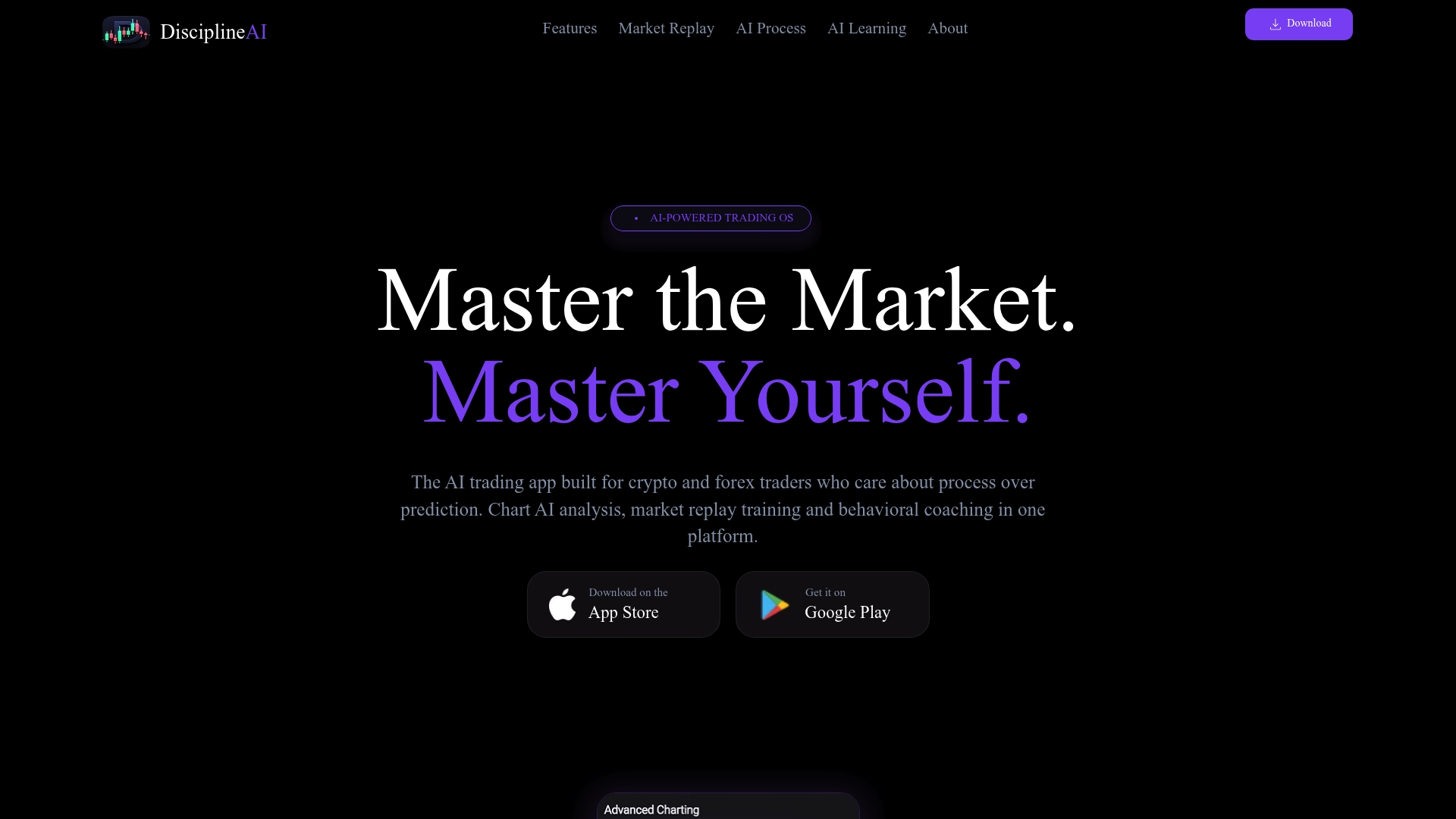
The platform's automated trade auditing identifies emotional patterns like revenge trading and FOMO directly from your trade history. Its market replay feature lets you practice discipline under realistic market conditions without risking live capital. The AI-driven process tracks your rule adherence over time and surfaces the specific behavioral patterns that are costing you money. For traders serious about building lasting discipline habits, Disciplineaiapp turns self-coaching from a vague intention into a measurable practice.
FAQ
What are crypto trading discipline habits?
Crypto trading discipline habits are structured rules and routines that traders follow to manage risk, control emotions, and execute trades consistently. They include practices like using stop-losses, capping risk per trade, and journaling emotional states.
How much should I risk per trade in crypto?
Risk no more than 1–2% of your total account on any single trade. On a $10,000 account, that means a maximum $100–$200 at risk per trade to prevent blow-ups.
Why does emotional control matter in trading?
Neutral emotional states produce winning trades 68.4% of the time, while revenge trading states produce winners only 18.3% of the time. Emotional control directly determines your win rate over time.
How do I avoid overtrading in crypto markets?
Set a hard daily loss limit and a cap on simultaneous open positions. When you hit the loss limit, close the platform for the day. Structured crypto overtrading prevention starts with predefined rules, not willpower.
What should I record in a trade journal?
Record entry and exit prices, position size, trade rationale, emotional state at entry, outcome, and whether you followed your rules. Reviewing these fields weekly reveals behavioral patterns that improve discipline faster than any other method.