
Behavioral coaching in trading is defined as a structured, evidence-based practice that helps traders regulate emotions, correct cognitive biases, and align their decisions with pre-planned performance goals. The field draws directly from Cognitive Behavioral Therapy (CBT) and Solution-Focused Brief Therapy (SFBT), applying those frameworks to the specific pressures of financial markets. Research shows 80–95% of retail traders fail within their first two years, and behavioral errors rather than flawed strategies drive most of those failures. That single statistic explains why trading psychology coaching has moved from a niche service to a core performance discipline. Disciplineaiapp is one platform built entirely around this shift, combining AI analytics with behavioral feedback to close the gap between what traders know and what they actually do.
What is behavioral coaching in trading?
Behavioral coaching in trading is the practice of using psychological and evidence-based strategies to help traders regulate emotions and improve decision-making under market pressure. The standard industry term for this field is trading psychology coaching, though behavioral coaching has become the widely used shorthand across both retail and institutional markets. The two terms refer to the same core practice: identifying the psychological patterns that cause poor decisions and replacing them with structured, rules-based habits.
The coaching process starts with a behavioral performance assessment. A coach or AI-driven system reviews a trader's transaction history, identifies recurring patterns like revenge trading or FOMO-driven entries, and maps those patterns to specific emotional triggers. From there, the work shifts to building self-regulation skills that hold up under real market pressure. This is not therapy in the clinical sense. It is performance psychology applied to a high-stakes decision environment.

Traders across equities, forex, futures, and crypto markets face the same core challenge: the market generates constant emotional noise, and most traders have no formal system for filtering it. Behavioral coaching provides that system.
How does behavioral coaching address psychological trading challenges?
The most common trading failures trace back to a short list of behavioral patterns. Between 70–80% of retail traders are overly aggressive or impulsive, which directly causes account drawdowns that technical skill alone cannot prevent. Recognizing these patterns is the first step in any coaching program.
The core behavioral pitfalls that coaching targets include:
- Revenge trading: Entering a new position immediately after a loss to "win back" money, bypassing all risk rules.
- FOMO entries: Chasing a move that has already run, driven by fear of missing out rather than a valid setup.
- Over-sizing: Increasing position size after a winning streak, treating recent gains as a buffer rather than real capital.
- Paralysis after losses: Refusing to take valid setups because of emotional residue from a recent drawdown.
- Overtrading: Filling slow sessions with low-quality trades to satisfy the urge to be active.
The physiological side of these failures matters as much as the psychological side. Market volatility triggers the body's fight-or-flight response, flooding the prefrontal cortex with stress hormones and degrading the quality of rational thought. The goal of coaching is not to eliminate emotion but to regulate the nervous system so that fight-or-flight responses do not hijack decision-making. That distinction matters because traders who try to suppress emotion entirely tend to become rigid and miss adaptive signals the market sends.
Behavioral coaching acts as an emotional circuit breaker. It inserts a structured pause between stimulus and response, giving the rational brain time to re-engage before a trade is placed.
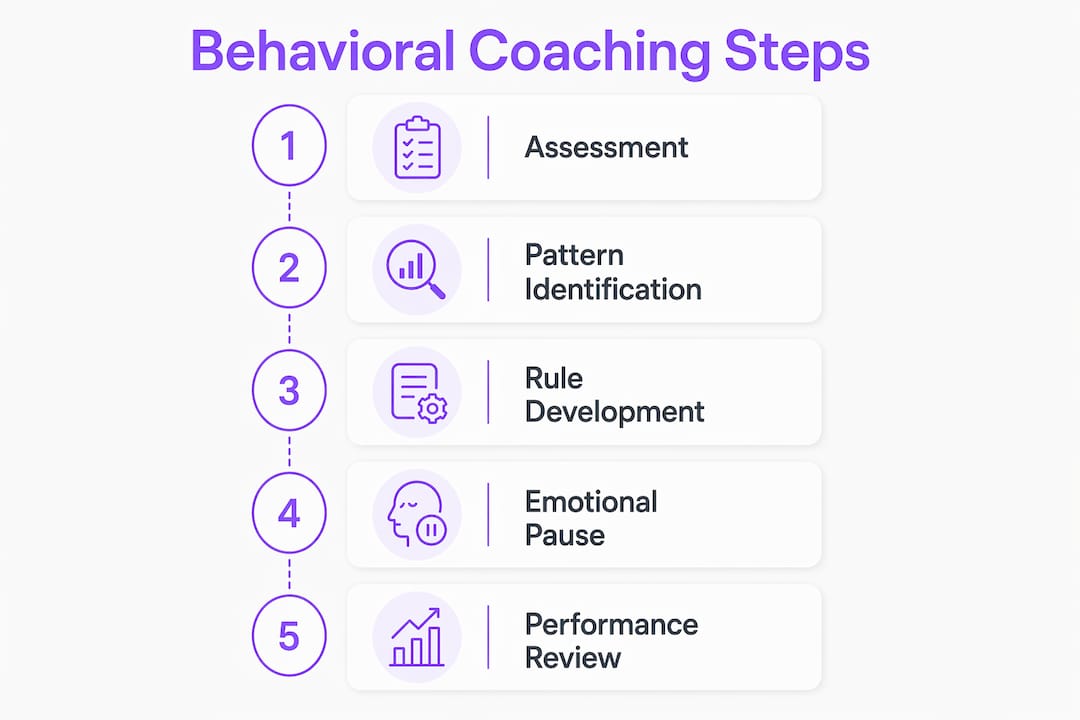
Pro Tip: Keep a one-sentence rule written at your workstation: "No trade placed within 10 minutes of a loss." That single constraint eliminates most revenge trading before coaching even begins.
Core methods used in behavioral trading coaching
Evidence-based trading psychology coaching draws from two primary frameworks: CBT and SFBT. Each serves a different function in the coaching process.
-
Cognitive Behavioral Therapy (CBT): Identifies distorted thinking patterns, such as "I must recover this loss today," and replaces them with accurate, rules-based thinking. CBT is the most widely researched psychological intervention and translates directly to trading because trading decisions are, at their core, a series of cognitive appraisals under uncertainty.
-
Solution-Focused Brief Therapy (SFBT): Shifts the focus from analyzing failures to replicating successes. Effective coaching uses the "exception principle" to identify the specific conditions under which a trader performs at their best, then builds protocols to recreate those conditions consistently. This approach amplifies strengths rather than cataloging weaknesses.
-
Pre-planned circuit breakers: Rules set in advance that trigger automatic responses during high-stress moments. Pre-planned circuit breakers preserve self-control by removing the need for in-the-moment discretion when cognitive resources are depleted. Examples include a daily loss limit that forces a session shutdown, or a mandatory 15-minute break after three consecutive losing trades.
-
Behavioral feedback loops: Regular review of trade data to identify patterns, measure progress, and adjust coaching targets. This is where technology adds the most value. Manual journaling captures some data, but AI-driven systems can process hundreds of trades and surface patterns a trader would never notice on their own.
-
Mindfulness and physiological regulation: Breathing protocols, body scans, and attention training reduce baseline stress levels and improve the trader's ability to stay present during volatile sessions.
Pro Tip: Before each trading session, write down your two most likely emotional failure modes for that day. Naming them in advance reduces their power significantly.
The shift from correcting flaws to proactive performance enhancement using evidence-based coaching methods is the defining change in modern trading psychology. Coaches now spend more time building on what already works than diagnosing what does not.
What are the measurable benefits of behavioral trading coaching?
The benefits of behavioral trading coaching show up in both performance metrics and psychological resilience. The most cited quantitative finding comes from Vanguard research: behavioral coaching can add up to 2% in additional net annual returns by preventing impulsive reactions during market volatility. That figure compounds significantly over a multi-year trading career.
The practical benefits traders report most consistently include:
- Tighter adherence to risk rules: Traders with behavioral coaching in place are less likely to override stop losses or increase position size outside their plan.
- Fewer emotional overreactions: Volatility events that previously caused panic selling or panic buying become manageable because the trader has pre-built responses.
- Improved trade review quality: Traders learn to assess decisions based on process rather than outcome, which produces better learning from both wins and losses.
- Greater psychological resilience: Drawdown periods become less destabilizing because the trader has a framework for interpreting losses without catastrophizing.
Clients actively seek advisors and coaches who help keep behavior in check during volatile markets, even when they do not label the service as behavioral coaching. That finding reveals something important: the demand for this type of support is real and growing, regardless of what traders call it. The benefits of behavioral stock coaching are most visible during high-volatility periods, which is precisely when undisciplined traders give back the most gains.
Institutional trading desks recognized this decades ago. The retail market is catching up, driven partly by the availability of AI tools that make personalized behavioral feedback accessible without a full-time human coach.
How does AI enhance behavioral coaching for traders?
AI changes behavioral coaching in two fundamental ways: it scales personalization, and it surfaces patterns that human observation misses. AI synthesizes data from financial transactions and behavioral patterns to reveal hidden investor biases that a trader would never identify through self-reflection alone. A trader might believe they trade calmly on Mondays, but transaction data might show that Monday morning entries are consistently oversized and poorly timed.
The practical applications of AI in trading psychology coaching include:
- Automated trade auditing: Every trade is logged, tagged by market condition, and analyzed for emotional markers like unusual sizing, rapid reversals, or entries that deviate from the stated strategy.
- Pattern detection: AI identifies recurring behavioral sequences, such as overtrading after a gap-up open, that repeat across weeks or months.
- Real-time feedback: Some platforms flag emotional risk in the moment, alerting the trader before a decision is finalized rather than after.
- Personalized coaching paths: Behavioral coaching tailored to individual psychology produces better outcomes than generic advice. AI makes that personalization scalable.
Disciplineaiapp is built on this model. Its AI Process feature audits trades automatically, its Market Replay tool lets traders re-experience past sessions to study their own emotional responses, and its Learning module reinforces behavioral habits over time. The platform identifies patterns like revenge trading and FOMO at the data level, then translates those findings into specific coaching feedback. For a deeper look at how AI is reshaping this field, the role of AI in trading psychology is worth reading in full.
Pro Tip: Run a behavioral audit on your last 50 trades before starting any coaching program. The data will tell you more about your actual trading psychology than any self-assessment questionnaire.
Key Takeaways
Behavioral coaching in trading works because it targets the behavioral errors that cause most retail trader failures, not the technical gaps.
| Point | Details |
|---|---|
| Behavioral errors drive failure | Between 80–95% of retail traders fail, primarily due to psychological mistakes rather than flawed strategies. |
| CBT and SFBT are the core frameworks | These evidence-based methods correct distorted thinking and replicate peak performance states. |
| Circuit breakers preserve discipline | Pre-planned rules remove in-the-moment discretion when stress depletes self-control. |
| Coaching adds measurable returns | Vanguard research links behavioral coaching to up to 2% in additional net annual returns. |
| AI scales personalization | Platforms like Disciplineaiapp use AI to surface hidden biases and deliver individualized feedback at scale. |
Why most traders underestimate what behavioral coaching actually fixes
Most traders who come to behavioral coaching expect it to help them feel calmer. That is not wrong, but it misses the deeper value. What coaching actually fixes is the gap between what you know and what you do when real money is on the line.
I have seen traders with genuinely strong strategies blow up accounts repeatedly because they could not execute their own rules under pressure. The strategy was never the problem. The execution was. Behavioral coaching is the only discipline that addresses execution directly, at the level of the nervous system and the decision-making process, rather than at the level of chart patterns or entry signals.
The traders who get the most from coaching are not the ones who are most emotionally volatile. They are the ones who are most honest about their patterns. The exception principle works because it forces you to ask a different question: not "why do I keep failing?" but "what was different on my best days?" That reframe alone changes how traders approach their own performance data.
AI tools have made this process faster and more precise. A platform that audits every trade and flags emotional patterns removes the self-reporting bias that makes manual journaling unreliable. Traders lie to themselves in their journals. They do not lie to their transaction logs. For traders who want to understand their own trading behavior analysis at a granular level, the data is the most honest coach available.
The future of trading psychology coaching is not a human coach on a weekly call. It is a continuous feedback loop between the trader's behavior and an AI system that knows their patterns better than they do.
— Tony
How Disciplineaiapp supports your behavioral coaching practice
Disciplineaiapp is built for traders who want more than buy and sell signals. The platform's AI Process audits every trade automatically, identifying emotional patterns like revenge trading and FOMO before they become habits. The Market Replay feature lets you re-examine past sessions with fresh eyes, studying your own decision-making in real market conditions. The AI Learning module reinforces behavioral habits over time, turning one-time insights into lasting discipline.
Disciplineaiapp focuses on discipline over prediction, which is the exact gap that behavioral coaching addresses. Traders who use the platform consistently report cleaner execution, fewer emotional overrides, and a clearer understanding of their own psychological patterns. If you are ready to close the gap between your strategy and your execution, explore the full feature set and see how AI-driven behavioral coaching works in practice.
FAQ
What is behavioral coaching in trading?
Behavioral coaching in trading is an evidence-based practice that uses psychological frameworks like CBT and SFBT to help traders regulate emotions, correct cognitive biases, and execute their strategies consistently under market pressure.
Why do stock traders need behavioral coaching?
Between 80–95% of retail traders fail within their first two years, primarily due to behavioral errors like impulsive trading and revenge trading rather than technical strategy failures.
How does behavioral coaching work in practice?
A coach or AI-driven system reviews trade history, identifies emotional patterns, and builds pre-planned rules and feedback loops that reduce impulsive decisions and reinforce disciplined execution.
Can behavioral coaching improve trading returns?
Vanguard research shows behavioral coaching can add up to 2% in additional net annual returns by preventing impulsive reactions during volatile market conditions.
How does AI fit into behavioral trading coaching?
AI synthesizes transaction data and behavioral patterns to surface hidden biases and deliver personalized coaching feedback at a scale and consistency that human coaching alone cannot match.