
Trading psychology fundamentals are the core mental and emotional principles that determine how traders manage decisions, risk, and pressure in live markets. Most traders lose not because their strategy fails, but because their mind does. Cambridge neuroscience studies show that morning cortisol levels predict daily trading performance, and chronic stress drives risk aversion or learned helplessness. The gap between knowing what to do and actually doing it is psychological. Closing that gap is what separates consistently profitable traders from the rest.
What are the main emotions and cognitive biases that affect trading psychology?
Fear, greed, FOMO, and regret are the four primary emotional drivers behind poor trading decisions. They do not operate independently. Fear, greed, and FOMO cycle into a destructive loop that produces revenge trading, overtrading, and blown accounts. Breaking that loop requires understanding exactly how each emotion operates.
Fear of loss causes traders to exit winning positions too early or freeze entirely when a setup appears. Greed pushes traders to hold positions past their target, turning profits into losses. FOMO drives entries on momentum without any edge, often at the worst possible price. Regret compounds all three by causing traders to second-guess rules they already know work.

Cognitive biases operate below conscious awareness and are equally damaging. A 2026 study of 70 individual investors found that overestimation predicts moderate-to-high risk of excessive trading behavior. That means traders who overestimate their own skill are statistically more likely to trade too much and too recklessly. Confirmation bias reinforces this by causing traders to seek out information that validates a trade they already want to take, ignoring contradictory signals.
| Driver | Type | Typical Behavior | Trading Impact |
|---|---|---|---|
| Fear of loss | Emotion | Early exits, hesitation | Missed gains, underperformance |
| Greed | Emotion | Holding past targets | Profits reversed to losses |
| FOMO | Emotion | Chasing momentum entries | Poor risk-reward, overtrading |
| Overestimation | Cognitive bias | Excessive position sizing | Blown accounts, excessive trading |
| Confirmation bias | Cognitive bias | Ignoring contrary signals | Poor trade selection |
Pro Tip: Before entering any trade, write down one reason the trade could fail. This simple habit directly counters confirmation bias by forcing you to consider the opposing view.
The psychological aspects of trading are not soft skills. They are measurable behavioral patterns with direct financial consequences. Traders who recognize their dominant emotional driver gain a concrete starting point for improvement.
How can traders develop emotional discipline and manage trading psychology effectively?
Emotional discipline is not about suppressing emotions. Trading psychology does not aim to eliminate emotions but to cultivate a neutral observer who notices fear or greed without reacting impulsively. That distinction matters enormously. Trying to eliminate emotions creates internal conflict. Observing them without acting on them builds real control.
Mindfulness is one of the most evidence-backed tools for building this capacity. Research cited by The Wall Street Coach confirms that mindfulness practices measurably improve hormonal profiles and financial performance by enabling more consistent emotional regulation. Traders who practice even five minutes of focused breathing before a session show measurably different cortisol responses than those who do not.
Pre-commitment rules remove willpower from the equation entirely. Experts at FX Foundations confirm that daily loss limits and cooling-off periods are effective countermeasures for impulsive trading. When a rule is set before the market opens, it does not require emotional strength to follow in the moment. The decision is already made.
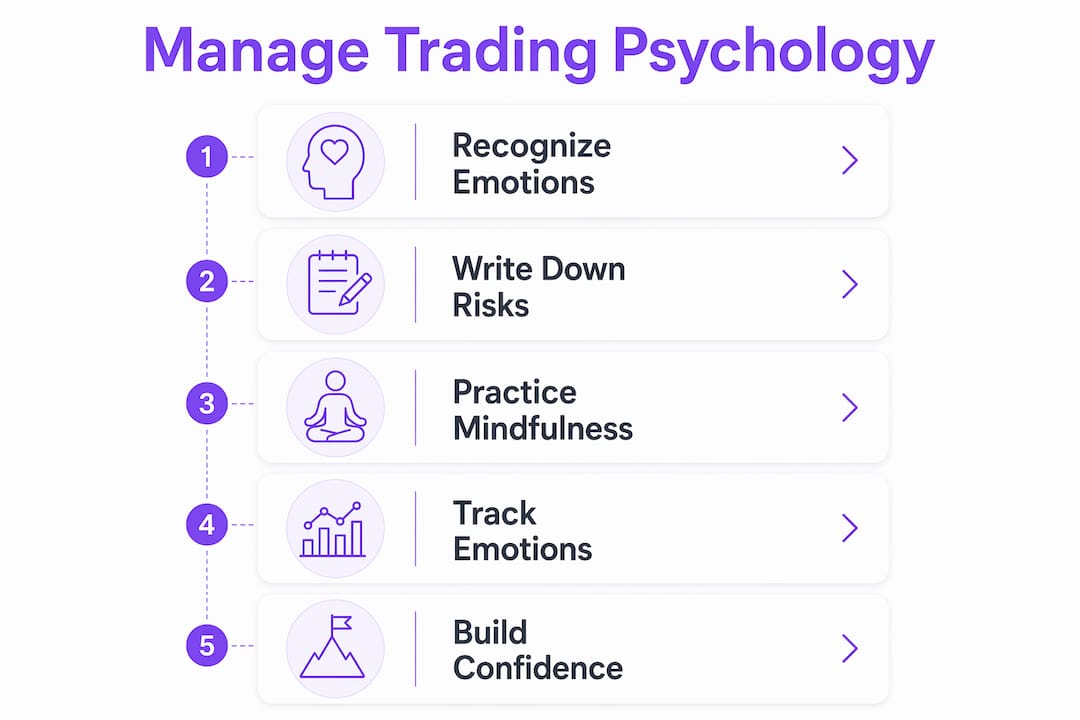
Here is a practical framework for building trader emotional discipline:
- Set a hard daily loss limit before the session starts. Write it down. Treat it as non-negotiable.
- Rate your emotional state on a 1–10 scale before and after every session. This creates data, not just feelings.
- Take a mandatory 15-minute break after any losing trade above your threshold. Physical distance from the screen interrupts the revenge trading impulse.
- Review your journal weekly for emotional patterns. Look for days when your emotional score was high and your performance was poor.
- Practice self-compassion after losses. Research by Dr. Kristin Neff, cited in 2026 coaching frameworks, shows that self-compassion after losses leads to faster recovery and better performance than self-criticism.
Pro Tip: Track emotional states in your trade journal using a simple 1–10 scale. The Wall Street Coach confirms that quantifying emotional states builds an empirical basis for behavioral improvement that memory alone cannot provide.
Building trading confidence comes from this kind of structured self-awareness. Confidence built on data is durable. Confidence built on a recent winning streak is fragile.
What psychological challenges do traders face during losses and how to overcome them?
Loss psychology follows a predictable sequence that most traders never recognize until they are deep inside it. The phases move from denial through anger, bargaining, and paralysis, before reaching acceptance. Each phase carries specific behavioral risks.
Prospect theory explains the underlying mechanics. Loss aversion and diminishing sensitivity mean early losses hurt more psychologically, but as a drawdown deepens, traders become numb and increasingly risk-seeking. That numbness is dangerous. It is the psychological state that produces catastrophic losses, not the initial losing streak.
The recovery paradox makes this worse. Forex Mechanics notes that after significant drawdowns, traders often increase position sizing to recover losses quickly, which escalates risk at exactly the wrong moment. The correct response is the opposite: slow down and reduce lot sizes during recovery. Capital preservation during a drawdown is the only path back.
| Phase | Typical Trader Behavior | Risk Level |
|---|---|---|
| Denial | Ignoring stop losses, averaging down | High |
| Anger | Revenge trading, doubling positions | Very High |
| Bargaining | Switching strategies mid-trade | High |
| Paralysis | Missing valid setups, freezing | Medium |
| Acceptance | Reviewing rules, reducing size | Low |
Overcoming trading fear in the loss domain requires removing discretion from the process. Automatic kill switches that execute hard daily loss limits prevent cognitive biases from driving irrational risk-taking during loss phases. A kill switch does not care how confident you feel. It stops the session when the threshold is hit, full stop.
- Predefine your maximum daily loss before the session, not during it.
- Reduce position size by at least 50% after hitting 50% of your daily loss limit.
- Require a 24-hour break before trading again after hitting the daily limit.
- Review the journal entry for that session before resuming, not after.
Pro Tip: Set your kill switch at a loss level where you can still think clearly. If you wait until you are emotionally compromised to stop trading, the kill switch is set too high.
Understanding the real cause of revenge trading is the first step toward preventing it. The behavior is not a character flaw. It is a predictable neurological response to loss that requires a structural solution, not a motivational one.
How do modern tools and AI support trading psychology fundamentals?
AI-driven tools have changed what is possible for individual traders managing their own psychology. The core value is pattern detection at a scale no human journaling practice can match. AI detects trading patterns across hundreds of sessions, identifying emotional signatures like revenge trading clusters, FOMO entries, and overtrading sequences that a trader reviewing their own notes would likely miss or rationalize away.
The most effective platforms combine behavioral analytics with structured coaching. They do not just flag a problem. They provide context, frequency data, and specific trade examples so the trader understands exactly when and why the behavior occurs. That specificity is what makes behavioral change possible.
Key capabilities that support mental preparation for trading include:
- Automated trade auditing that flags trades deviating from the trader's own stated rules
- Emotional pattern detection that identifies revenge trading and FOMO sequences across sessions
- Market replay training that lets traders practice decision-making under simulated pressure without real capital at risk
- Quantified journaling that scores emotional states alongside performance metrics
Pro Tip: Use trading behavior analysis tools to review your last 50 trades specifically for emotional deviations from your plan. The pattern you find will almost always surprise you.
The importance of trading psychology tools is not that they replace discipline. They make discipline measurable. A trader who can see that 80% of their losing trades happen in the hour after a stop-out has a concrete behavioral target to address. That is a fundamentally different starting point than "I need to be more disciplined."
Key Takeaways
Mastering trading psychology fundamentals requires structural rules, measurable self-awareness, and consistent behavioral review rather than willpower or motivation alone.
| Point | Details |
|---|---|
| Emotions follow predictable patterns | Fear, greed, FOMO, and regret cycle into destructive behaviors that preset rules can interrupt. |
| Cognitive biases drive overtrading | Overestimation of skill is a statistically proven predictor of excessive trading behavior. |
| Pre-commitment rules beat willpower | Daily loss limits and cooling-off periods reduce impulsive trading without relying on in-the-moment discipline. |
| Loss psychology escalates risk | As drawdowns deepen, traders become numb and risk-seeking. Reducing size during recovery protects capital. |
| AI makes discipline measurable | Behavioral analytics tools identify emotional trading patterns across sessions that manual review misses. |
Why psychological mastery is the real trading edge
The traders I have watched struggle the longest are not the ones with bad strategies. They are the ones who refuse to accept that their mind is the primary variable. A solid edge in the market is worth almost nothing if you abandon it the moment you hit a drawdown. And almost every trader does, at least once.
What changed my perspective was seeing how predictable the failure patterns are. Revenge trading, FOMO entries, holding losers and cutting winners short. These are not random mistakes. They are neurological responses to loss and uncertainty that every human brain produces. The traders who outperform over time are not the ones who feel less fear or greed. They are the ones who have built systems that make acting on those feelings structurally difficult.
Self-compassion is underrated in trading circles. Dr. Kristin Neff's research is not soft psychology. It is performance science. Traders who beat themselves up after losses compound the emotional damage and make the next mistake more likely. Traders who acknowledge the loss, review what happened without judgment, and move on recover faster and perform better. That is a measurable outcome, not a mindset platitude.
The long-term edge belongs to traders who treat their psychology as a skill to train, not a weakness to hide. Journaling, kill switches, mindfulness, and behavioral coaching are not supplements to a trading system. They are the system.
— Tony
How Disciplineaiapp supports your trading psychology
Disciplineaiapp was built specifically for the gap between knowing what to do and actually doing it under pressure. The platform combines AI-driven behavioral analysis with structured coaching to help traders identify and address the emotional patterns that cost them money.
The AI Process feature audits trades automatically, flagging deviations from your own rules and surfacing emotional patterns like revenge trading and FOMO sequences across your full trade history. The AI Learning module builds on that data with targeted coaching that addresses your specific behavioral tendencies, not generic advice. For traders who want to practice decision-making without risking capital, the Market Replay tool creates realistic pressure scenarios that build psychological resilience before the market opens. Disciplineaiapp turns discipline from an intention into a measurable, trainable skill.
FAQ
What are trading psychology fundamentals?
Trading psychology fundamentals are the core mental and emotional principles that govern how traders make decisions, manage risk, and respond to losses and gains. They include emotional discipline, cognitive bias awareness, and self-regulation under pressure.
Why do emotions hurt trading performance?
Emotions like fear, greed, and FOMO trigger impulsive decisions that override a trader's plan. FX Foundations confirms these emotions cycle into destructive behaviors like revenge trading when no preset rules exist to interrupt them.
What is the most effective way to manage trading psychology in forex?
Pre-commitment rules, including daily loss limits and mandatory cooling-off periods, are the most effective tools for managing trading psychology in forex. They remove in-the-moment emotional decision-making by setting boundaries before the session begins.
How does loss aversion affect trading decisions?
Loss aversion causes early losses to feel disproportionately painful, but as drawdowns deepen, traders become numb and increasingly risk-seeking. This shift often leads to catastrophic position sizing during recovery attempts.
Can AI tools improve trading psychology?
AI tools improve trading psychology by detecting behavioral patterns across hundreds of sessions that manual journaling misses. Platforms like Disciplineaiapp identify revenge trading clusters and FOMO entries with data-level specificity, giving traders a concrete behavioral target to address.