
Revenge trading is defined as taking impulsive trades immediately after a loss, driven by the emotional urge to recover money rather than by any valid market setup. It is the most common and costly behavioral pattern in active trading. The reason why traders revenge trade after losses comes down to neuroscience: a financial loss triggers the same brain regions as physical pain, flooding your system with cortisol and adrenaline that suppress rational thinking by 44%. Daniel Kahneman's research on loss aversion shows losses feel roughly twice as painful as equivalent gains feel good. That asymmetry is what makes the urge to trade back so overwhelming.
Why traders revenge trade after losses: the brain science
The core mechanism behind revenge trading is a neurological hijack. When you take a loss, your amygdala fires an alarm signal that triggers a stress hormone cascade. Cortisol and adrenaline flood your prefrontal cortex, which is the part of your brain responsible for planning, risk assessment, and impulse control. The result is that emotional brain centers override logic, creating a false sense of urgency to recover the loss immediately.

This manufactured urgency is not a character flaw. It is a predictable physiological response. Your brain interprets a financial loss as a threat, and threats demand immediate action. The problem is that the market does not care about your emotional state, and acting on urgency rather than analysis almost always makes things worse.
Several behavioral biases amplify this response and explain the psychological triggers in trading that push traders toward revenge entries:
- Loss aversion: The pain of a $500 loss outweighs the pleasure of a $500 gain, so you feel compelled to "undo" the loss.
- Recency bias: Your most recent loss feels like evidence that a win is overdue, which is statistically false.
- Illusion of control: You believe trading harder or faster will fix the outcome, when the market is indifferent.
- Sunk cost fallacy: You feel obligated to "earn back" money already gone, treating past losses as a debt the market owes you.
"Revenge trading is not a discipline problem. It is a stress response problem. The trader who revenge trades is not weak. They are human, operating under a hormonal load that would impair anyone's judgment."
Understanding this distinction matters. Blaming yourself for lacking willpower misses the actual cause and leads to the wrong solutions.
Does revenge trading actually hurt your performance?
The data on this is unambiguous. Revenge trades carry a win rate as low as 22%, compared to planned trades that typically run at 45–60% for disciplined traders. They also tend to occur within 15 minutes of a loss and at larger than usual position sizes. That combination of poor timing, inflated size, and low win rate creates a cascade effect where a manageable loss becomes a catastrophic drawdown.
| Factor | Revenge Trade | Plan-Based Trade |
|---|---|---|
| Win rate | ~22% | 45–60% |
| Position size | Larger than normal | Pre-defined by rules |
| Entry basis | Emotional urgency | Valid setup criteria |
| Time after loss | Within 15 minutes | No emotional link |
| Outcome pattern | Cascading drawdown | Controlled risk |
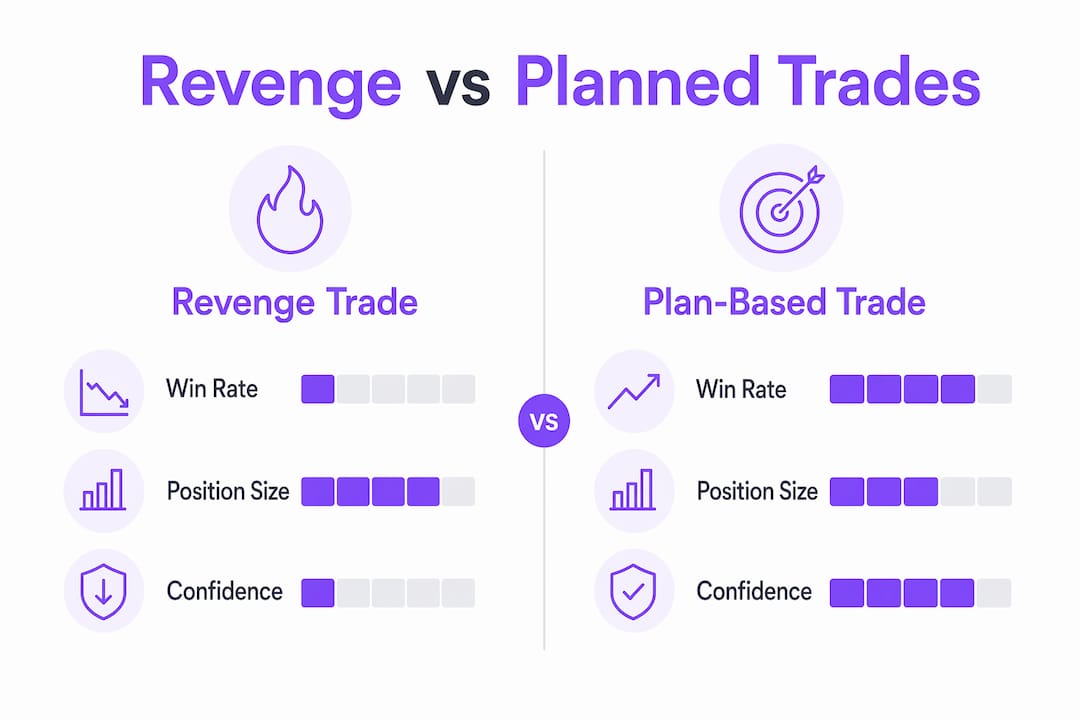
The emotional cycle compounds the financial damage. After a revenge trade fails, confidence drops further, which triggers another round of stress hormones and another impulsive entry. Traders who review their trade performance patterns consistently find that a small number of revenge trade clusters account for a disproportionate share of their total losses for the year.
The effects of loss on trading extend beyond the account balance. Repeated revenge trading erodes your trust in your own system, makes you second-guess valid setups, and creates a negative feedback loop that is genuinely hard to break without structural intervention.
How to avoid revenge trading after a loss
Overcoming trading losses emotionally requires more than telling yourself to "stay calm." You need pre-committed rules that activate before the stress response does. Here are the methods that actually work:
- Enforce a mandatory cooldown period. A 30-minute cooldown rule after any loss reduces revenge trading by 93% when enforced at the platform level. The key word is "enforced." A rule you can override under stress is not a rule.
- Reduce position size immediately after a loss. Lowering your size cuts the emotional weight of the next trade. Smaller position sizing keeps you inside the rational decision range where your prefrontal cortex stays online.
- Use a kill-switch protocol. Set a daily loss limit in advance. When you hit it, your trading session ends. No exceptions. This is a structural defense, not a willpower test.
- Journal every trade with emotional context. Reflective journaling helps you identify the specific conditions under which you revenge trade. Most traders discover their triggers are predictable: certain times of day, certain loss sizes, or certain market conditions.
- Apply the standalone test before every entry. Ask yourself: "Would I take this trade if I had not just lost money?" If the honest answer is no, the setup does not exist. You are trading your emotions, not the market.
Pro Tip: Set your cooldown timer before your trading session starts, not after a loss occurs. Pre-commitment works because it removes the decision from the moment of peak emotional stress.
The goal is to build a system that protects you from yourself during the 15-minute window when willpower is least effective. Willpower is not a reliable defense against a cortisol spike. Structure is.
Can technology help traders control revenge trading?
AI and behavioral analytics tools have changed what is possible for individual traders managing their emotional responses. The gap between knowing you should not revenge trade and actually stopping in the moment is where technology provides the most value.
Here is how modern platforms address the problem:
- Automated cooldown enforcement: Platform-level timers that lock trading access after a defined loss threshold. Unlike a mental note to yourself, these cannot be overridden in a moment of stress.
- Emotional pattern detection: AI systems that flag trades taken within a short window after losses, at inflated sizes, without a matching setup. This surfaces the hidden behavioral leaks in your trade log that are easy to miss in real time.
- Digital journaling with pattern recognition: Tools that tag trades by emotional context and surface recurring triggers. Seeing the data on your own revenge trade clusters is more persuasive than any general advice.
- Market replay training: Practicing entries in a simulated environment after a simulated loss builds the neural pathways for disciplined response before real money is at stake.
The role of AI in trading psychology is shifting from signal generation to behavioral coaching. The traders who improve fastest are not the ones who find better setups. They are the ones who stop destroying their edge with emotional trades. Maintaining a consistent daily trading routine supported by behavioral data gives you the feedback loop that pure willpower never can.
Key takeaways
Revenge trading is a neurological stress response, not a discipline failure, and structural safeguards outperform willpower every time.
| Point | Details |
|---|---|
| Root cause is neurological | Cortisol and adrenaline suppress rational thinking after losses, making impulsive trades feel urgent. |
| Win rate is dangerously low | Revenge trades carry a win rate as low as 22%, making them mathematically unsustainable. |
| Cooldowns cut the behavior | A mandatory 30-minute break after losses reduces revenge trading by 93% when enforced at the platform level. |
| Position size is your first lever | Reducing trade size after a loss lowers emotional stakes and keeps your prefrontal cortex engaged. |
| Technology enforces what willpower cannot | AI-driven behavioral tools detect emotional trade patterns and automate the safeguards you need most. |
The uncomfortable truth about willpower and revenge trades
I have reviewed hundreds of trade logs, and the pattern is always the same. The trader who revenge trades is not undisciplined in general. They are disciplined right up until the moment cortisol takes over. Then every rule they know evaporates.
The uncomfortable truth is that willpower is the wrong tool for this problem. You would not ask someone to bench press their way out of a broken arm. Asking a trader to "just stay calm" during a hormonal stress response is the same category of mistake. The solution is not more mental toughness. It is removing the decision from the moment of peak impairment.
What I have found actually works is a combination of pre-committed position sizing and platform-enforced cooldowns. The position sizing matters more than most traders realize. When your position is small enough that a loss does not feel catastrophic, the amygdala alarm does not fire as loudly. You stay in the rational range. The cooldown handles the cases where the alarm fires anyway.
Recognition is still the first line of defense. If you can catch yourself thinking "I need to get this back right now," that thought is the signal. Not a signal to trade. A signal to stop. The traders who break the cycle fastest are the ones who learn to treat that urgency as a warning, not a call to action. Pair that recognition with trading discipline practices built into your platform, and you have a system that actually holds under pressure.
— Tony
Stop revenge trading with Disciplineaiapp
Disciplineaiapp is built specifically for the gap between knowing better and doing better. Its AI-driven behavioral engine detects revenge trading patterns in your trade log, flags emotional entries in real time, and enforces automated cooldown timers that activate when you need them most.
The platform features include automated trade auditing, market replay training for building disciplined responses under simulated pressure, and journaling analytics that surface your specific emotional triggers. If you are serious about stopping the cycle of loss-driven impulsive trades, Disciplineaiapp gives you the structural safeguards that willpower alone cannot provide. Visit Disciplineaiapp to see how behavioral coaching and AI analytics work together to protect your edge.
FAQ
What is revenge trading?
Revenge trading is the act of placing impulsive trades immediately after a loss, driven by the emotional need to recover money rather than by a valid market setup. It is defined by urgency, inflated position size, and the absence of a legitimate entry signal.
Why do traders revenge trade after losses?
Traders revenge trade because financial losses trigger a cortisol and adrenaline response that suppresses the prefrontal cortex, the brain region responsible for rational decision-making. This stress response creates a false sense of urgency that overrides trading rules and analysis.
How damaging is revenge trading to performance?
Revenge trades carry a win rate as low as 22% and typically occur at larger than normal position sizes within 15 minutes of a loss. That combination turns a single manageable loss into a cascading drawdown that can wipe out days or weeks of gains.
Does a cooldown period actually work?
A mandatory 30-minute cooldown enforced at the platform level reduces revenge trading by 93%. The critical factor is platform-level enforcement. A cooldown rule you can override under stress provides almost no protection.
How does journaling help with revenge trading?
Journaling with emotional context helps traders identify the specific conditions that trigger revenge trades, such as loss size, time of day, or market type. Seeing your own pattern in data form makes the behavior visible and creates a concrete basis for rule adjustments.