
Overtrading in crypto markets is defined as executing trades at a frequency that exceeds what your strategy justifies, driven by emotion rather than evidence. The industry term for this pattern is excessive trading, and it is one of the most consistent destroyers of retail trading accounts. Active traders making 10 or more trades per week underperform passive investors by an average of 34% annually due to trading costs and poor timing. That number should reframe how you think about activity as a proxy for performance. This article gives you the frameworks, habits, and tools to avoid overtrading crypto markets by trading less and trading smarter.
Why do traders overtrade in crypto markets?
The answer is neurobiological before it is behavioral. When you watch a crypto position move against you, your brain interprets the drawdown as a survival-level threat, triggering cortisol release and an urgent need to act. That urgency is not rational analysis. It is your nervous system trying to resolve discomfort through movement, and placing another trade delivers a short dopamine hit that temporarily satisfies it.
Two behavioral finance concepts explain most overtrading patterns:
- Loss aversion: Losses feel roughly twice as painful as equivalent gains feel pleasurable. This asymmetry pushes traders to act defensively and impulsively rather than waiting for high-probability setups.
- Disposition effect: Investors sell winning positions 1.5 to 2 times more often than losing ones. The result is a portfolio that holds losers too long and cuts winners too early, compounding losses through both bad timing and excessive activity.
Boredom is an underrated trigger. Many traders mistake a slow market for a signal to find something to trade. This is the illusion of control at work: the belief that more activity equals more influence over outcomes. Crypto markets run 24 hours a day, seven days a week, which makes this trap worse than in traditional markets. There is always a chart moving somewhere, and that constant availability feeds impulsive entries.
"Willpower is a depletable resource. Structuring systems of friction is more effective for sustained trading discipline than relying on mental toughness alone."
This is the core insight that separates traders who improve from those who repeat the same mistakes. You cannot think your way out of a neurobiological response. You need rules, checklists, and automated systems that make impulsive trades harder to execute.
How to use structured plans and signal validation to prevent overtrading

Preventing crypto overtrading starts before the market opens. A structured pre-trade routine forces objectivity at the moment when your judgment is clearest, not after two hours of watching price action.
A practical pre-trade checklist should answer these questions before any position is opened:
- Does this setup match my documented strategy criteria exactly?
- What is the risk/reward ratio, and does it meet my minimum threshold?
- Have I already hit my daily or weekly trade limit?
- What is my emotional state right now, and is it neutral enough to trade?
- Is there a confirmed signal from an objective source, not just my gut?
That fifth question matters more than most traders admit. AI-powered signal confirmation and automated stop-losses reduce emotional trading errors and counter biases like the disposition effect and confirmation bias directly. Tools like TradeAlgo provide data-driven signal layers that give you an objective second opinion before you commit capital.
Pro Tip: Set a hard rule that you will not enter any trade that fails two or more checklist criteria. Write this rule down and keep it visible at your workstation. The physical act of checking a box creates friction that slows impulsive decisions.
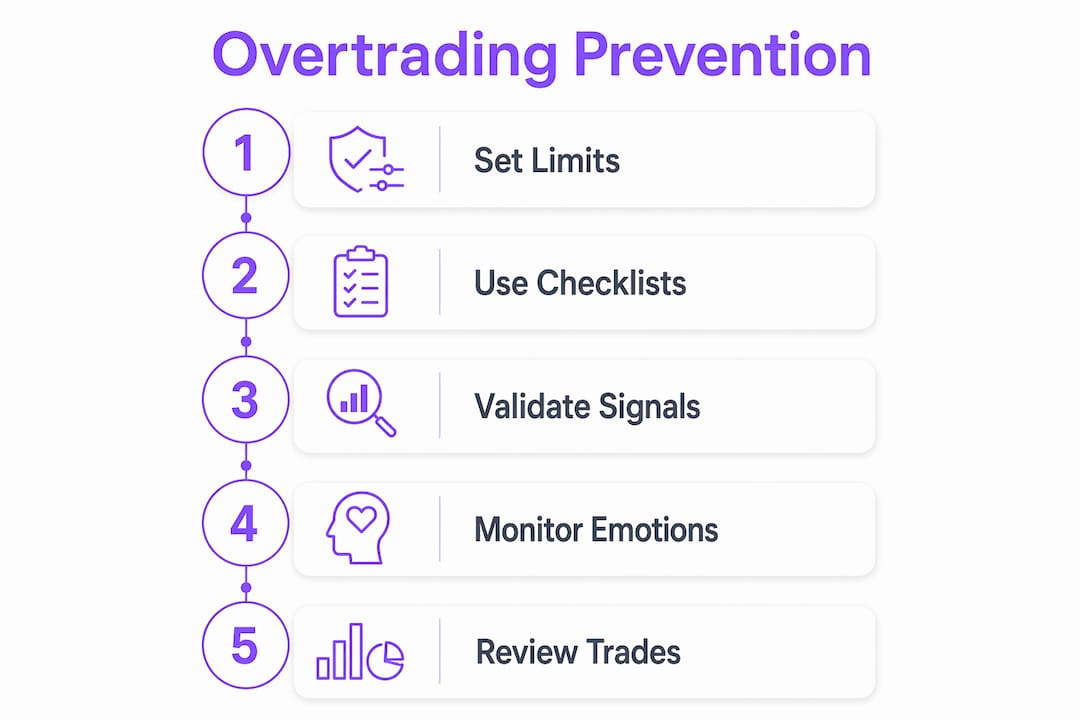
Risk management rules are the structural backbone of reducing trading frequency. Here is a framework that works:
| Rule | Purpose | Implementation |
|---|---|---|
| Daily trade limit | Caps total exposure per session | Set a maximum of 3 trades per day in your trading plan |
| Position size cap | Limits single-trade risk | Risk no more than 1-2% of account per trade |
| Automated stop-loss | Removes discretionary exits | Set stops at entry, not after the trade moves against you |
| Trading hours window | Prevents off-plan session trades | Trade only during your defined 2-4 hour window |
| Cooling-off period | Stops revenge trading | Mandatory 24-hour pause after two consecutive losses |
Automated trading systems achieve 31% better risk-adjusted returns by eliminating emotional interference. That improvement comes almost entirely from removing the discretionary exits and entries that happen when stress overrides strategy.
A pre-session checklist reduces overtrading risk by three times compared to trading without one. Three times is not a marginal improvement. It is the difference between a sustainable trading practice and one that burns through capital in volatile conditions.
Restricting your trading to a defined time window is one of the most underused tools in crypto. Because crypto never closes, traders feel obligated to monitor and react around the clock. Defining a two to four hour window, and treating trades outside it as rule violations, removes the majority of impulsive entries that happen during low-liquidity or emotionally charged periods.
What habits sustain crypto trading discipline over time?
Discipline is not a personality trait. It is a system that you build and maintain through deliberate habits. The traders who reduce overtrading over time do so because they create data feedback loops that make their mistakes visible and their improvements measurable.
A trade journal is the most powerful tool in that loop. Every entry should record not just the trade details but your emotional state at entry, whether the setup met your checklist criteria, and whether you followed your exit rules. After 30 sessions, patterns emerge. You will see that your worst trades cluster around specific emotional states, times of day, or market conditions. That data is more persuasive than any rule you write in the abstract.
- Track rule adherence, not just P&L. A trade that lost money but followed your rules is a success. A trade that made money but broke your rules is a failure. Measuring discipline separately from profit reframes what success looks like.
- Set weekly trade limits, not just daily ones. If you hit your weekly limit by Wednesday, the rest of the week is observation only. This forces you to be selective from the start of each week.
- Enforce cooling-off periods after losses. Two consecutive losses trigger a mandatory pause. This is not optional. Write it into your trading plan as a hard rule, not a guideline.
- Avoid recovery trades entirely. The impulse to "make back" a loss in the same session is one of the clearest signs of emotional trading. Recovery trades almost always violate setup criteria and extend drawdowns.
Pro Tip: When you feel the urge to place an impulsive trade, replace it with a rewarding substitute activity that satisfies your brain's need for relief without causing harm. A short walk, a coffee break, or five minutes of music interrupts the dopamine loop without costing you capital.
Accepting flat sessions as a win is a discipline milestone that most traders never reach. Many traders mistake boredom for lack of opportunity, but a session where no setup met your criteria and you traded nothing is often the most profitable outcome of the day. Reframe inactivity as execution of your strategy, not failure to act.
Weekly reviews should include a specific audit of rule violations. Not to punish yourself, but to identify which criteria are being bypassed most often and why. If you are consistently skipping the risk/reward check, the problem is not willpower. The problem is that the check is too vague or too slow. Fix the system, not your character.
How do advanced traders scale capital without overtrading?
Scaling trading capital introduces a psychological challenge that most traders underestimate. When position sizes increase, the emotional stakes rise proportionally, and the same discipline that worked at smaller sizes can break down under the pressure of larger dollar moves.
The solution is graduated exposure. Traders should move up position size in stages, maintaining each level for at least six months to confirm psychological stability before increasing further. This is not about being conservative with capital. It is about confirming that your discipline holds under real financial pressure before you expose more of your account to it.
| Scaling stage | Position size | Minimum duration before advancing |
|---|---|---|
| Foundation | 0.5% per trade | 3 months of rule adherence |
| Intermediate | 1% per trade | 6 months of consistent discipline |
| Advanced | 2% per trade | 6 months with no major rule violations |
| Professional | 2-3% per trade | Ongoing review every quarter |
After any significant rule violation or drawdown period, the correct response is to drop back one stage, not to push through at the same size. Professionals rebuild emotional stability after losses with smaller positions before returning to larger exposure. This is not weakness. It is how you protect your capital and your decision-making capacity simultaneously.
Monitoring your trading performance patterns during scaling periods is non-negotiable. The data will show you whether your discipline metrics are holding or degrading as size increases, giving you an objective basis for decisions rather than a feeling.
Key takeaways
Avoiding overtrading in crypto markets requires structured systems, behavioral awareness, and graduated discipline, not willpower or market prediction.
| Point | Details |
|---|---|
| Overtrading is neurobiological | Dopamine and cortisol responses drive impulsive trades; systems of friction are more effective than mental resolve. |
| Pre-trade checklists cut overtrading | A structured checklist reduces overtrading risk by three times by forcing objectivity before every entry. |
| Automate your exits | Automated stop-losses and take-profit orders deliver 31% better risk-adjusted returns by removing emotional interference. |
| Journal for discipline, not just profit | Track rule adherence separately from P&L to identify emotional patterns and improve over time. |
| Scale gradually | Hold each position size level for at least six months before increasing to confirm psychological stability. |
Why the "trade less" advice is harder than it sounds
I have worked with enough traders to know that telling someone to trade less is almost useless advice without a structural reason to do it. The problem is not that traders lack knowledge. They know overtrading hurts performance. The problem is that the urge to act feels like conviction, and most trading environments reward that feeling rather than questioning it.
What actually works, in my experience, is making the impulsive trade harder to place than the disciplined trade. That means pre-filled checklists that require completion before order entry, AI-driven alerts that flag when your behavior deviates from your plan, and a journal that makes your rule violations visible in cold data. When you can see that 80% of your losing trades happened outside your defined trading window, you stop arguing with the rule.
The traders I have seen improve most consistently are not the ones who became more disciplined through willpower. They are the ones who built systems that made discipline the path of least resistance. Crypto markets are designed to keep you engaged and reactive. Your job is to build an environment that works against that design, not with it.
No-trade sessions are not failures. They are the clearest evidence that your system is working. The market will always offer another setup tomorrow. Your capital, once lost to overtrading, will not replace itself.
— Tony
How Disciplineaiapp helps you trade with discipline
Disciplineaiapp is built specifically for traders who understand the psychology of overtrading and want a system that enforces discipline automatically. The platform combines AI-driven trade auditing with behavioral coaching, identifying patterns like revenge trading and FOMO before they cost you capital.
With features including automated trade checklists and journaling, market replay training, and real-time emotional pattern detection, Disciplineaiapp gives you the structural friction that makes disciplined trading the default rather than the exception. If you are serious about reducing trading frequency and improving decision quality, explore the full platform and see how systematic discipline translates directly into better performance.
FAQ
What is overtrading in crypto markets?
Overtrading in crypto markets means executing trades at a frequency that exceeds what your strategy justifies, typically driven by emotional triggers like boredom, loss aversion, or FOMO rather than valid setups. Active traders making 10 or more trades per week underperform passive investors by an average of 34% annually.
How does a pre-trade checklist reduce overtrading?
A pre-trade checklist forces you to validate setup criteria, risk/reward ratios, and emotional state before entering any position. Research shows a structured pre-session checklist reduces overtrading risk by three times compared to trading without one.
Why does willpower alone fail to prevent overtrading?
Willpower is a depletable resource that degrades under stress, and crypto market volatility creates constant neurobiological pressure to act. Systems of friction, such as checklists, trade limits, and automated stops, are more effective because they remove the decision from the moment of peak emotional activation.
How should I scale position sizes without increasing overtrading risk?
Move up position size in stages and hold each level for at least six months before increasing further. After any significant rule violation or drawdown, drop back one stage and rebuild consistency before advancing again.
Does journaling actually improve trading discipline?
Yes. Tracking rule adherence and emotional state alongside trade results reveals patterns that are invisible in P&L data alone. Experienced traders who use structured journals reduce impulsive trades over time as data feedback makes their behavioral triggers visible and addressable.