
FOMO in crypto trading is the emotional impulse that compels traders to buy into surging assets based on social pressure and urgency rather than rational analysis. The formal term in behavioral finance is "herding bias," and it costs retail traders more than most realize. 73–81% of retail Bitcoin buyers lost money, with the majority entering positions roughly two months after prices had already peaked. That single statistic defines the problem: fear of missing out crypto gains drives late entries, and late entries lose money. This article breaks down the psychology behind that pattern, the behavioral traps that reinforce it, and the evidence-based frameworks that actually work to stop it.
How FOMO in crypto trading gets amplified by your brain and your feed
The psychology of crypto trading is not simply about greed. It involves at least four distinct cognitive biases working simultaneously. Loss aversion makes the pain of a missed gain feel disproportionately worse than an equivalent loss. Herd mentality pulls traders toward whatever the crowd is doing, particularly when price charts are vertical. Confirmation bias filters out bearish signals once a trader has decided to buy. Anchoring bias locks attention onto a recent price high, making any current price look like a discount.
These biases do not operate in isolation. Crypto markets trigger dopamine release in patterns that neurologically resemble gambling. Each price alert, each green candle, each Twitter notification about a 40% overnight move activates the brain's reward circuitry. The result is a feedback loop where checking prices becomes compulsive and rational analysis gets crowded out by urgency.
Financial influencers, commonly called finfluencers, accelerate this process significantly. A 2026 survey found 64.2% of retail investors favor regulating finfluencers specifically because of their documented role in amplifying trading impulses and cognitive biases. A single viral post about a token's gains can move thousands of retail traders to act within hours, most of them entering well after the smart money has already positioned.
Pro Tip: Before acting on any crypto tip from social media, ask one question: would this trade meet your entry criteria if the post did not exist? If the answer is no, the trade is FOMO, not strategy.
| Cognitive bias | How it shows up in crypto |
|---|---|
| Loss aversion | Panic buying after missing a 30% move to avoid "missing more" |
| Herd mentality | Buying because everyone in a Discord server is buying |
| Confirmation bias | Ignoring bearish on-chain data after committing to a position |
| Anchoring bias | Treating a token's all-time high as its "true" value |
What FOMO-driven trading actually looks like in practice
The most recognizable pattern is the late entry. A token rises 50% over three days. Social media fills with screenshots of gains. Retail traders, watching from the sidelines, feel mounting pressure and buy in on day four. The token corrects 35% over the next week. This is not bad luck. It is the statistical signature of fear of missing out crypto behavior, and the BIS data confirms it repeats across markets and geographies.
A study of 403 retail crypto investors in Turkey found that self-confidence and greed correlate directly with FOMO susceptibility, particularly among young traders with heavy social media use. Overconfidence leads traders to believe they can time entries better than they actually can. Greed removes the internal brake that would otherwise trigger a pause before an impulsive buy.
Impulsivity reduces rational analysis and promotes emotional hastiness in cryptocurrency investment decisions. This is not a character flaw. It is a measurable behavioral mechanism where affect-driven risk-taking bypasses deliberate thinking. Volatile markets with 24/7 price feeds are specifically designed to exploit this mechanism.
The emotional cycle does not stop at the bad entry. It continues into compulsive price checking, sleep disruption, and eventually panic selling at the worst possible moment. Sleep loss lowers frustration tolerance and increases anxiety and impulsivity, which then fuels the next round of poor decisions. Crypto trading anxiety becomes self-reinforcing once this cycle starts.
Here are the most common FOMO trading mistakes that repeat across retail portfolios:
- Buying at price peaks after social media hype, not before
- Skipping position sizing rules because "this one is different"
- Holding losers too long to avoid admitting the entry was emotional
- Selling winners too early out of fear the gain will disappear
- Overloading a single position because conviction feels like certainty
- Ignoring stop-losses set before the trade because the price "might recover"
- Re-entering a position immediately after being stopped out
Pro Tip: If you have made the same mistake from this list more than twice, it is a pattern, not a coincidence. Patterns require structural fixes, not willpower.
Effective strategies to manage FOMO in crypto trading
Overcoming FOMO in investments requires removing the conditions that make impulsive decisions easy, not just deciding to be more disciplined. Willpower is a finite resource. Systems are not.

Dollar-cost averaging (DCA) is the most structurally sound defense against FOMO. By committing to fixed purchases at regular intervals regardless of price, DCA removes the timing decision entirely. There is no moment of "should I buy now?" because the answer is already predetermined. Automated DCA and preset entry rules substitute process for impulse and represent the most evidence-supported framework for reducing emotional crypto trading errors.
Professional traders limit risk per trade to 1–2% of total capital. This single rule does more to reduce FOMO pressure than any motivational strategy. When the maximum loss on any trade is capped at 2%, the urgency to "get in now" loses its emotional grip. The trade becomes one of many rather than a make-or-break moment.
Pre-committed trading plans go further by defining entry criteria, exit targets, stop-loss levels, and mandatory cool-off periods before any unplanned trade executes. A cool-off period of 24 hours before acting on any trade not in the original plan eliminates the majority of FOMO entries, because most urgency feelings dissipate within hours.
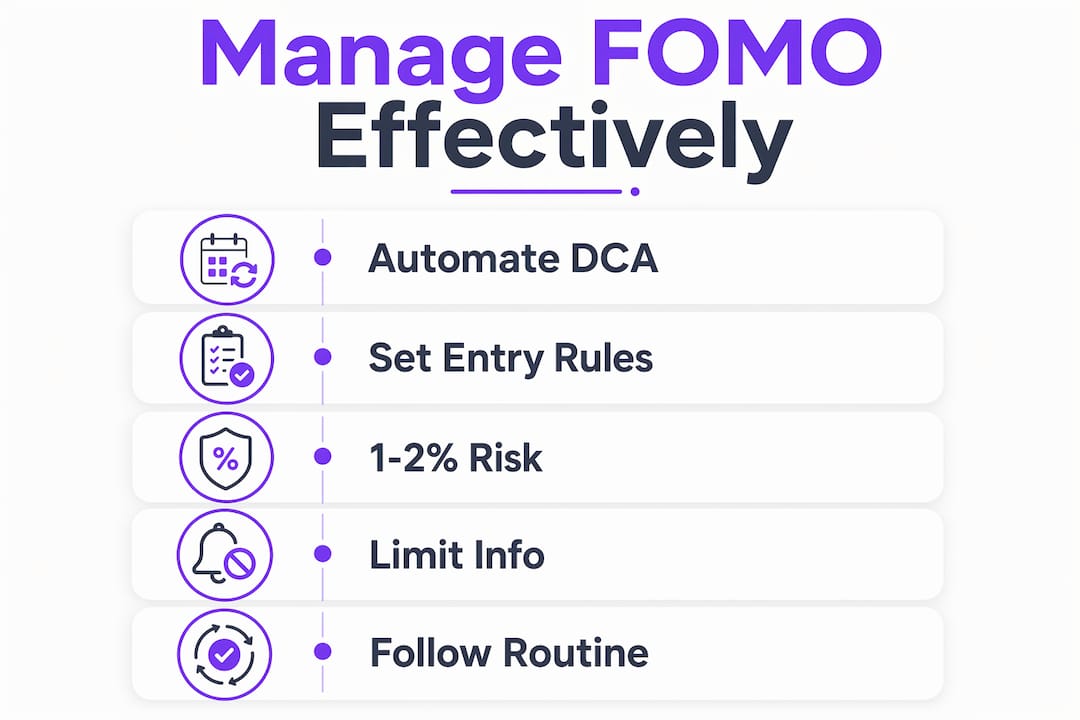
| Strategy | Core benefit | How to implement |
|---|---|---|
| Dollar-cost averaging | Removes timing pressure entirely | Set fixed weekly buys regardless of price action |
| 1–2% risk cap per trade | Reduces emotional stakes per decision | Calculate position size before every entry |
| Pre-committed entry criteria | Separates strategy from hype | Write entry rules before markets open |
| Social media limits | Reduces finfluencer-driven impulses | Restrict crypto content to 2 curated sources |
| Mandatory cool-off period | Eliminates urgency-driven entries | Wait 24 hours before any unplanned trade |
| Trade journaling | Surfaces emotional patterns over time | Log emotion, rationale, and outcome for every trade |
Pro Tip: Curate your information sources down to two or three credible outlets. Every additional finfluencer you follow is a statistical increase in your FOMO exposure.
How to build a daily routine that protects against FOMO cycles
The impact of FOMO on trading compounds over time when traders have no structural routine to interrupt the cycle. The solution is not to consume more market analysis. It is to reduce the number of discretionary decision points in your trading day.
Removing discretionary decision points through automation significantly reduces emotional hijacking during FOMO moments. Automated DCA, pre-set allocation caps, and standing stop-loss orders mean fewer live decisions under pressure. Each live decision under pressure is an opportunity for FOMO to override your plan.
Tracking emotion-labeled trades and implementing daily trading caps helps prevent behavior spirals including revenge trading and overtrading triggered by FOMO cycles. Labeling each trade with the emotional state at entry (calm, anxious, excited, fearful) creates a data set that reveals your personal FOMO triggers within weeks.
The following daily habits form a practical defense against FOMO traps:
- Set a fixed time window for market review, such as 30 minutes each morning, and close all charts outside that window
- Turn off price alerts for assets you are not actively managing
- Log every trade with an emotion tag before the session ends
- Set a daily loss limit and stop trading the moment it is reached
- Review your written entry criteria before opening any new position
- Schedule one weekly review of your trade journal to identify emotional patterns
- Prioritize seven to eight hours of sleep, since poor sleep increases impulsivity and risk-taking in measurable ways
The goal of this routine is not perfection. It is to make impulsive decisions structurally harder to execute than planned ones.
Key takeaways
FOMO in crypto trading is a behavioral pattern driven by cognitive biases and social media pressure, and it is best controlled through systematic frameworks rather than willpower alone.
| Point | Details |
|---|---|
| FOMO causes late entries | Most retail buyers enter after peaks, with BIS data showing 73–81% of Bitcoin buyers lost money. |
| Cognitive biases amplify the problem | Loss aversion, herd mentality, and confirmation bias work together to override rational analysis. |
| Finfluencers increase trading frequency | 64.2% of retail investors support regulating finfluencers due to their role in amplifying impulsive behavior. |
| Systems beat willpower | Automated DCA, 1–2% risk caps, and pre-committed entry rules remove the conditions for impulsive decisions. |
| Journaling reveals your patterns | Emotion-labeled trade logs expose personal FOMO triggers and create the data needed to correct them. |
Why emotional discipline is the real edge in crypto markets
I have watched traders with genuinely strong technical analysis skills consistently underperform traders with average analysis but tight process discipline. The difference is almost never information. It is the ability to not act when the market is screaming at you to act.
The uncomfortable truth about FOMO strategies in crypto is that most traders already know what they should do. They know not to chase pumps. They know to size positions conservatively. They know social media is not a trading signal. The gap is not knowledge. It is execution under emotional pressure.
What I have found actually works is removing the decision itself. When your DCA is automated, you cannot FOMO into a position because the position is already being built systematically. When your entry criteria are written down before the market opens, the question is not "should I buy this?" but "does this meet my criteria?" That shift from open-ended judgment to binary checklist is where most of the emotional work gets done.
Trade journaling is the other piece that most traders skip because it feels administrative. It is not. It is the only way to see your own behavioral patterns with enough clarity to change them. After 30 labeled trades, you will know exactly which conditions trigger your worst decisions. That self-knowledge is worth more than any indicator.
The psychology of crypto trading rewards the trader who is least reactive, not the one who processes the most information. Build the systems that make you structurally less reactive, and the results follow.
— Tony
How Disciplineaiapp helps you trade with discipline, not emotion
If you recognize your own patterns in this article, the next step is building the infrastructure to change them, not just the intention.
Disciplineaiapp is built specifically for this problem. Unlike conventional trading tools that focus on signals and price alerts, Disciplineaiapp combines AI analytics with behavioral coaching to identify emotional patterns like FOMO and revenge trading in your actual trade history. The platform's automated trade auditing reviews your decisions against your stated criteria, surfacing the gap between your plan and your execution. The AI-driven features include market replay training, emotion pattern detection, and trade review processes that turn your journal into a structured feedback loop. If discipline is the edge, Disciplineaiapp is the tool that builds it.
FAQ
What is FOMO in crypto trading?
FOMO in crypto trading is the fear of missing out on profitable price moves, which drives impulsive, late-entry buying decisions based on social pressure rather than analysis. The formal behavioral finance term is herding bias, and it is one of the most documented causes of retail trading losses.
How does FOMO differ from FUD in crypto?
FOMO drives impulsive buying at price peaks out of fear of missing gains, while FUD (fear, uncertainty, and doubt) drives panic selling at price lows out of fear of further losses. Both are emotional responses that override rational strategy, but they operate at opposite ends of the market cycle.
What percentage of crypto traders lose money due to FOMO?
BIS research across 95 countries found that 73–81% of retail Bitcoin buyers lost money, with most entering positions approximately two months after price peaks. This timing gap is the statistical signature of FOMO-driven behavior.
What is the most effective way to manage FOMO in trading?
The most effective approach combines automated dollar-cost averaging, pre-committed entry criteria, and a 1–2% risk cap per trade. These three systems remove the live decision points where FOMO has the most influence over trader behavior.
Does social media make FOMO worse for crypto traders?
Yes. A 2026 survey found 64.2% of retail investors support regulating finfluencers because of their documented role in amplifying cognitive biases and trading frequency. Limiting crypto content to two or three credible sources is one of the highest-leverage steps a trader can take to reduce crypto trading anxiety.