
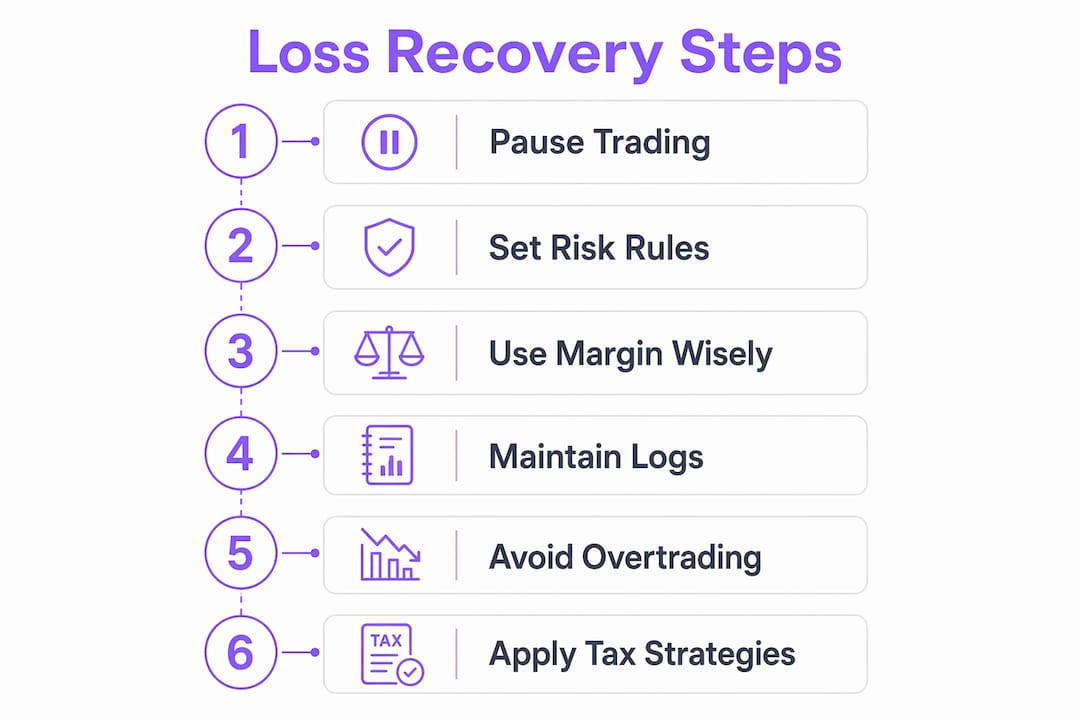
Recovering from crypto trading losses is defined as the disciplined process of rebuilding capital and decision-making quality after a drawdown, not simply waiting for prices to recover. Most traders fail at this because they treat recovery as a market problem when it is actually a behavioral one. The real work happens in how you size your next trade, manage your psychology, and use tools like tax-loss harvesting and stop-loss rules to prevent one bad trade from becoming a catastrophic streak. This guide covers the exact steps to rebuild after crypto losses, from the first 24 hours post-loss through sustainable capital recovery.
How to recover from crypto trading losses: the first reset
The single most important action after a significant loss is to stop trading immediately. Manufactured urgency within 24 hours of a loss degrades decision quality and leads to oversized, reactive trades. That urgency feels real, but it is a psychological response, not a market signal.
Waiting at least 24 hours before placing your next trade is the minimum standard for serious recovery. During that window, your job is not to analyze charts. Your job is to remove yourself from the screen entirely. Set a timer, go for a walk, or do anything that breaks the feedback loop between the loss and your next click.
When you do return, set your position size before you open a chart. Revenge trading leads to larger-than-intended positions and compounds losses faster than any market move can. The fix is a predefined rule: your first trade back uses half your normal risk size, no exceptions.
- Wait a minimum of 24 hours before re-entering any position
- Set your risk size in writing before opening your trading platform
- Use a physical timer or app to enforce the walk-away period
- Review your last trade log before placing any new order
- Identify whether the loss came from strategy failure or execution failure
Pro Tip: Decide your risk percentage for new trades when you are not watching charts and not emotionally triggered. Rules made in calm moments hold. Rules made while staring at a red candle are rationalizations.
Understanding why traders revenge trade after losses is the first step toward breaking the cycle before it starts.
What risk management rules protect capital during recovery?
The 1–2% per trade risk rule is the foundation of professional crypto risk management. Reducing that figure to 0.5% during a drawdown slows further damage and gives your account the breathing room to survive long enough to recover. Smaller risk per trade feels frustrating when you want to make back losses fast. That frustration is exactly the signal to hold the rule tighter.

The math of loss recovery is asymmetric and most traders never fully grasp it. A 50% loss requires a 100% gain to break even. A 75% loss requires a 300% gain. Chasing recovery with larger positions does not accelerate the timeline. It makes the required gain exponentially larger.
Isolated margin vs. cross margin during recovery
Your margin type choice directly controls how much damage a single bad trade can do.
| Margin type | Risk exposure | Recovery suitability |
|---|---|---|
| Isolated margin | Capped to allocated margin per position | Preferred during drawdown periods |
| Cross margin | Entire account balance as collateral | High cascade liquidation risk |
Isolated margin caps your loss to the amount you allocate to one position. Cross margin treats your whole account as collateral, which means one liquidation can trigger a cascade that wipes your remaining balance. During recovery, isolated margin is the only rational choice.
Fixed stop-loss orders placed at technical invalidation points, not emotional ones, are non-negotiable. Removing stop-loss orders after a losing trade is one of the most common causes of catastrophic loss. Stops should only move to breakeven after a trade has proven out in your direction, never removed to give a losing position more room.
Pro Tip: Use limit orders for exits instead of market stops during high-volatility periods. Price wicks can trigger market stops at terrible fills. A limit order gives you price control even in fast-moving conditions.
How do you rebuild trading capital step by step?
Rebuilding capital after a loss requires a structured approach, not urgency. Dollar-cost averaging combined with staged accumulation reduces emotional pressure and enforces discipline during recovery phases. Attempting to time the exact bottom is statistically unlikely. DCA removes that pressure by spreading entries over time.
Sunk-cost compulsion is the hidden enemy of capital rebuilding. Oversized, high-urgency trades driven by the need to "get back to even" statistically worsen outcomes rather than improve them. Recognizing this pattern in your own behavior is more valuable than any technical setup.
- Calculate your current account balance and set a realistic recovery target based on actual math, not emotion
- Reduce position size to 0.5% risk per trade until you have completed five consecutive profitable trades
- Apply DCA entries on spot holdings across three to five scheduled buy points rather than one lump entry
- Add opportunistic buys near documented technical support levels only when your edge is verified
- Scale position size back toward 1% only after your trade log shows consistent execution, not just wins
- Review your trade log weekly and document every deviation from your rules, not just your P&L
Maintaining a consistent trade log is not optional during recovery. What you do after a loss matters more than the loss itself. The log is the evidence base that tells you whether your recovery is built on discipline or luck.
Avoiding overtrading crypto markets is especially critical during rebuilding phases, when the temptation to force trades is highest.
How does tax-loss harvesting help with crypto loss recovery?
Tax-loss harvesting is the practice of selling a losing crypto position to realize the loss on paper, then using that loss to offset capital gains or reduce taxable income. Crypto is classified as property by the IRS, which means the wash-sale rule does not apply as of april 2026. Traders can realize losses and repurchase the same cryptocurrency immediately without disallowance, maintaining market exposure while capturing the tax benefit.
The annual limit for offsetting ordinary income is $3,000. Losses beyond that amount carry forward to future tax years. This is not a minor detail. For a trader who has taken a significant drawdown, harvesting losses can meaningfully reduce the tax bill on profitable trades elsewhere in the portfolio.
- Identify positions with unrealized losses that exceed your cost basis
- Sell the position to realize the loss before the tax year closes
- Use a limit order to repurchase at or near the same price to maintain exposure
- Document the sale date, cost basis, and repurchase price for your tax records
- Coordinate harvesting with your accountant if gains from other assets are significant
- Avoid harvesting losses that would trigger short-term capital gains on repurchase if timing is unfavorable
Tax-loss harvesting coordinated with limit orders lets you maintain your economic position in an asset while locking in the tax benefit. Tools like CoinTracking help automate the cost basis tracking required to execute this correctly.
Common mistakes that derail crypto loss recovery
The most destructive mistake traders make during recovery is increasing position size after a loss to recover faster. This is the sunk-cost fallacy in action. It feels logical. It is statistically catastrophic given the asymmetric math of loss recovery.
Removing stops, revenge trading, and escalating size are the three behaviors that turn a recoverable drawdown into an account wipeout. Stopping revenge trading requires more than willpower. It requires structural rules that make the bad behavior harder to execute than the good behavior.
Setting a daily loss limit is the most practical structural rule available. When you hit that limit, your trading session ends. No exceptions, no overrides. Technology can enforce this more reliably than self-discipline alone, especially in the hours after a loss when decision quality is lowest.
Pro Tip: Set a behavioral trigger before each session: "If I lose X amount today, I close the platform and do not return until tomorrow." Write it down before you open your first chart. The act of writing it makes the rule real before the emotional pressure arrives.
Adjusting your strategy based on documented trading behavior, not just outcomes, is what separates traders who recover from those who repeat the same cycle. If your log shows three consecutive revenge trades, the problem is behavioral, not analytical.
Key Takeaways
Recovering from crypto trading losses requires disciplined risk rules, behavioral controls, and structured capital rebuilding, not faster or larger trades.
| Point | Details |
|---|---|
| Pause before re-entering | Wait at least 24 hours post-loss to prevent reactive, oversized trades. |
| Reduce risk size immediately | Drop to 0.5% risk per trade during drawdown to slow further damage. |
| Use isolated margin only | Isolated margin caps single-position losses and prevents cascade liquidations. |
| Apply DCA for rebuilding | Spread entries over multiple buy points rather than timing one bottom. |
| Harvest tax losses strategically | Realize losses to offset gains or up to $3,000 of ordinary income with no wash-sale restriction. |
What recovery actually looks like from the inside
The hardest part of recovering from a significant crypto loss is not the math. The math is straightforward once you accept it. The hard part is sitting with the discomfort of trading smaller when every instinct is screaming at you to make it back fast.
I have watched traders with genuinely good strategies blow their accounts not because their analysis was wrong, but because they abandoned their rules in the two weeks after a loss. The loss itself was survivable. The response to the loss was not. That pattern repeats across experience levels and account sizes.
The traders who actually recover share one trait: they treat the post-loss period as a separate phase with its own rules, not a continuation of normal trading. They cut size, document everything, and refuse to let urgency drive decisions. They also use tools that hold them accountable when their own discipline wavers.
AI-assisted behavioral analysis, like what Disciplineaiapp provides, changes the recovery dynamic because it removes the self-reporting bias. You cannot lie to a system that audits every trade. That accountability is worth more than any signal or indicator during a drawdown.
The uncomfortable truth is that most traders who fail to recover do so by choice, not circumstance. They choose urgency over process. The process is available to anyone willing to follow it.
— Tony
Disciplineaiapp: built for the recovery phase
Recovering capital is only half the work. The other half is changing the behaviors that caused the loss in the first place.

Disciplineaiapp combines AI analytics with behavioral coaching to identify patterns like revenge trading and FOMO directly in your trade history. The platform's automated trade auditing flags emotional decision points you would likely miss in a manual review. The Market Replay feature lets you replay past market conditions and practice disciplined execution without real capital at risk. For traders in recovery, the full features suite provides the structural accountability that makes post-loss rules stick. Discipline built through repetition and feedback outlasts discipline built through willpower alone.
FAQ
How long does it take to recover from crypto trading losses?
Recovery time depends on the size of the drawdown and the consistency of your risk rules. A trader following a 0.5–1% risk per trade rule during recovery rebuilds capital far more predictably than one chasing larger positions.
What is the wash-sale rule for crypto in 2026?
The wash-sale rule does not apply to cryptocurrency as of april 2026. Traders can sell a losing crypto position and repurchase it immediately without losing the tax deduction on the realized loss.
How do I stop revenge trading after a loss?
Set a written daily loss limit before each session and close your platform when you hit it. Structural rules enforced by technology are more reliable than willpower alone after a loss.
Is dollar-cost averaging effective for recovering crypto capital?
DCA is effective for rebuilding a cost basis on spot holdings because it removes the need to time a single bottom entry. Spreading buys across multiple price points reduces emotional pressure and lowers average entry cost over time.
What margin type should I use during crypto loss recovery?
Isolated margin is the correct choice during recovery. It caps your loss to the amount allocated to one position and prevents a single liquidation from triggering a cascade that wipes your remaining balance.