
Revenge trading is defined as placing impulsive trades driven by the urgency to recover a recent loss rather than following a valid setup or strategic plan. Unlike a calculated re-entry, revenge trading is motivated by emotion, specifically frustration, anger, and loss aversion, not market logic. The behavior appears across stocks, forex, and crypto markets, and it sits at the intersection of behavioral economics and trading psychology. Traders who understand the mechanics behind it gain a measurable edge over those who rely on willpower alone to stay disciplined.
What is revenge trading and why does it destroy accounts?
Revenge trading, also called "tilt" in poker and behavioral finance circles, is the act of abandoning your trading plan to chase a loss. The core revenge trading definition centers on motivation: the trade is not placed because the setup is valid, but because the trader feels compelled to "fix" the financial pain of a prior loss. That distinction separates it from every other type of trading error.
The consequences compound fast. A trader who loses $500 on a EUR/USD position and immediately doubles down on the next trade without analysis is no longer trading. They are gambling with a brokerage account. The effects of revenge trading include accelerated drawdowns, broken risk rules, and a psychological feedback loop that makes each subsequent loss harder to process rationally.

What makes this pattern particularly destructive is its self-reinforcing nature. Each revenge trade that fails increases the emotional pressure to recover, which increases the likelihood of another revenge trade. Behavioral economists call this "tilt escalation," and it is one of the most documented paths to account liquidation in retail trading.
What behaviors and patterns signal revenge trading?
Recognizing the signs of revenge trading in real time is harder than it sounds, because the trades often feel justified in the moment. The setup looks plausible, the logic feels sound, but the underlying motivation is recovery, not opportunity.
The most common behavioral signals include:
- Immediate re-entry after a loss. Entering a new trade within minutes of closing a losing one, with no analysis period in between.
- Position size escalation. Increasing position size impulsively after a loss to recover faster, which is the defining feature of tilt escalation.
- Stop-loss removal. Widening or deleting stop-loss orders to give a losing trade "room to breathe," which eliminates the primary risk control.
- Trade frequency spikes. Placing three to five trades in rapid succession after a single loss, each one slightly larger than the last.
- Rule abandonment. Ignoring pre-defined entry criteria, risk-to-reward ratios, or daily loss limits because the emotional urgency overrides the plan.
These behaviors are measurable. Traders who review their journals with a focus on time between loss and re-entry, size changes, and trade frequency can identify revenge trading episodes even when the setups appeared valid at the time.
Pro Tip: Tag every trade in your journal with the time elapsed since your last loss and the position size relative to your average. A pattern of sub-15-minute re-entries at above-average size is a statistical fingerprint of revenge trading, regardless of how logical the trade felt.
Why does revenge trading happen? The psychology behind it
The psychological and neurological explanation for revenge trading is more specific than "emotions got in the way." Loss aversion is the foundational mechanism: humans feel the pain of a loss roughly twice as intensely as the pleasure of an equivalent gain. This asymmetry creates an urgent, almost physical need to neutralize the loss as quickly as possible.
When a trader takes a significant loss, cortisol spikes in the brain. Cortisol impairs the prefrontal cortex, which governs rational planning and impulse control, while simultaneously activating the amygdala, the brain's threat-detection center. The result is a neurological state that prioritizes speed and action over analysis and patience. The trader is not being irrational by choice. Their brain has entered a threat-response mode that makes deliberate, plan-based decisions genuinely harder to execute.
"Losses trigger a threat response that prioritizes urgency over the trading plan, making simple discipline advice often ineffective." — FXStreet
This is why telling a trader to "just follow your rules" after a loss rarely works. The advice is correct, but it is delivered to a brain that has temporarily lost access to the cognitive resources needed to follow it. Behavioral neuroscience research on value synthesis and decision-making confirms that loss states distort how traders weigh attributes of a trade, causing them to overweight the potential for recovery and underweight the actual probability of success.
The practical implication is significant. Emotional control in trading is not a character trait. It is a state-dependent capacity that degrades under stress. Strategies that work with this biological reality, rather than against it, produce better outcomes than those that demand pure willpower.
How to identify and measure revenge trading in your own practice
Detecting revenge trading requires treating your trade journal as a behavioral data set, not just a performance log. The goal is to find statistical patterns that reveal emotional decision-making even when individual trades looked reasonable.
Here is a four-step process to flag revenge trades empirically:
- Log time between loss and re-entry. Record the exact timestamp of every loss and every subsequent entry. Entries within 15 minutes of a loss at larger-than-normal size are the most reliable statistical indicator of a revenge trade.
- Track position size relative to your baseline. Calculate your average position size over the prior 20 trades. Any trade placed at more than 1.5 times that average immediately after a loss warrants a review.
- Note your emotional state before entry. Use a simple 1-to-5 scale for frustration and urgency before each trade. Trades placed at a 4 or 5 on either scale deserve extra scrutiny.
- Review win rates by emotional state. Compare your win rate on trades placed within 15 minutes of a loss versus trades placed after a 30-minute cooldown. The gap will be instructive.
The data from this kind of analysis can be striking. In one documented case, a 30-minute cooldown eliminated 93% of revenge trades. Those trades had a 22% win rate and were costing the trader $4,200 per month. The cooldown did not require better analysis. It required a pause.
| Metric | What it reveals |
|---|---|
| Time between loss and re-entry | Re-entries under 15 minutes signal emotional urgency, not opportunity |
| Position size vs. baseline | Sizes above 1.5x average post-loss indicate tilt escalation |
| Emotional state score | Scores of 4-5 on frustration correlate with lower win rates |
| Win rate by cooldown period | Trades after 30-minute breaks consistently outperform immediate re-entries |
Effective strategies to stop revenge trading and maintain discipline
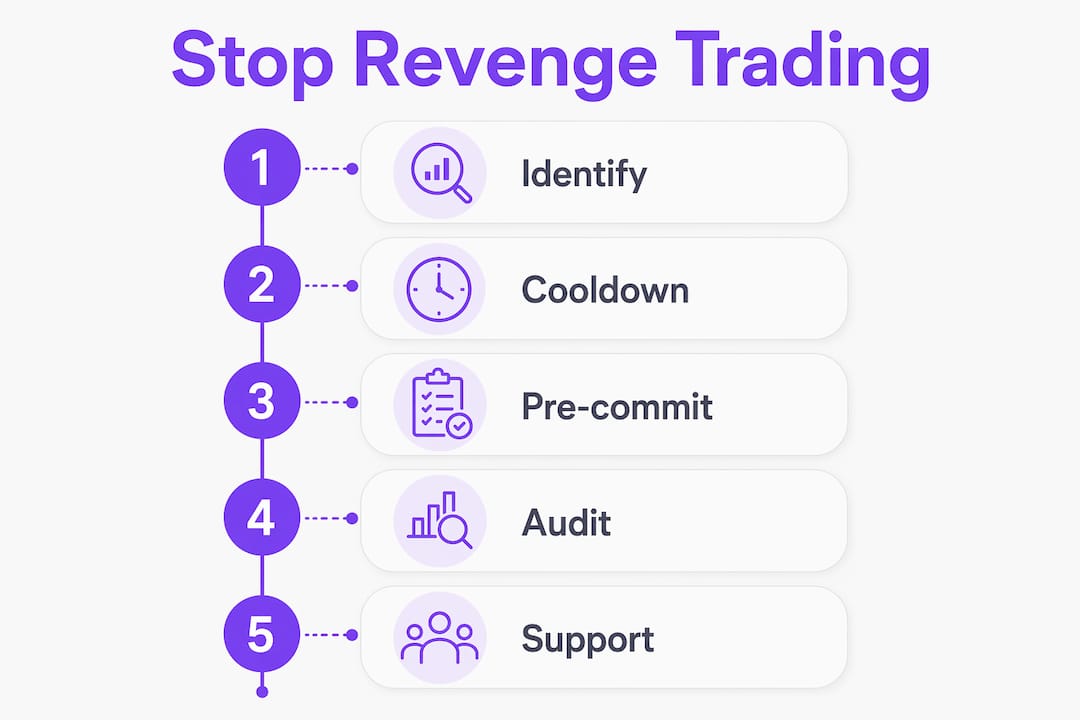
Stopping the common forex revenge trading cycle requires more than awareness. It requires pre-committed behavioral structures that activate before the emotional state takes hold.
The most effective approaches include:
- Circuit-breaker breaks. Stop trading for a minimum of 30 minutes after any loss that exceeds your predefined threshold. This is not optional recovery time. It is a mandatory emotional regulation tool that gives the prefrontal cortex time to regain function.
- Hard daily loss limits. Set a maximum daily loss in your platform before the trading session begins. When the limit is hit, the session ends. No exceptions.
- Trigger documentation. After any revenge trading episode, document the triggers before resuming trading. Identifying the specific loss size, time of day, or market condition that triggered the behavior reduces recurrence.
- Pre-trade self-check questions. Before entering any trade after a loss, answer three questions in writing: What is the setup? What is my risk? Am I entering because the market is right or because I want to recover?
- AI-assisted behavioral tracking. Tools that analyze trading patterns automatically can flag revenge trade signatures in real time, removing the burden of self-detection from a compromised emotional state.
Pro Tip: Pre-commitment beats willpower every time. Set your daily loss limit and cooldown rules in writing before the market opens, when your prefrontal cortex is fully functional. Decisions made in a calm state are far more reliable than decisions made mid-drawdown.
The comparison between manual discipline and technology-supported tools is not close. Mechanical guardrails consistently outperform willpower-based approaches because they operate independently of the trader's emotional state. A platform restriction that prevents trading for 30 minutes after a loss does not care how urgent the recovery feels.
The uncomfortable truth about stopping revenge trading
Most traders approach revenge trading as a knowledge problem. They read about it, recognize it in hindsight, and assume that awareness will prevent it next time. It does not. I have seen traders with years of experience and detailed journals still blow through daily loss limits within minutes of a bad trade, because they treated discipline as a decision they would make in the moment rather than a structure they built in advance.
The real shift happens when you stop treating emotional control as a skill you perform under pressure and start treating it as an architecture you design when you are calm. Pre-commitment devices, cooldown rules, and behavioral tracking tools are not crutches. They are the actual strategy. Willpower is the crutch.
The traders I have seen make lasting progress on FOMO and revenge trading share one habit: they review their behavioral data as rigorously as their technical setups. They know their revenge trade fingerprint, the specific loss size, time of day, and market condition that triggers it, and they have a rule in place for exactly that scenario. That specificity is what separates behavioral improvement from behavioral intention.
Revenge trading is a solvable problem. But it is solved with structure, not resolve.
— Tony
How Disciplineaiapp helps you break the revenge trading cycle
Disciplineaiapp is built specifically for the gap between knowing what to do and actually doing it under pressure.
The platform's automated trade auditing identifies revenge trade signatures in your history, flagging entries that match the time, size, and frequency patterns associated with emotional decision-making. The behavioral coaching features enforce cooldown periods, track your emotional state across sessions, and surface patterns you would not catch manually. Market replay training lets you practice discipline in simulated high-pressure scenarios before real capital is at risk. If you are serious about stopping the revenge trading cycle, Disciplineaiapp gives you the behavioral infrastructure to do it.
FAQ
What is the revenge trading definition in simple terms?
Revenge trading is placing an impulsive trade to recover a recent loss rather than following a valid setup. The motivation is emotional recovery, not market opportunity.
What causes revenge trading in forex?
Revenge trading in forex is caused by loss aversion and the cortisol-driven threat response that follows a loss. This neurological state impairs rational planning and creates urgent pressure to act, overriding the trading plan.
How do I identify revenge trades in my journal?
Flag any trade entered within 15 minutes of a loss at a position size above your 20-trade average. A 30-minute cooldown has been shown to eliminate the vast majority of revenge trades in documented cases.
Can AI tools help stop revenge trading?
Yes. AI-powered platforms like Disciplineaiapp detect behavioral patterns such as rapid re-entry and size escalation automatically, providing real-time alerts and enforcing cooldown rules without relying on the trader's willpower.
What is the fastest way to stop revenge trading?
The fastest intervention is a hard circuit-breaker: stop trading for 30 minutes after any loss that exceeds your threshold. Pair this with a pre-session daily loss limit set before the market opens, when your decision-making is unimpaired.
Key takeaways
Revenge trading is a behavioral pattern driven by neuroscience, not weakness, and it requires structural interventions, not willpower, to stop.
| Point | Details |
|---|---|
| Core definition | Revenge trading is impulsive loss-recovery trading, not a technical error but a motivational one. |
| Neurological cause | Cortisol spikes after losses impair the prefrontal cortex, making plan-based decisions genuinely harder to execute. |
| Detection method | Flag trades entered within 15 minutes of a loss at above-average size as statistical revenge trade signatures. |
| Most effective intervention | A 30-minute circuit-breaker cooldown eliminated 93% of revenge trades in one documented case. |
| Long-term solution | Pre-committed rules and AI-assisted behavioral tracking outperform willpower-based discipline consistently. |