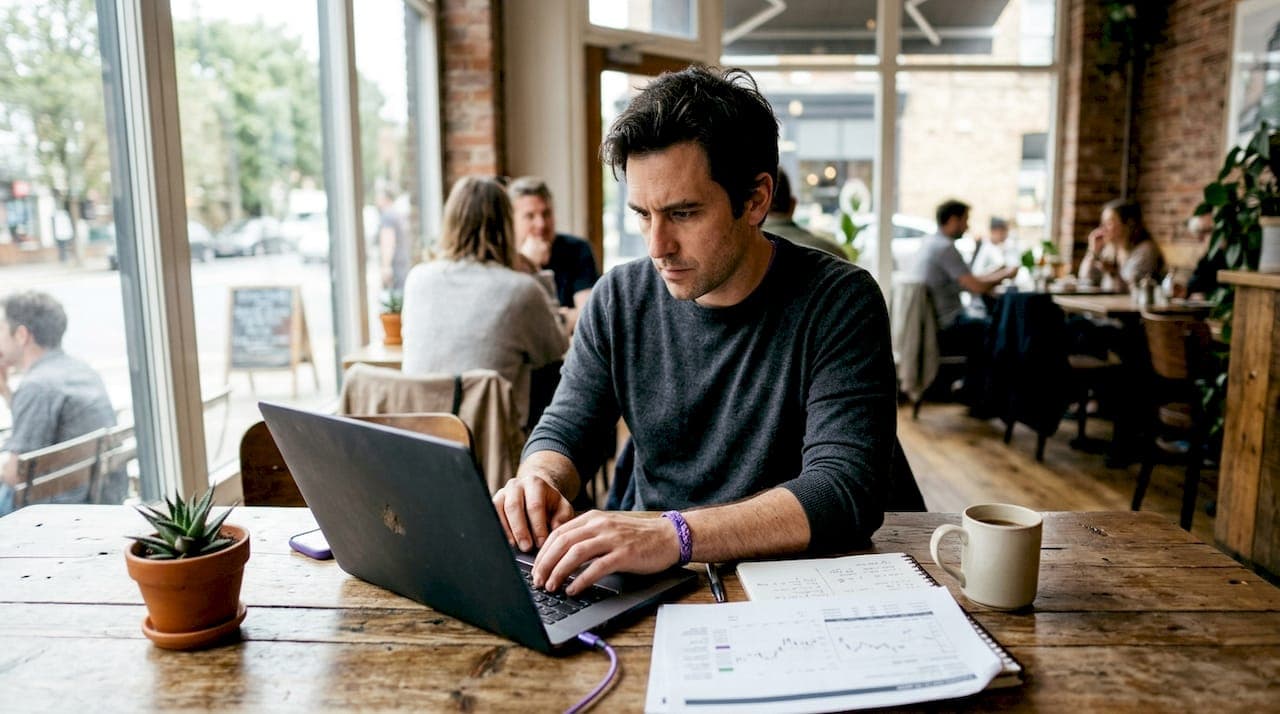
Trade replay analysis is the practice of replaying historical market data or your own executed trades bar-by-bar or tick-by-tick to evaluate decisions without any knowledge of future price action. Unlike reviewing a static chart after the fact, replay forces you to make decisions in real time against past market conditions. Tools like TradingView's Bar Replay and TradeZella have made this practice accessible to forex, crypto, and stock traders at every level. The result is a training method that builds genuine discretionary skill, not just theoretical understanding.
What is trade replay analysis and how does it work?
Trade replay analysis is defined as the interactive simulation of past market sessions where future price bars remain hidden until you advance the replay. You relive a historical trading session as if it were happening live. The key distinction is that you cannot see what comes next, which eliminates hindsight bias from the review process.
Two formats exist within this practice. Market replay, also called bar replay, reconstructs historical price action one bar at a time. Trade replay goes further by plotting your actual executed trades, with real fills, directly onto the replayed chart. Both formats serve the same core goal: replacing result-based hindsight with process-based hindsight.

The shift from result hindsight to process hindsight is what makes replay genuinely educational. When you review a finished chart, your brain already knows the outcome and rationalizes every decision. Replay removes that shortcut. You see only what you would have seen in the moment, which forces honest self-assessment.
How does trade replay differ from backtesting and paper trading?
These three trade analysis techniques are frequently confused, but they serve different purposes and belong at different stages of your development.
Backtesting runs a defined set of rules automatically across historical data and produces statistical output: win rate, drawdown, expectancy. It validates whether a rules-based strategy has an edge. The process is automated and requires no real-time decision-making from you.
Paper trading simulates live or delayed market conditions using virtual funds. You place orders in real time, but no real money changes hands. It tests your ability to execute in current market conditions, not past ones.
Trade replay sits between the two. It is manual and interactive, with no future data visible, making it the best tool for discretionary decision training. You practice reading price action, timing entries, and managing trades exactly as you would live, but in a controlled environment.
The recommended workflow for serious traders follows this sequence:
- Backtest first to confirm a strategy has a statistical edge before investing practice time.
- Replay second to build the discretionary skill needed to execute that strategy under pressure.
- Paper trade third to stress-test execution in live market conditions with no financial risk.
- Go live last once both the strategy and the execution are proven.
Pro Tip: Never skip the replay stage just because backtesting showed positive results. A strategy with a proven edge still fails when execution is poor, and replay is where execution gets trained.
What are the main types and features of trade replay software?
Trade replay software falls into two categories based on what it replays: market data or your personal trade history.
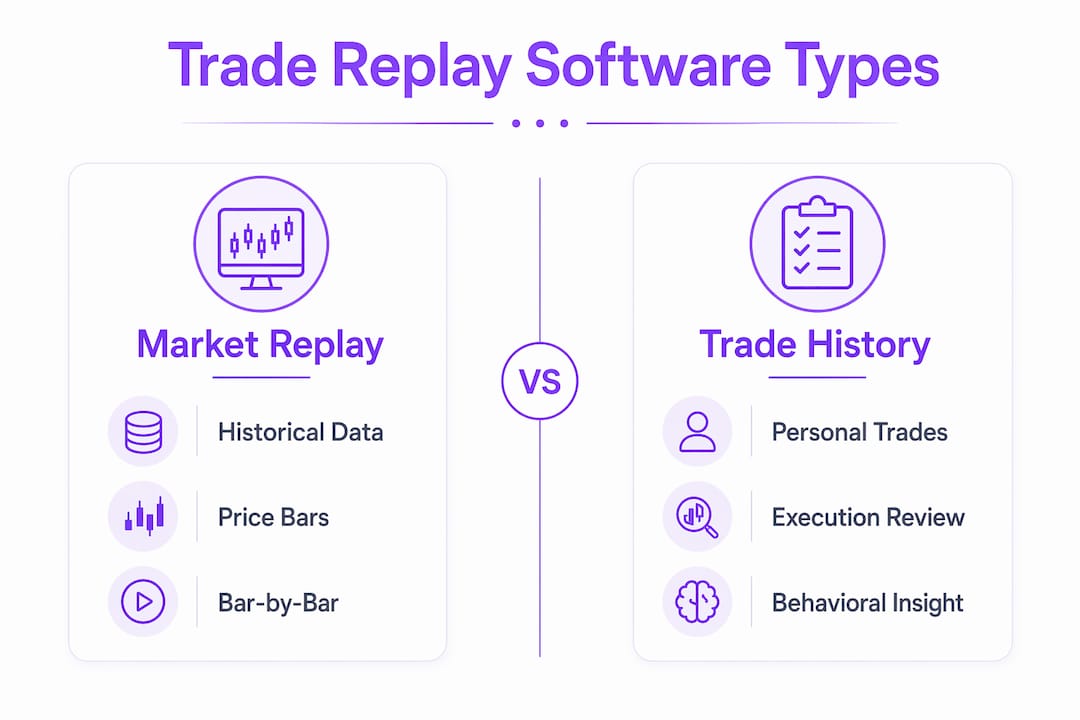
Market replay tools, such as TradingView's Bar Replay, start from a selected historical point and advance price action step by step. You can pause, annotate the chart, apply indicators, and adjust replay speed. The platform synchronizes replay across multiple chart timeframes simultaneously, which matters for traders who use multi-timeframe analysis.
Trade replay tools, like those found in TradeZella, go one step further. They plot your actual fills, entries, exits, and stop levels directly onto the replayed chart. This lets you see not just what the market did, but exactly where you got in and out relative to price action as it unfolded.
Key features to look for in any trade replay software:
- Configurable replay speed so you can slow down fast-moving sessions or accelerate quieter ones.
- Custom start points so you can target specific sessions, setups, or dates.
- Indicator integration so your standard analysis tools remain active during replay.
- Chart annotation tools so you can mark decisions and observations in real time.
- Multi-timeframe synchronization so higher-timeframe context stays visible.
The risk-free practice environment that replay creates is its most underrated benefit. You can practice 50–100 historical sessions without risking a single dollar, building pattern recognition and timing that transfers directly to live trading.
Why does replay interval granularity matter so much?
Replay interval granularity defines how much time each step of the replay covers. A one-second interval advances the chart one second per step. A five-minute interval jumps five minutes per step. The choice has a direct impact on what you learn and what you miss.
Too coarse an interval causes traders to miss the exact moment a setup invalidates. If your replay jumps five minutes at a time on a one-minute chart, you will skip the candle that broke your key level and triggered your stop. You then draw the wrong conclusion about why the trade failed.
Proper interval selection is not optional. It is the difference between learning the right lesson and reinforcing a bad habit. TradingView's Bar Replay allows intervals ranging from one second on second-based charts up to one day on daily charts.
Practical guidelines by trading style:
- Scalpers and day traders should replay at one-second to one-minute intervals to capture micro-timing and order flow nuances.
- Swing traders can use five-minute to one-hour intervals without losing meaningful context.
- Position traders reviewing daily setups can replay at the daily interval without distortion.
Pro Tip: Match your replay interval to the chart timeframe you actually trade. Replaying a five-minute setup at a one-hour interval is like watching a film at 10x speed. You see the plot but miss everything that matters.
How does data depth affect the realism of trade replay?
Data quality determines whether the lessons you learn from replay transfer to live trading. Not all replay platforms use the same data layers, and the difference is significant.
Three data layers exist in market microstructure:
- L1 data (top of book) shows the best bid and ask price at any moment. Most retail replay platforms use only this layer.
- L2 data (full order book depth) shows all resting orders at every price level. This is what serious order-flow traders need to reconstruct true market conditions.
- Time and sales tape records every actual transaction, including size and direction. It allows reconstruction of real trade prints as they occurred.
"Most replay platforms approximate fills simplistically. Serious order-flow traders require full L2 order book data and detailed fill probability modeling to analyze execution quality properly." — NexusFi Academy
Fill simulation is where most platforms fall short. The naive approach assumes that if price touched your limit level, you got filled. Real markets do not work that way. Queue position, order size, and liquidity all affect whether your order fills at the intended price. Execution quality analysis requires high-fidelity data to produce reliable conclusions.
For forex and crypto traders, L1 data is often sufficient because those markets are highly liquid and fills at limit prices are generally reliable. For futures traders, especially those trading thin instruments, L2 data and queue modeling are necessary for meaningful replay results.
How to use trade replay analysis to improve your trading
The most common mistake traders make with replay is treating it like passive review. Effective replay is active practice. You make decisions in real time, record your reasoning, and then evaluate the outcome after each session.
A structured approach produces the best results:
- Select specific sessions with purpose. Choose sessions that contained setups you are actively working on, not random historical dates.
- Commit to decisions before advancing the replay. Write down your entry, stop, and target before you see the next bar. This eliminates the temptation to adjust based on what you sense is coming.
- Use your actual indicators and drawing tools. Replay without your standard setup teaches you nothing about how you trade in real conditions.
- Debrief after each session. Note what you saw correctly, what you missed, and what you would change. This is where trading behavior analysis turns raw replay into lasting improvement.
- Combine replay with backtesting and paper trading. Replay alone builds skill. The full three-stage workflow builds confidence.
Common pitfalls that undermine replay practice:
- Running replay too fast to make genuine real-time decisions.
- Skipping sessions that resulted in losses instead of studying them closely.
- Ignoring execution nuances like slippage and spread, which matter in live trading.
- Treating replay as a one-time exercise rather than a regular part of your stock trading discipline routine.
Replay is more effective than backtesting for discretionary traders because it trains live-like decision-making, not just strategy validation. The goal is not to find out whether your strategy works. The goal is to train yourself to execute it correctly under pressure.
Key Takeaways
Trade replay analysis is the most direct training method for discretionary traders because it removes hindsight bias and forces real-time decisions against historical market conditions.
| Point | Details |
|---|---|
| Core definition | Trade replay replays historical price action bar-by-bar with future data hidden to eliminate hindsight bias. |
| Replay vs. backtesting | Backtesting validates rules-based strategies; replay trains the discretionary execution that backtesting cannot measure. |
| Interval granularity | Match replay interval to your trading timeframe or you will miss setup invalidations and learn the wrong lessons. |
| Data depth matters | L1 data suits most retail traders; futures and order-flow traders need L2 data for realistic fill simulation. |
| Structured practice | Commit to decisions before advancing each bar, debrief after every session, and combine replay with paper trading. |
Why replay changed how I think about trading practice
Most traders treat trade review as a results audit. They look at a finished chart, see where price went, and judge whether their entry was good or bad. That process is almost useless because the brain reverse-engineers logic from outcomes. You will always find a reason why the trade "should have worked" or "obviously failed."
Replay breaks that pattern completely. When you cannot see the next bar, you are forced to confront what you actually knew at the moment of decision. That is a fundamentally different experience. I have watched traders replay sessions they were convinced they managed well, only to realize they were reacting to noise rather than reading structure. The replay does not lie.
The gap between knowing a strategy and executing it consistently is almost entirely psychological. Replay is the only training method that puts you inside that gap and forces you to work through it. Backtesting tells you whether an edge exists. Replay tells you whether you can actually use it.
The next frontier is AI integration. Platforms that combine replay with behavioral pattern detection, like identifying revenge trading sequences or FOMO entries across replayed sessions, will give traders something they have never had before: objective feedback on their decision process, not just their results. That combination of AI-driven pattern detection and replay training is where the real performance gains will come from.
— Tony
Disciplineaiapp brings replay and behavioral coaching together
Disciplineaiapp is built for traders who know their strategy but struggle to execute it consistently. The platform combines market replay training with AI-powered trade auditing that identifies behavioral patterns like revenge trading and FOMO across your actual trade history.
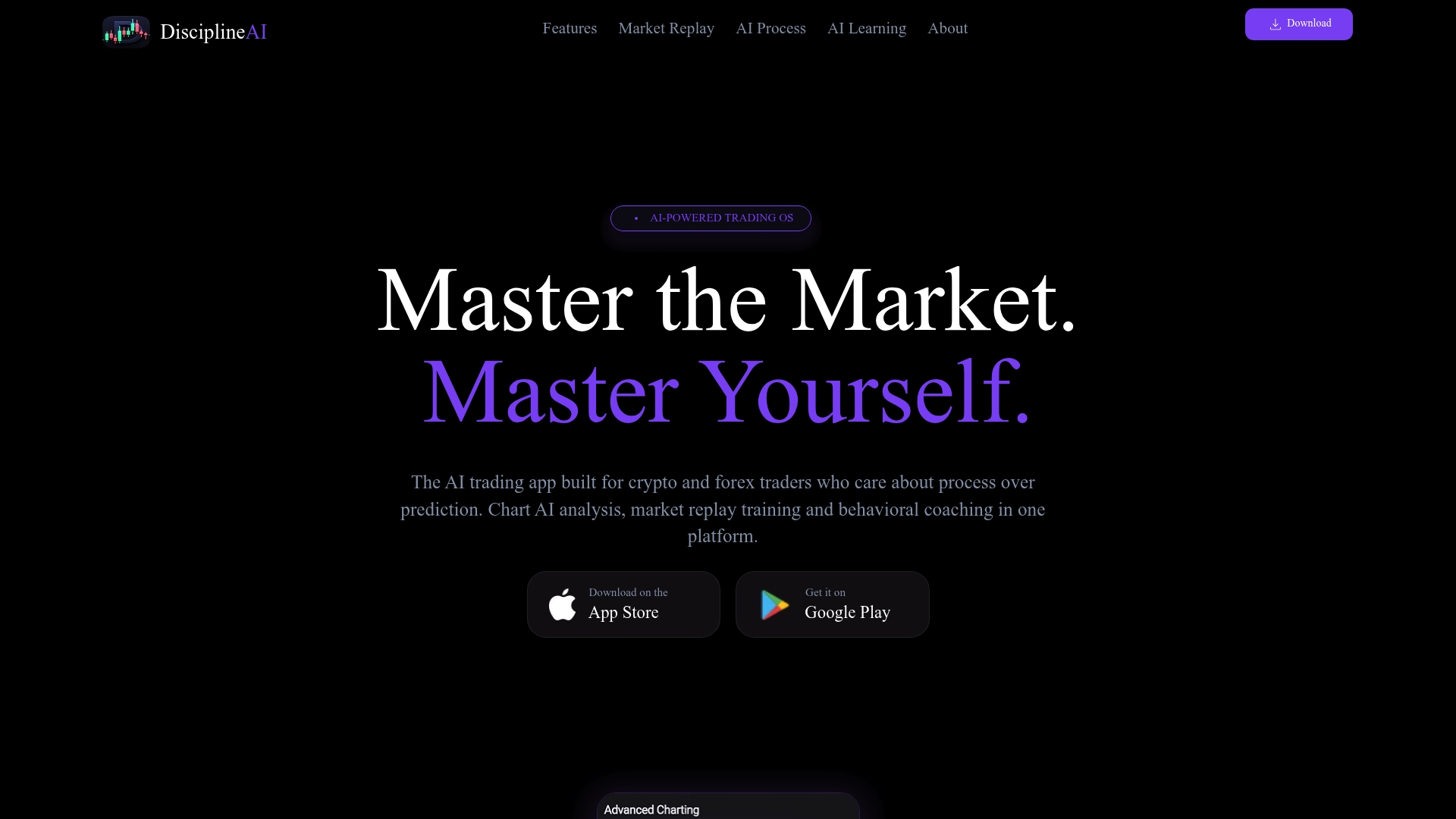
Where most replay tools stop at showing you what happened, Disciplineaiapp connects execution patterns to emotional triggers and gives you a structured path to correct them. The full feature set includes automated trade auditing, market replay, and behavioral coaching built into a single workflow. For forex, crypto, and stock traders serious about closing the gap between knowledge and execution, Disciplineaiapp is the logical next step after understanding what trade replay analysis is.
FAQ
What is trade replay analysis in simple terms?
Trade replay analysis is the practice of replaying past market sessions bar-by-bar with future price hidden, so you can evaluate your trading decisions without knowing the outcome in advance.
How is trade replay different from backtesting?
Backtesting runs rules automatically over historical data to produce statistics. Trade replay is manual and interactive, training the discretionary judgment that automated backtesting cannot measure.
What trade replay software do most traders use?
TradingView's Bar Replay is the most widely used tool for market replay. TradeZella offers trade replay that plots your actual executed fills onto the replayed chart for deeper performance evaluation.
Why does replay interval granularity matter?
A replay interval that is too coarse causes you to skip the exact moment a setup fails, leading to false conclusions about your trades. Match the interval to the timeframe you actually trade.
Can trade replay analysis help with emotional trading habits?
Replay builds the pattern recognition and timing that reduce impulsive decisions. When combined with behavioral analysis tools, it helps traders identify and correct emotional patterns like revenge trading and FOMO before they cost real money.