
A trading accountability system is a structured framework that enforces consistent rule adherence through mechanical, social, and procedural mechanisms rather than willpower alone. Most traders know their rules. The real problem is following them when markets move fast and emotions run high. Between 85% and 95% of funded traders lose their accounts primarily due to behavioral drift under pressure, not from a lack of strategy knowledge. That statistic reveals a discipline gap no amount of journaling alone can close. A true accountability system fills that gap by making rule-breaking structurally difficult, not just emotionally uncomfortable.
What is a trading accountability system and how does it work?
A trading accountability system is a governance framework, not a performance log. The distinction matters because most traders confuse journaling with accountability. A journal records what happened. A governance system monitors whether you are approaching a rule breach before it occurs and creates friction that stops you from crossing the line.
The system operates on three layers. Internal accountability includes self-review, journaling, and pre-trade checklists. External accountability introduces social visibility through partners, communities, or coaches. Mechanical enforcement uses broker-level tools and automated rules that physically prevent certain actions. Each layer addresses a different failure mode.

Willpower is a finite resource that depletes under stress. When a trade moves against you and adrenaline spikes, the mental commitment you made at 8:00 AM carries far less weight than it did before the session opened. Accountability systems are designed for that exact moment. They replace the internal struggle with external structure.
Pro Tip: Design your accountability system for your worst trading day, not your best. The rules you need most are the ones you are most likely to break when you are losing.
How do the main accountability structures differ?
Traders build accountability through four recognized structures, and each serves a distinct function.
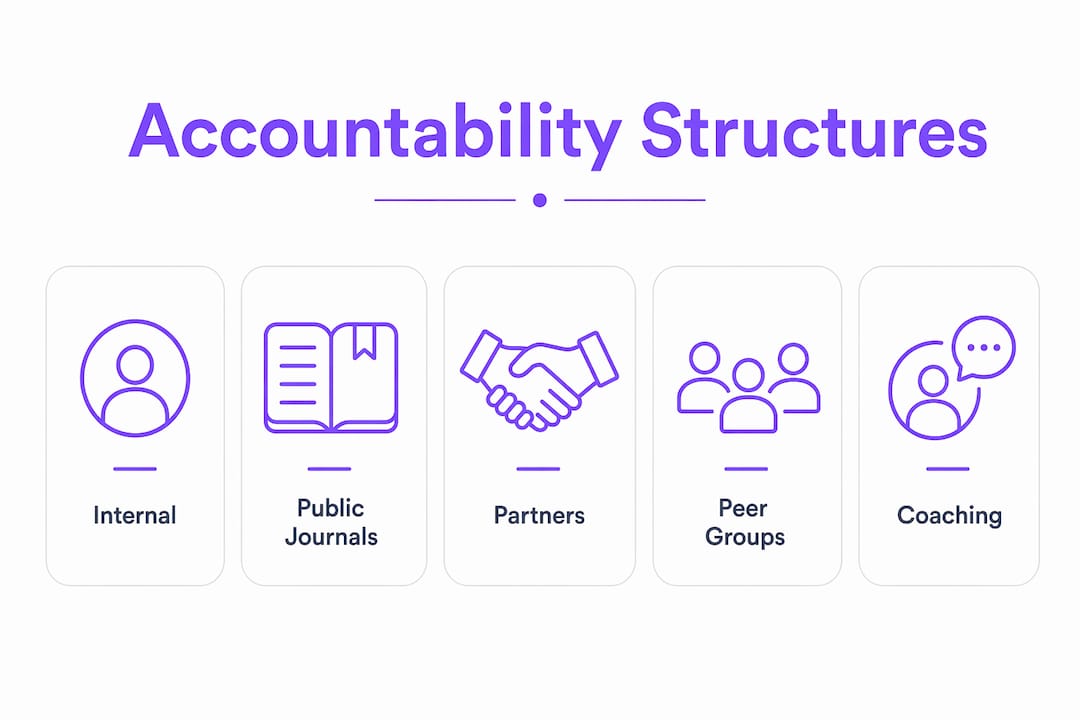
Public trading journals create social visibility. When you post your trades publicly, the cost of breaking your rules extends beyond your own conscience. Other traders can see your decisions, your rationale, and your results. That visibility alone changes behavior. The limitation is that self-reporting can drift toward selective honesty over time.
Accountability partners create bidirectional commitment. You and one other trader agree to review each other's sessions, flag rule violations, and hold weekly check-ins. The relationship works because both parties have skin in the game. If you skip the review, your partner notices. The weakness is that partners with similar blind spots may reinforce each other's bad habits.
Peer trading groups and pods add diversity to the feedback loop. A group of five to ten traders brings different strategies, risk tolerances, and emotional patterns to the table. Social accountability structures like trading communities provide multiple layers of visibility, social norms, support, and honest feedback that a single partner cannot replicate. The tradeoff is that group dynamics can soften criticism when cohesion becomes more important than honesty.
Professional coaching targets specific behavioral patterns with focused intervention. A coach who specializes in behavioral coaching in trading identifies the exact triggers behind revenge trading, FOMO entries, and position-sizing violations. Coaching is the most expensive layer, but it produces the fastest behavioral change for traders with deeply ingrained patterns.
Research from Dr. Gail Matthews shows that participants with written goals and weekly accountability reports complete their goals at 76%, compared to 43% for those without external accountability. That 33-percentage-point gap translates directly to trading: traders with structured external accountability follow their rules at a measurably higher rate than those relying on internal resolve.
Layering these structures compounds the effect. A trader who keeps a public journal, meets weekly with a partner, and participates in a peer group builds redundancy into their discipline. When one layer fails, the others hold.
What role does mechanical enforcement play in accountability?
Mechanical enforcement is the most reliable layer of any accountability system because it removes the decision entirely. Discipline is a system property created by pre-committed rules and enforcement mechanisms, not a character trait you summon on demand. Broker-level tools make this concrete.
The most critical rules to enforce mechanically are what practitioners call Tier 1 survival rules:
- Daily loss limits: A hard stop that closes all positions and locks trading when a set dollar threshold is hit.
- Maximum position size: A cap that prevents oversizing during high-conviction moments that often precede the largest losses.
- OCO (One Cancels the Other) orders: Automated stop-loss and take-profit pairs that execute without manual intervention.
- Drawdown circuit breakers: Platform-level rules that pause trading after a defined sequence of losing trades.
The data on mechanical enforcement is stark. Broker-enforced daily loss limits reduce override rates by a factor of 5–10 compared to mental commitments. Only about 3% of traders break broker-enforced limits, versus 72% who violate willpower-bound rules. That difference is not about character. It is about system design.
Soft guardrails, like a sticky note on your monitor saying "stop at $500 loss," carry almost no enforcement weight under stress. Hard guardrails, like a broker setting that physically prevents new orders after a daily loss threshold, carry full enforcement weight regardless of your emotional state. Broker-level enforcement provides higher override friction than platform-side limits because it requires manual intervention to bypass, which slows impulsive decisions during emotional drawdowns.
A common mistake is applying mechanical enforcement only to entry rules while leaving exit decisions to willpower. Exits are where most traders lose the most money. Automating stop-losses and profit targets for every trade removes the temptation to "let it run" or "just wait for a recovery."
How do traders build accountability into their daily routine?
Embedding accountability into daily practice requires structure at three points: before the session, during the session, and after the session.
-
Pre-session checklist: Write down your rules for the day before markets open. Include your maximum daily loss, the setups you will trade, and the conditions that would cause you to stop trading. Sign it. The physical act of committing creates a reference point you can return to mid-session.
-
Public journal entry: Post your plan before the session opens. Include your rationale for each potential trade. Public posting creates accountability before a single order is placed, not just after results are known.
-
Broker-level limits: Set your daily loss limit in your broker platform every morning. Do not rely on memory or discipline to honor it. If your broker does not support automated limits, use a trading system that enforces rules at the execution layer.
-
Mid-session check-in: At a defined time, pause and review your current P&L against your daily limit. If you are within 20% of your loss limit, reduce position size for the remainder of the session. This is a habit-based rule, not a mechanical one, but it builds the review reflex.
-
Post-session review with your partner or group: Share your session results, flag any rule violations, and identify the trigger behind each breach. Reviewing trading behavior analysis data from your sessions accelerates pattern recognition and shortens the feedback loop between a mistake and a correction.
Pro Tip: Schedule your accountability partner check-in at the same time every day. Consistency in the meeting time reduces the temptation to skip it on bad trading days, which are exactly the days you need it most.
The goal is to design your trading environment so that following your rules is the path of least resistance. Accountability shifts discipline from an internal struggle into a social and structural environment where rule-breaking carries visible consequences. That shift is the entire point of the system.
Key Takeaways
A trading accountability system works because it replaces willpower with structure, making rule adherence the default rather than the exception.
| Point | Details |
|---|---|
| Governance over journaling | Real accountability monitors rule proximity in real-time, not just results after the fact. |
| Mechanical enforcement wins | Broker-enforced limits reduce rule violations by a factor of 5–10 compared to mental commitments. |
| Layer your structures | Combining public journals, partners, peer groups, and coaching compounds behavioral improvement. |
| Design for stress | Build your system around your worst trading day, when willpower is lowest and rules matter most. |
| Pre-session commitment | A written, public pre-session plan creates accountability before a single trade is placed. |
Why I think most traders are solving the wrong problem
Traders spend years refining their edge and almost no time designing their accountability system. I have watched traders with genuinely profitable strategies blow their accounts repeatedly because they treated discipline as a personal failing rather than a system design problem.
The uncomfortable truth is that breaking rules consistently signals a system design flaw, not a knowledge gap. You do not need more motivation. You need more friction between your emotional impulse and your next order. The traders who improve fastest are not the ones with the most willpower. They are the ones who build the most honest external feedback loops and the hardest mechanical guardrails.
What I have found most counterintuitive is that social accountability works faster than most traders expect. Posting a losing trade publicly and explaining the rule you broke is genuinely uncomfortable. That discomfort is the mechanism. It is not punishment. It is the cost that makes the rule real. Traders who embrace that discomfort early stop needing it as often. The habit forms because the social consequence was real enough to matter.
The traders I respect most are not the ones who never break rules. They are the ones who built systems that catch them when they do, correct the behavior quickly, and make the same mistake less likely next time. That is what trading discipline best practices actually look like in practice. Not perfection. Structured recovery.
— Tony
How Disciplineaiapp supports your accountability system
Disciplineaiapp is built specifically for traders who understand that discipline is a system problem, not a willpower problem.

The platform combines AI-powered trade auditing with behavioral coaching to identify emotional patterns like revenge trading and FOMO directly from your trade data. Every session is reviewed automatically, flagging rule violations and surfacing the behavioral triggers behind them. The market replay feature lets you revisit past sessions in real time, so you can study exactly where your discipline broke down and practice better responses. Disciplineaiapp functions as the mechanical and analytical layer of your accountability system, giving you the real-time compliance data that journaling alone cannot provide. Traders who want a structured, data-driven accountability framework can explore Disciplineaiapp and see how it fits their process.
FAQ
What is a trading accountability system?
A trading accountability system is a structured framework of mechanical, social, and procedural rules that enforce consistent trading discipline. It replaces reliance on willpower with external enforcement and social visibility.
Why does willpower fail traders under pressure?
Willpower is a finite resource that depletes under stress. When markets move against a position, emotional pressure overrides mental commitments, which is why mechanical and social enforcement structures outperform internal resolve.
What is the difference between a trading journal and an accountability system?
A trading journal records results after the fact. A true accountability system monitors rule proximity in real time and creates friction before a breach occurs, not just documentation after a loss.
How effective are broker-enforced trading limits?
Broker-enforced daily loss limits reduce override rates by a factor of 5–10 compared to mental commitments. Approximately 3% of traders break broker-enforced limits, versus 72% who violate willpower-bound rules.
How do I start building a trading accountability system?
Start with one mechanical rule enforced at the broker level, such as a daily loss limit. Add a public journal for pre-session planning. Then find one accountability partner for weekly post-session reviews. Layer additional structures as each habit solidifies.