
A break of structure is defined as the moment price closes a candle body beyond a prior significant swing high in an uptrend, or beyond a prior swing low in a downtrend, confirming trend continuation. This concept sits at the core of Smart Money Concepts (SMC) and institutional price action analysis. Understanding it separates traders who react to noise from those who read market intent. A valid BOS requires a full candle body close beyond the swing level, not just a wick pierce. The closely related concept of Change of Character (CHoCH) signals the opposite: a potential trend reversal rather than continuation.
What is a valid break of structure?
A valid break of structure has one non-negotiable rule: the candle body must close beyond the protected swing point, not just poke through it. Experienced traders follow the principle that "wicks are traps, closes are facts." A wick that pierces a swing high and then retreats is a liquidity sweep, not a structural break. The market is grabbing stop losses sitting above that level, not committing to a new directional move.
Three criteria define a genuine BOS:
- Candle body close: The full body of the candle must close beyond the prior swing high (uptrend) or swing low (downtrend).
- Protected swing point: The level broken must be the most recent swing point created by the prior confirmed BOS, not any random minor high or low.
- Displacement or momentum: A genuine BOS includes displacement, meaning a strong, fast-moving candle that shows institutional commitment. Slow grinding price moves through a level often fail.
Why does the body close matter so much? Because wicks represent temporary excursions into liquidity pools. Market makers and institutional players frequently push price above a swing high to trigger stop orders, then reverse. If you enter on the wick, you get caught in that reversal. Waiting for the body close filters out the majority of those traps.
Pro Tip: Set your chart to show candle closes in real time. Never mark a BOS until the candle has fully closed. An open candle that looks like a break can reverse completely in the final seconds before close.

Waiting for a body close reduces false signals significantly, though it does not guarantee continuation. BOS is a confirmation tool, not a crystal ball. The close tells you what happened; it does not promise what comes next.
How does break of structure differ from CHoCH?
BOS and CHoCH (Change of Character) are the two structural events that define trend behavior, and confusing them is one of the most expensive mistakes a trader can make. BOS confirms trend continuation while CHoCH signals a counter-trend break and a potential reversal.
The table below shows the core differences:
| Feature | BOS | CHoCH |
|---|---|---|
| Direction | With the existing trend | Against the existing trend |
| Signal type | Trend continuation | Possible trend reversal |
| Swing point broken | Same-direction protected swing | Opposite-direction protected swing |
| Trader action | Look for continuation entries | Watch for new trend forming |
| Sequence | Follows prior BOS in trend | Often precedes a new BOS in new direction |
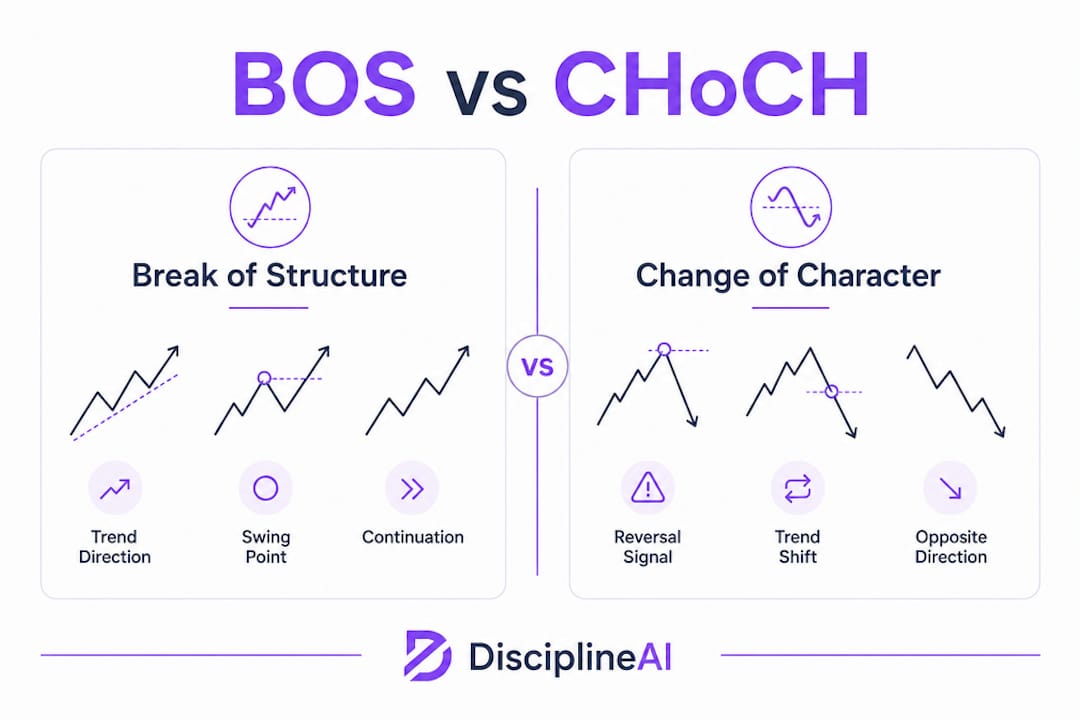
In a bullish trend, each BOS breaks the most recent higher high, confirming buyers remain in control. A CHoCH occurs when price instead breaks the most recent higher low, the first sign that sellers are stepping in. That CHoCH does not confirm a new downtrend on its own. It signals character has changed. A subsequent BOS to the downside then confirms the reversal is real.
The sequence matters: CHoCH first, then BOS in the new direction. Traders who skip the CHoCH and jump into reversal trades early often get stopped out before the new trend confirms. The CHoCH is the warning; the BOS is the confirmation.
Terminology also varies across educators and trading communities. Some analysts call CHoCH a "market structure shift" (MSS). Others use "structure break" to describe both events. The underlying logic stays the same regardless of the label: one event continues the trend, the other challenges it.
What role does timeframe play in reading structure breaks?
Timeframe is the most underestimated variable in structure break trading. A BOS on a 1-minute chart means almost nothing if the 4-hour chart is in a strong opposing trend. Higher timeframe BOS signals carry more weight because they represent larger pools of capital and broader market consensus.
The fractal nature of markets means structure exists at every timeframe simultaneously. A daily chart uptrend contains dozens of lower timeframe downtrends within it. Each of those lower timeframe moves will produce its own BOS and CHoCH signals, most of which are noise relative to the daily direction.
Pro Tip: Build your analysis top-down. Establish directional bias on the daily or 4-hour chart first. Then drop to the 1-hour or 15-minute chart to find BOS signals that align with that bias. Never trade a lower timeframe BOS that runs against your higher timeframe trend.
Market structure experts advise treating higher timeframes for directional context and lower timeframes purely for entry timing. This approach keeps you on the right side of the dominant move while still allowing precise entries. A BOS on the 15-minute chart in the direction of a 4-hour uptrend is a high-quality signal. The same 15-minute BOS against that 4-hour trend is a low-quality, high-risk trade.
Lower timeframes also produce more frequent BOS signals, which creates a different problem: overtrading. Structure labeling is subjective, and lower timeframe breaks often represent noise rather than genuine directional commitment. Range-bound markets generate constant BOS and CHoCH signals that lead nowhere. The fix is simple: require confluence from higher timeframes before acting on any lower timeframe structure break.
How should traders apply BOS signals in real decisions?
BOS is a confirmation tool, not a standalone entry signal. BOS confirms trend continuation but is descriptive, not predictive. That distinction shapes how you build a trading process around it.
A practical BOS-based trading process works like this:
- Identify the higher timeframe trend. Use the daily or 4-hour chart to determine whether price is making higher highs and higher lows (uptrend) or lower highs and lower lows (downtrend). This is your directional bias.
- Mark protected swing points. Identify the most recent swing high and swing low created by the last confirmed BOS. These are the only levels that qualify for the next valid structure break.
- Wait for a candle body close. Do not act on wicks. Do not act on open candles. Wait for the full body close beyond the protected swing point.
- Confirm with confluence. Combine the BOS with supporting factors: a liquidity grab before the move, a fair value gap (FVG) in the direction of the break, an order block as a potential entry zone, or a higher timeframe level aligning with the break.
- Define your invalidation point. Set your stop loss beyond the swing point that would invalidate the BOS. If price returns below the broken swing high in an uptrend, the structure break has failed.
- Avoid internal structure breaks. Mislabeling internal swings as valid BOS signals causes false-positive trades. Only the protected swing point created by the prior confirmed BOS qualifies. Minor highs and lows within a swing do not count.
- Manage position size relative to the setup quality. A BOS with strong displacement, higher timeframe alignment, and liquidity confluence justifies a larger position than a BOS with weak momentum and no supporting factors.
The traders who use BOS most effectively treat it as one vote in a broader analysis, not the final word. When BOS aligns with order block support, a liquidity sweep below a prior low, and a fair value gap above, the probability of follow-through increases meaningfully. When BOS stands alone on a lower timeframe with no supporting context, it is a low-confidence signal worth skipping. AI-powered pattern detection can help traders identify these confluence factors across multiple timeframes faster than manual scanning.
Key Takeaways
A break of structure confirms trend continuation only when a candle body closes beyond a protected swing point with displacement, higher timeframe alignment, and clear invalidation criteria in place.
| Point | Details |
|---|---|
| Body close is mandatory | Only a full candle body close beyond the swing level counts as a valid BOS. |
| BOS vs CHoCH direction | BOS continues the trend; CHoCH breaks against it and signals a possible reversal. |
| Timeframe hierarchy matters | Use higher timeframes for directional bias and lower timeframes only for entry timing. |
| Confluence improves reliability | Combine BOS with liquidity grabs, order blocks, and fair value gaps for stronger signals. |
| BOS is descriptive, not predictive | It confirms what happened, not what will happen; always define your invalidation point. |
Why most traders misread structure breaks
The biggest mistake I see traders make with BOS is treating every swing high or low as a protected level. They mark every minor pivot on a 5-minute chart and call every close beyond it a structure break. The result is a chart covered in labels and a trading account full of losses from false signals.
The rule that changed my perspective: only the swing point created by the prior confirmed BOS qualifies as a protected level. Everything else is internal structure, and internal breaks are noise. Once I applied that filter, the number of valid signals dropped sharply. But the quality of those signals improved just as sharply.
The other issue is psychological. When you have been watching a level for hours and price finally closes beyond it, the urge to enter immediately is intense. That urgency is exactly what gets traders into bad trades. The close is the signal. The entry comes after you check confluence, not before. Trading psychology research consistently shows that impulsive entries on structural events are one of the leading causes of avoidable losses.
BOS analysis also rewards journaling. Reviewing your labeled structure breaks after the fact, comparing what you called a BOS to what price actually did, builds the pattern recognition that no article can fully teach. The traders who improve fastest are the ones who review their structure calls with the same discipline they apply to their entries.
— Tony
How Disciplineaiapp supports structure-based trading
Applying BOS analysis consistently across multiple assets and timeframes is where most traders lose discipline. Disciplineaiapp is built for exactly that challenge.

The platform's market structure analysis engine scans for structural events, liquidity conditions, and trend states across multiple crypto assets and timeframes simultaneously. Traders receive AI-generated trade setups with confidence scores that factor in BOS confirmation, higher timeframe alignment, and confluence conditions. The built-in trade journal and AI trade autopsies let you review every structure-based decision with objective performance data. Disciplineaiapp's AI learning resources also help traders build deeper fluency in market structure concepts, from BOS identification to full SMC frameworks.
FAQ
What is a break of structure in trading?
A break of structure occurs when a candle body closes beyond the most recent protected swing high in an uptrend or swing low in a downtrend, confirming trend continuation. Wick-only breaks do not qualify.
What is the difference between BOS and CHoCH?
BOS signals trend continuation by breaking a same-direction swing point. CHoCH signals a potential reversal by breaking the opposite-direction protected swing, and it typically precedes a new BOS in the new trend direction.
Why do wicks not count as a valid structure break?
Wicks represent temporary liquidity grabs where price hunts stop orders before reversing. Only a full candle body close beyond the level confirms genuine directional commitment from the market.
How does timeframe affect BOS reliability?
Higher timeframe BOS signals carry more weight because they reflect broader market participation. Lower timeframe breaks frequently appear as noise within the dominant higher timeframe trend and produce more false signals.
Can BOS be used as a standalone trading signal?
BOS is a confirmation tool, not a standalone entry trigger. Combining it with liquidity events, order blocks, fair value gaps, and higher timeframe bias produces significantly stronger trade setups than using BOS alone.