
A crypto trading routine is the process of organizing your daily trading activities into structured phases that sharpen decision-making, control risk, and reduce emotional reactions. Without a routine, you trade on impulse. With one, you trade on rules. The difference shows up directly in your results. This guide breaks down how to create a crypto trading routine using 2026 industry standards, covering pre-session preparation, execution discipline, and post-session review. It also explains how to establish a crypto trading plan that works as a living document, not a one-time setup.
What are the essential components of a crypto trading routine?
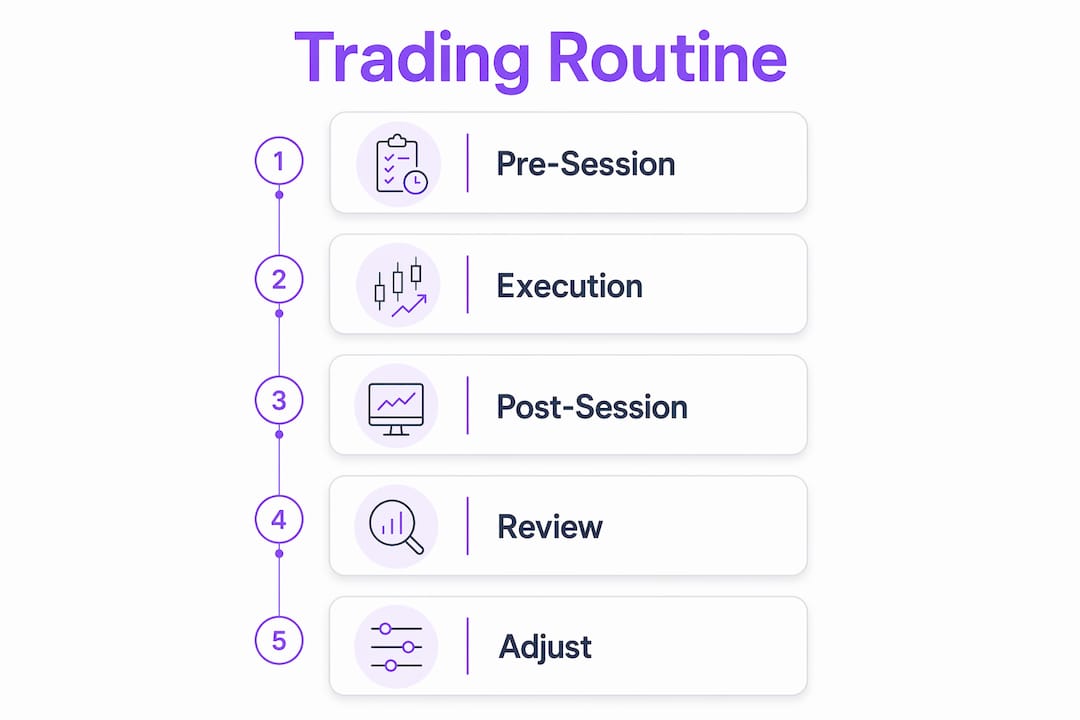
A sustainable trading routine divides into three phases: pre-session preparation, execution, and post-session review, with a total daily time commitment of 30–90 minutes. That range covers everything from a focused 30-minute session for swing traders to a full 90-minute process for active day traders. The structure keeps you systematic rather than reactive.
Pre-session preparation (15–20 minutes)
Pre-session preparation is your market overview. You check the macro environment, scan Bitcoin and Ethereum trends, review key support and resistance levels, and read any scheduled news events. This phase also includes an honest emotional readiness check. If you are stressed, sleep-deprived, or distracted, that assessment belongs here, not after you have already placed a trade.
Execution phase (20–30 minutes)
The execution phase is where you follow your entry and exit rules without improvising. You do not analyze new setups during this phase. You act only on setups identified during pre-session. Separating analysis from execution lowers cognitive load and reduces the emotional interference that causes impulsive decisions. Think of analysis as your planning meeting and execution as the meeting where you only implement what was already decided.

Post-session review (10–20 minutes)
Post-session review is where growth happens. Spend 5–10 minutes recording each trade, then 5–10 minutes debriefing on what worked and what did not. Note your emotional state during each trade. Patterns emerge over weeks, and those patterns tell you more about your edge than any indicator.
Pro Tip: Set a hard rule that you will not open a new chart during your execution window. All chart analysis must happen before the session starts. This one boundary eliminates a large share of impulsive entries.
A daily crypto trading checklist for this routine looks like this:
- Check macro news and scheduled economic events
- Review Bitcoin and Ethereum trend direction
- Mark key chart levels on your watchlist
- Assess your emotional state and decide whether to trade
- Execute only pre-identified setups during your scheduled session window
- Record every trade immediately after closing it
- Debrief on execution quality, not just profit or loss
How do you build a crypto trading plan within your routine?
A trading plan is the written rulebook your routine enforces. A concise, one-to-two page plan covers six core areas: your edge, instrument selection, entry and exit rules, risk management, session rules, and a review cycle. Keeping it short forces clarity. A ten-page plan rarely gets read before a trade.
Risk management is the most critical section. The industry standard is risking 1–2% of your account per trade. That means on a $10,000 account, you risk $100–$200 per position. If your total drawdown reaches 10–15%, your plan should trigger a trading halt or a mandatory review period. These are not suggestions. They are pre-set rules you follow before emotions get involved.
Hard stop-loss orders placed directly in the exchange are non-negotiable. A mental stop-loss is not a stop-loss. It is a wish. When price moves against you, the mental note disappears and the loss grows. Exchange-placed stops remove that decision from your hands entirely.
Maintain a minimum risk-to-reward ratio of 1:2 on every trade. For every $1 you risk, your target must return at least $2. This ratio means you can be wrong on half your trades and still be profitable over time. Without it, even a high win rate can produce a net loss.
Pro Tip: Review your trading plan at the end of every month. Pull your journal data, identify which rules you broke and why, and update the plan to reflect what you actually learned. A plan that never changes is a plan that never improves.
Session rules deserve their own section in your plan. News blackout windows are periods where you do not trade regardless of what the chart shows. Major announcements, Federal Reserve decisions, and surprise regulatory news all create conditions where technical setups fail unpredictably. Skipping those windows is not weakness. It is risk management.
| Plan component | Key requirement |
|---|---|
| Edge definition | Describe the specific market condition your strategy exploits |
| Instrument selection | List the coins or pairs you trade and why |
| Entry and exit rules | Define exact conditions, not vague signals |
| Risk management | 1–2% risk per trade, hard stop-loss in exchange |
| Session rules | Scheduled hours, news blackout windows |
| Review cycle | Monthly journal review and plan update |
What tools and checklists support a consistent trading routine?
The right tools reduce the friction between knowing your rules and following them. A pre-market checklist is the most practical tool you can build. It takes less than five minutes to run through and prevents the most common execution errors.
A solid pre-market checklist covers:
- Major news or macro events scheduled for the day
- Bitcoin trend direction on the daily and four-hour chart
- Ethereum trend confirmation or divergence
- Key support and resistance levels on your watchlist
- Your maximum trade count for the session
- Your emotional state score (a simple 1–10 self-rating works)
Setting process goals rather than profit goals changes your relationship with results. A process goal sounds like "I will only take setups that meet all five of my entry criteria today." A profit goal sounds like "I need to make $500 today." The second version creates pressure that leads to overtrading crypto markets and forces trades that do not exist.
Alerts and automation remove the need to stare at charts. Set price alerts at your key levels and walk away. When the alert fires, you check the setup. This approach eliminates the boredom-driven trades that happen when traders watch charts for hours with nothing to do.
Disciplineaiapp adds a layer of behavioral analytics on top of these tools. Its automated trade auditing identifies patterns like revenge trading and FOMO across your trade history, giving you data on your emotional tendencies rather than just your profit and loss numbers.
| Daily checklist item | Purpose |
|---|---|
| News and macro check | Avoid trading into scheduled volatility |
| Bitcoin and Ethereum trend | Confirm market direction before entering |
| Key level marking | Define your trade zones in advance |
| Emotional state check | Gate your session on readiness, not habit |
| Max trade count | Prevent overtrading during slow sessions |
| Trade journal entry | Build the data set for monthly review |
How do you avoid common pitfalls in your trading routine?
The most expensive mistake traders make is using mental stop-losses instead of exchange orders. Mental stops cause emotional losses because the decision to exit gets re-evaluated in real time under stress. Hard stops placed in the exchange at the moment of entry remove that re-evaluation entirely.
Mixing analysis and execution in the same session is the second most common error. When you analyze and trade simultaneously, you generate new ideas mid-session and act on them before they have been properly evaluated. The fix is simple: finish all analysis before the session window opens and commit to it.
Tiered drawdown protocols are the most underused tool in routine design. A tiered protocol works like this: after two consecutive losses, reduce your position size by 50%. After a third consecutive loss, stop trading for the day. This structure prevents the emotional spiral where one bad trade leads to three more as you try to recover.
"A routine checklist moves traders from emotional reactions like FOMO to systematic, rule-based decisions." This shift is the core behavioral change that separates consistent traders from reactive ones.
Common pitfalls and their fixes:
- Skipping the pre-session checklist. Fix: treat it as a non-negotiable gate. No checklist, no trading.
- Moving a stop-loss to avoid a loss. Fix: place hard stops in the exchange at entry. Never touch them.
- Trading during news events. Fix: mark news blackout windows in your calendar before the session.
- Chasing a missed setup. Fix: FOMO-driven entries are the leading cause of impulsive losses. If you missed it, log it and move on.
- Skipping the post-session review. Fix: schedule it as a fixed appointment, not an optional task.
Emotional state assessment before each session is not optional. Traders who skip this step trade through stress, fatigue, and frustration without realizing it. A simple 1–10 self-rating before every session, with a rule to sit out if you score below 6, prevents a significant share of avoidable losses.
Key Takeaways
A consistent crypto trading routine built on structured phases, written rules, and monthly review is the most reliable path to disciplined, profitable trading.
| Point | Details |
|---|---|
| Three-phase structure | Divide every trading day into pre-session, execution, and post-session review. |
| Written trading plan | Cover edge, risk rules, session rules, and a monthly review cycle in one to two pages. |
| Hard stop-loss orders | Place stops in the exchange at entry. Never rely on mental notes to exit a trade. |
| 1:2 risk-to-reward minimum | Target at least $2 for every $1 risked to maintain profitable expectancy over time. |
| Tiered drawdown protocols | Pre-set position reductions and trading halts to stop emotional spirals during losing streaks. |
Why most traders skip the one thing that actually works
Most traders spend months searching for a better indicator or a new strategy. The real gap is almost never the signal. It is the space between knowing what to do and actually doing it when the market moves against you.
I have seen traders with genuinely good setups blow accounts because they had no structure around execution. They knew the rules. They just had no system to enforce them when emotions took over. The routine is that system.
The shift that changes everything is moving from outcome thinking to process thinking. When you stop measuring every session by profit and loss and start measuring it by how well you followed your rules, the pressure drops. Better decisions follow. The profits come later, as a result of the process, not in spite of it.
Building discipline habits takes longer than building a strategy. That is the uncomfortable truth. But a trader with average setups and excellent discipline will outperform a trader with excellent setups and no discipline over any meaningful time horizon. The routine is not a constraint. It is the edge.
The traders I have watched improve the fastest share one habit: they treat their monthly plan review as seriously as they treat their best trade setups. They bring data, they ask hard questions, and they update their rules. That iterative process is what turns a routine into a real system.
— Tony
How Disciplineaiapp supports your trading routine
Building a routine is one thing. Sticking to it through losing streaks and volatile markets is another challenge entirely.
Disciplineaiapp is built specifically for that second challenge. Its automated trade auditing identifies emotional patterns like revenge trading and FOMO across your full trade history, so you can see exactly where your routine breaks down. The market replay feature lets you practice executing your plan under realistic conditions before real money is at stake. Session reminders and performance analytics keep your review cycle on track. For traders serious about turning their routine into a repeatable system, Disciplineaiapp provides the behavioral data that a standard trading journal cannot.
FAQ
What is a crypto trading routine?
A crypto trading routine is a structured daily process divided into pre-session preparation, execution, and post-session review. It replaces impulsive decisions with rule-based actions tied to a written trading plan.
How long should a daily crypto trading routine take?
A complete daily routine takes 30–90 minutes depending on your trading style. Pre-session preparation runs 15–20 minutes, execution 20–30 minutes, and post-session review 10–20 minutes.
What is the recommended risk per trade in a crypto routine?
The industry standard is 1–2% of your account per trade. On a $10,000 account, that means risking $100–$200 per position, with a trading halt triggered if total drawdown reaches 10–15%.
How often should you update your crypto trading plan?
Update your trading plan monthly using data from your trade journal. Treating the plan as a living document rather than a fixed rulebook is what produces consistent improvement over time.
How does a routine reduce emotional trading?
A routine checklist reduces cognitive load by converting decisions into pre-set rules. This moves traders from reactive emotional responses like FOMO to systematic execution, which directly reduces impulsive trades and emotional losses.