
Trade mistake tracking means tagging every rule violation on a trade and measuring its total dollar cost, not just counting how often it happens. Do this now: pull up your last closed trade, assign it one behavior tag, and log the realized P&L next to it. That single entry starts the dataset. Everything else, from tag taxonomy to review cadence, exists to scale that habit into a monthly loop that finds your single most expensive habit and kills it.
TL;DR:
- Tracking mistakes by dollar cost instead of frequency reveals high-impact errors, such as oversized positions or revenge trades, that require structural fixes.
- Tagging trades immediately at entry and within ten minutes of close ensures honest data, reducing hindsight bias and clarifying the true cause of mistakes.
- Limiting the tag library to 10-15 categories and reviewing them quarterly prevents overlap and maintains clarity in diagnosing costly habits.
- Enforcing a Rule of Three identifies recurring mistakes needing urgent, measurable fixes like size caps or cooldown timers, rather than relying solely on willpower.
- Automating data capture and mistake analysis with platforms like Discipline AI streamlines the process and highlights persistent patterns for effective discipline improvement.
Table of Contents
- Common Mistake Taxonomy and Why Tags Matter
- How to Build a Tagging System and Journal Schema
- Immediate Logging Rules and Data Capture
- Analyze and Rank Mistakes by Total Cost, Not Frequency
- Review Cadence and the Rule of Three
- Tools and Low-Friction Workflows
- How Discipline AI Maps to This Workflow
- Reading the Behavior Behind the Tags
- Making Mistake Tracking Work With Your Existing Journal
- Templates for a Working Mistake Log
- Turning Mistake Analysis Into a Corrective Action
- Staying Objective When Reviewing Your Own Trades
- The Principle That Changed My Own Tracking
- Try an Automated Approach to Mistake Tracking
- Sources
- FAQ
Common Mistake Taxonomy and Why Tags Matter
Most traders lump every losing trade into one mental bucket labeled "bad trade." That's the problem. A losing trade that followed every rule isn't a mistake at all. Only rule violations and process errors count, according to FundingOptimal's guide on tracking trading mistakes. Tags turn that distinction into data instead of a feeling.
A workable taxonomy covers five behavior families:
- Entry errors: chased price, entered before confirmation, ignored a key level
- Exit errors: moved stop away from risk, exited early on noise, held past the target
- Sizing errors: oversized the position, doubled down after a loss, ignored the risk cap
- Discipline errors: revenge trade, traded outside the plan, skipped the checklist
- Analysis errors: misread the trend, wrong timeframe, traded a low-liquidity setup
Tags describe what you did at the moment of the decision, not how the trade turned out. A well-executed trade that loses money gets no mistake tag. Apply the tag at entry, or within ten minutes of close, before hindsight rewrites the story.
How to Build a Tagging System and Journal Schema
Skip the twenty-column spreadsheet nobody updates. A minimal schema needs nine fields:
- Timestamp (date and time)
- Instrument
- Direction (long or short)
- Entry price and exit price
- Position size
- Realized P&L
- Tag(s) applied
- Discipline score
- One short note (under 15 words)
The discipline score is simple math: rules followed divided by total rules for that trade. If your plan has five checklist items and you honored four, that trade scores 80%. Track this per trade and average it weekly. A dropping score usually shows up before your account balance does.
Keep your tag library between 10 and 15 tags total. More than that, and tags overlap or get applied inconsistently. TradeReveal's tagging guide recommends a short, closed vocabulary applied at entry specifically to avoid outcome bias. Audit the list quarterly and merge near-duplicates ("oversized" and "too big" are the same mistake wearing two names).
Pro Tip: Write your tag definitions once, in one sentence each, and pin them somewhere visible. If you have to think for more than five seconds about which tag applies, the definition is too vague.
Immediate Logging Rules and Data Capture
Timing determines whether your data is honest. Log entry tags the moment you enter. Log exit tags within 10 minutes of close, before you've had time to build a story that excuses the decision. Time stamp everything; a tag applied an hour later, after you've checked the chart three more times, is contaminated by hindsight.
Split your fields into what gets automated and what you write by hand:
- Auto-import: fill prices, fees, order ID, timestamp, position size, straight from broker exports or an API connection
- Manual entry: tags, discipline score, the short subjective note
- Never automate: the note describing your mental state, because that's the part software can't infer
If you're pulling data through a broker API, reconcile it against your manual journal weekly. Mismatches happen. Interactive Brokers' own troubleshooting guidance recommends enabling advanced API logging and pulling diagnostics when fills don't match, which prevents small data drift from becoming a corrupted month of records.
Analyze and Rank Mistakes by Total Cost, Not Frequency
A mistake that happens 20 times and costs $15 each is a $300 problem. A mistake that happens twice and costs $2,000 each is a $4,000 problem. Rank by total P&L impact, not how often the tag shows up in your log. Rare, high-cost mistakes routinely outweigh frequent small ones, which is exactly why frequency-based tracking misleads traders into fixing the wrong habit.
The aggregation itself takes three steps:
- Filter your journal by a single tag
- Sum the realized P&L across every trade carrying that tag
- Sort all tags from most negative to the least negative
Before assuming a losing tag is a discipline problem, separate the read from the instrument versus the exit. Oyamori's framework on trade loss attribution asks whether the move actually happened, whether the instrument would have paid on a normal move, and whether there was a moment the trade sat in profit. That answers whether you misread the market, picked a bad instrument, or exited badly, and each diagnosis points to a different fix.
Once you've isolated the top tag, the countermeasure should be structural. An oversized-position tag gets a hard size cap enforced by your platform, not a mental note to "size down." A closer look at how performance patterns compound into cost shows why soft reminders rarely survive a losing streak.
Review Cadence and the Rule of Three
Detection without a schedule is just journaling for its own sake. Three cadences make the loop work:
- Immediate debrief: two minutes after close, tag the trade and note the discipline score
- Weekly review: 60 to 120 minutes, scan every tag from the week, flag anything repeating
- Monthly ranking session: sum P&L by tag across the full month, pick the single worst tag, assign one fix
The rule of three is the enforcement mechanism: if a violation shows up three times in two weeks, it graduates from "watch it" to "fix it with a structural change." Willpower rarely survives a third repetition. A checklist step, a hard size cap, or a cooldown timer after a loss works better than a reminder to try harder next time.
Structural fixes are measurable by design. If the fix is a size cap, success means the oversized tag disappears from the next monthly ranking. If the fix targets revenge trading habits specifically, success means zero occurrences of that tag following a losing trade for 30 days.
Pro Tip: Don't try to fix three tags at once after a bad month. Pick the tag with the largest total dollar cost, fix it completely, and only then move to the next one on the list.
Tools and Low-Friction Workflows
Most traders move through three tiers. A manual spreadsheet works fine under roughly 20 trades a month with fewer than 10 tags; anything more and manual entry becomes the reason people quit journaling. A dedicated trading journal with built-in tagging and filtering is the right move once volume or tag count grows past that point. Full automation through broker API capture makes sense once you're trading frequently enough that manual entry itself introduces errors.
Whatever tier you're on, check for five capabilities before committing:
- Custom, editable tag fields
- Quick entry (under 30 seconds per trade)
- Tag-based filtering and search
- Automatic P&L aggregation by tag
- Import or API support for broker data
Automated trade journaling removes the main bookkeeping friction that kills consistency, since the moment logging feels like a chore, the log stops being accurate.
How Discipline AI Maps to This Workflow
Discipline AI builds several pieces of this system directly into the platform instead of leaving you to stitch together a spreadsheet and a broker export. Here's the direct mapping:
- Automated journaling captures fills, size, and P&L without manual re-entry
- Tag support lets you separate setup tags from mistake tags inside the same trade record
- Discipline score tracks rules-followed percentage automatically across your history
- AI trade autopsies flag repeated execution patterns, like a stop moving right after a losing session
- Market replay lets you rehearse a corrective rule before risking live capital on it
A reasonable first test: run a one-month P&L-by-tag report and request one AI autopsy on your worst tag. The trading psychology resources on consistent execution cover the behavioral side of the same loop this article describes.
Reading the Behavior Behind the Tags
Tags tell you what happened. They don't automatically tell you why it kept happening, and that's the gap most trackers never close. The fix is to layer a second question onto your weekly review: what was true about the market or your mental state in the minutes before this tag appeared?
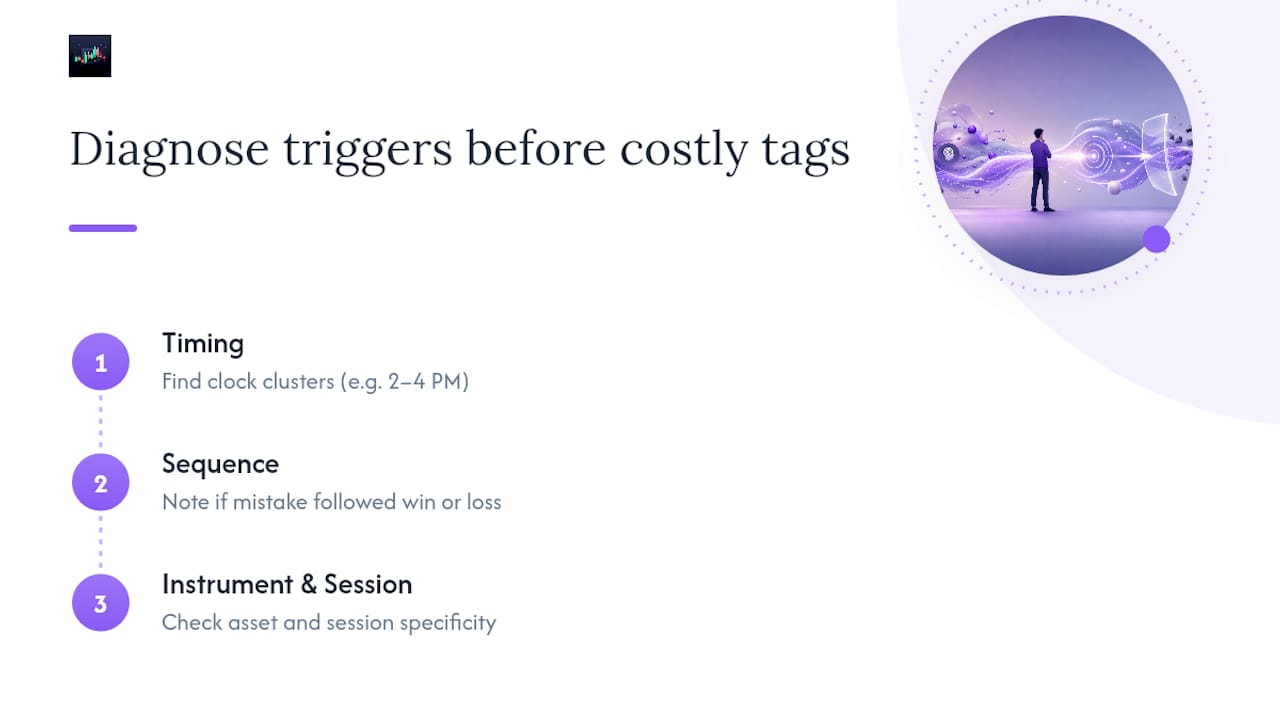
Start with timing. Pull every trade carrying your worst tag and check the clock. A cluster of oversized-position tags showing up between 2 and 4 PM might mean fatigue, not carelessness. A cluster of revenge-trade tags appearing within 20 minutes of a loss points to an emotional trigger with a clear window, which is exactly the kind of pattern a cooldown timer is built to interrupt.
Next, check sequence. Does the mistake follow a win or a loss? Overconfidence after a winning streak produces a different mistake profile than frustration after a drawdown, even when the resulting tag looks identical on paper. Your short subjective note, the one field you can't automate, is what separates these two cases in the data.
Finally, look at instrument and session context. A trader who only breaks size discipline on one specific asset, or only during a specific session, has isolated something closer to a trigger than a general character flaw. That's useful, because a trigger can be engineered around with a rule, while a vague sense of "I need more discipline" rarely survives contact with a losing week. The goal isn't to diagnose your psychology in the abstract. It's to find the two or three conditions that reliably precede your most expensive tag, then build a rule that interrupts one of those conditions specifically.
Making Mistake Tracking Work With Your Existing Journal
You don't need to abandon whatever journal you're already running. Most performance trackers already capture win rate, average win/loss, and equity curve. Mistake tags slot in as an additional column, not a replacement system, and the two data sets answer different questions.
Performance metrics tell you what's working in aggregate. Win rate and expectancy describe outcomes. Mistake tags describe behavior. The connection between the two is where the real insight lives: pull every trade tagged with a specific mistake and check whether its win rate is meaningfully lower than your overall average.
The cleanest way to integrate the two is a shared trade ID. Every trade gets one row with your existing performance fields (P&L, R multiple, setup type) plus the mistake fields (tag, discipline score, note) in the same record. That lets you filter by setup and by mistake simultaneously, which surfaces questions a single-axis view can't answer, like whether your best setup is being undermined by one specific execution error.
Setup tags and mistake tags need to stay separate categories inside that shared record. A trade tagging system built to find your edge treats "breakout" and "pullback" as one axis and "oversized" or "moved stop early" as a completely different axis. Mixing them into one tag field makes it impossible to tell whether a losing month came from a bad setup choice or from good setups executed badly, and those two problems need entirely different fixes.
Templates for a Working Mistake Log
A usable log fits on one screen. Here's a minimal row structure you can copy into a spreadsheet or replicate inside a journaling app today:
Run this same structure for every trade, win or loss. A winning trade that violated a rule still gets a mistake tag; profit doesn't erase a process error, it just delays the lesson.
For the monthly rollup, a second, shorter template does the ranking work:
Sorted this way, the fix priority is obvious without any further analysis. Six oversized trades cost four times more than nine early-stop trades combined, even though the stop mistake happened more often. That single table, updated monthly, is the entire analytical engine behind this method.
Turning Mistake Analysis Into a Corrective Action
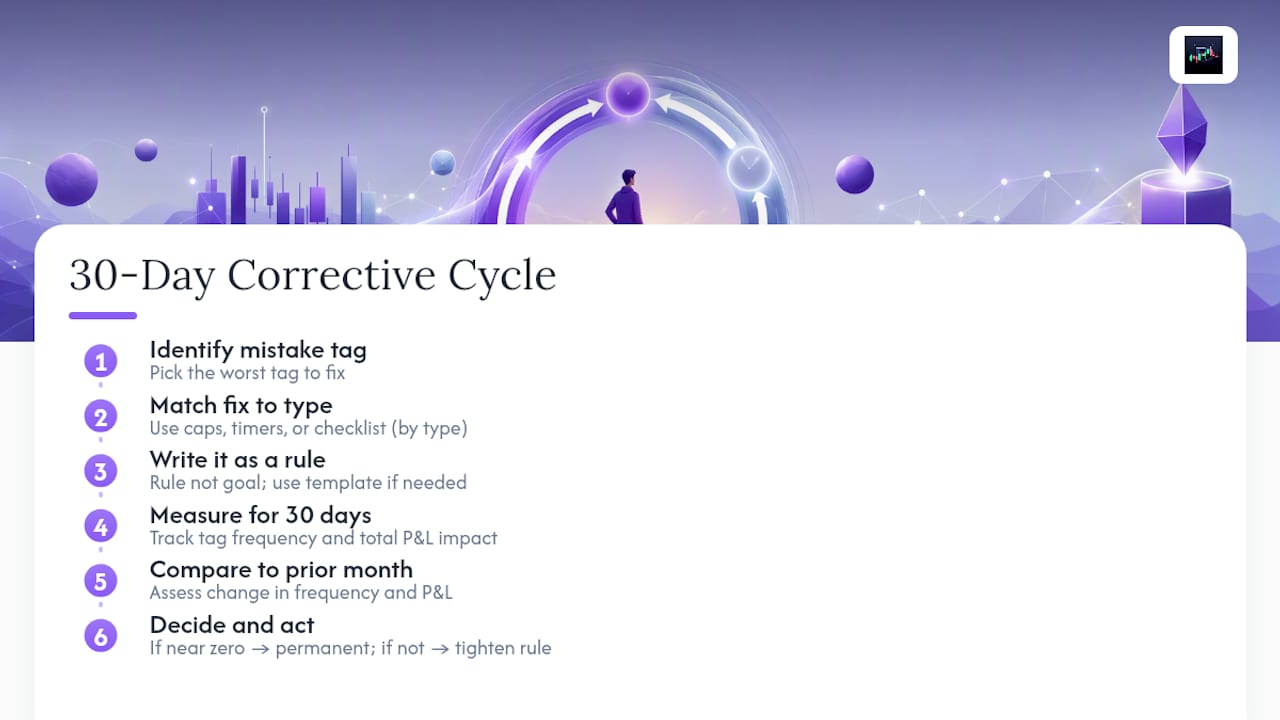
Identifying the worst tag is the easy part. Most tracking systems fail at the next step: converting an insight into a rule that actually survives contact with a live market. A correction has to be structural, specific, and measurable, or it quietly disappears the first time you're tired or down for the day.
Start by matching the fix to the mistake type instead of reaching for a generic "be more careful" resolution. Sizing errors respond to hard caps enforced by the platform, not a mental limit you can override in the moment. Discipline errors like revenge trading respond better to a forced cooldown timer after a loss than to willpower, since the research on breaking revenge-trading habits points to removing the option to trade for a fixed window, not asking yourself to resist the urge. Exit errors, like moving a stop, often respond best to a checklist step that requires a written reason before any stop adjustment.
Write the fix down as a rule, not a goal. "I will size down" is a goal. A copy-paste set of trade management rules gives you a starting template if you're building this list from scratch rather than writing each rule from first principles.
Set a measurement window before you start. Thirty days is usually enough to see whether a fix is working. Track the specific tag's frequency and total P&L impact across that window and compare it against the prior month. If the tag drops to zero or near zero, the fix worked and it becomes a permanent rule. If it persists, the fix wasn't specific enough, and you need a tighter version of it, not a different mistake to chase instead.
Staying Objective When Reviewing Your Own Trades
The hardest part of mistake tracking isn't the spreadsheet. It's reviewing your own decisions honestly when every instinct pushes toward a justification. A few habits keep the process honest.
Tag at the time of the decision, not after you know the outcome. This is the single most important rule in the entire system, because a profitable trade built on a rule violation will always feel forgivable in hindsight. If you catch yourself thinking "well, it worked out," that's usually the exact moment the tag needs to go on anyway.
Separate the loss from the mistake explicitly. A trade can lose money while following every rule perfectly; that's not a mistake, it's a normal outcome of a probabilistic activity. A trade can also make money while violating three rules, and that's still a mistake, just one that got lucky. Judging trades by outcome instead of process is the root cause of most self-justification, since a winning outcome feels like proof the decision was correct even when it wasn't.
Write the note before checking the P&L. If your journal shows the profit or loss first, you'll unconsciously write a note that matches the outcome rather than what actually happened during the trade. Some traders solve this by hiding the P&L column until after the note is written.
Finally, review with someone else's eyes in mind, even if no one else ever reads the log. Write the note the way you'd explain the trade to a trading partner who would call out an excuse. That single mental shift, writing for an audience rather than for yourself, closes most of the gap between an honest log and a flattering one.
The Principle That Changed My Own Tracking
Every tracking system I've studied eventually drowns traders in tags nobody acts on. The fix isn't more categories. It's picking the single tag costing the most money and fixing only that one until it disappears from the monthly ranking. Depth beats breadth every time discipline is the constraint, not data.
— Tony
Try an Automated Approach to Mistake Tracking
If you've been running this system by hand, the tagging and aggregation steps are the two that eat the most time, and they're exactly what automated capture is built to remove. The platform applies tags at the trade level, calculates your discipline score automatically, and generates AI trade autopsies that surface repeated execution patterns without you manually sorting a spreadsheet every Sunday night.

A practical way to start: run a one-month P&L-by-tag audit inside the app and request a single AI autopsy on whatever tag ranks worst. That's a small, measurable test. You're not committing to overhauling your whole process, just checking whether your top mistake this month costs more or less than last month.
Current pricing details for the Pro plan are listed on the Disciplineaiapp pricing page, including monthly, annual, and one-time options. If you want a structured, outcomes-focused path through the same discipline framework covered here, The Disciplined Trader walks through it as a standalone program. Start with one metric. Track tag count and total P&L per tag for thirty days, and let the ranking tell you what to fix next.
Sources
- How to Track Trading Mistakes: A Complete Guide — FundingOptimal blog
- Trade Loss Attribution: Was It the Read, the Instrument, or the Exit? — Oyamori
- How to Tag Trading Mistakes in Your Journal | TradeReveal
- Diagnosing issues and troubleshooting with the TWS API — Interactive Brokers Campus
FAQ
What Is the Best Way to Track Trades?
The most effective method combines a standardized tag library with a discipline score and a fixed review cadence, according to FundingOptimal's tracking guide. A spreadsheet works at low volume; a dedicated journal or an automated platform like Discipline AI becomes more useful as trade count and tag complexity grow.
Why Do Most Day Traders Lose Money?
Most day traders lose money because they repeat the same unpriced mistakes without ever measuring which one costs the most, rather than because of any single flawed strategy. Tracking mistakes by dollar impact, not just frequency, is what turns a vague sense of "I keep messing up" into a fixable, specific habit.
What Is the Rule of Three in Trade Tracking?
The rule of three means that any mistake tag appearing three times within a two-week window requires a structural fix, such as a hard size cap or a forced cooldown, rather than another mental reminder. Willpower alone rarely holds after a third repetition of the same error.
How Much Does Discipline AI Cost?
Discipline AI's Pro plan is available for $8.99 per month, $79.99 per year, or $199.99 as a one-time purchase. The Disciplined Trader program is offered separately as a one-time $79 purchase.
What Is Trade Loss Attribution?
Trade loss attribution separates whether a losing trade failed because of a misread market, a poor instrument choice, or a bad exit decision. Oyamori's attribution framework uses three diagnostic questions to point toward the correct fix instead of a generic "trade better" resolution.