For most active U.S. traders who need tick-level execution signals, Discipline AI is the strongest starting point in 2026. It combines AI-generated trade setups, confidence scoring, multi-timeframe market structure analysis, and execution guidance across crypto, forex, and stocks, all delivered through a mobile-first platform with iOS and Android support.
Three reasons it stands out for most traders:
- Tick-level signal processing: Discipline AI analyzes liquidity events, aggressor-side participation, and volatility conditions at the trade level, not the bar level, which is where execution decisions actually live.
- Best for: Crypto-first and multi-asset intraday traders who want AI-assisted order-flow signals without building a custom desktop stack.
- Trial access: Available via app download on iOS and Android with subscription tiers; no long-term lock-in required to evaluate the platform.
One honest caveat: if you trade weekly options or hold swing positions for days at a time, tape-level tools are probably overkill. Bar-level volume indicators and trend tools will serve you better at that timeframe.
Table of Contents
- What features separate entry-level from professional order-flow tools?
- How do you choose the right order-flow tool for your style?
- How does Discipline AI meet the order-flow checklist?
- Key Takeaways
- Order flow tools and the problem most traders skip
- Discipline AI is worth testing before you commit to any other platform
- Useful sources and further reading
What features separate entry-level from professional order-flow tools?
These are the dimensions that decide whether a platform is actually fit for order-flow trading, not just marketed that way.
- Platform support: — Desktop (Windows/macOS), mobile (iOS/Android), or browser-based. Desktop platforms often carry lower latency; mobile platforms offer flexibility.
| Dimension | Entry-level tools | Professional-level tools |
|---|---|---|
| Data source | Bar-aggregated approximation | Tick-level exchange feed |
| Footprint charts | Basic or absent | Full bid/ask volume per price level |
| DOM / depth | Static snapshot | Live depth with history and heatmap |
| CVD | Script-based, community | Native, multi-timeframe |
| Platform | Browser or mobile only | Desktop + mobile + API |
| Latency | 1–5 seconds | Sub-second |
| Pricing | Free to subscription tiers | Subscription tiers |
| Trial | Limited demo or no trial | 48–72 hour live data trial |
| Training resources | Community forums | Structured tutorials, live support |
Trust signals to verify before you pay: published data-source documentation, stated latency specs (not just "fast"), product screenshots showing real market sessions (not staged demos), and clear trial cancellation terms. If a vendor cannot tell you exactly where their data comes from, that is your answer.
How do you choose the right order-flow tool for your style?
The decision rule is simple: match your timeframe and market to the features that actually affect your entries and exits.
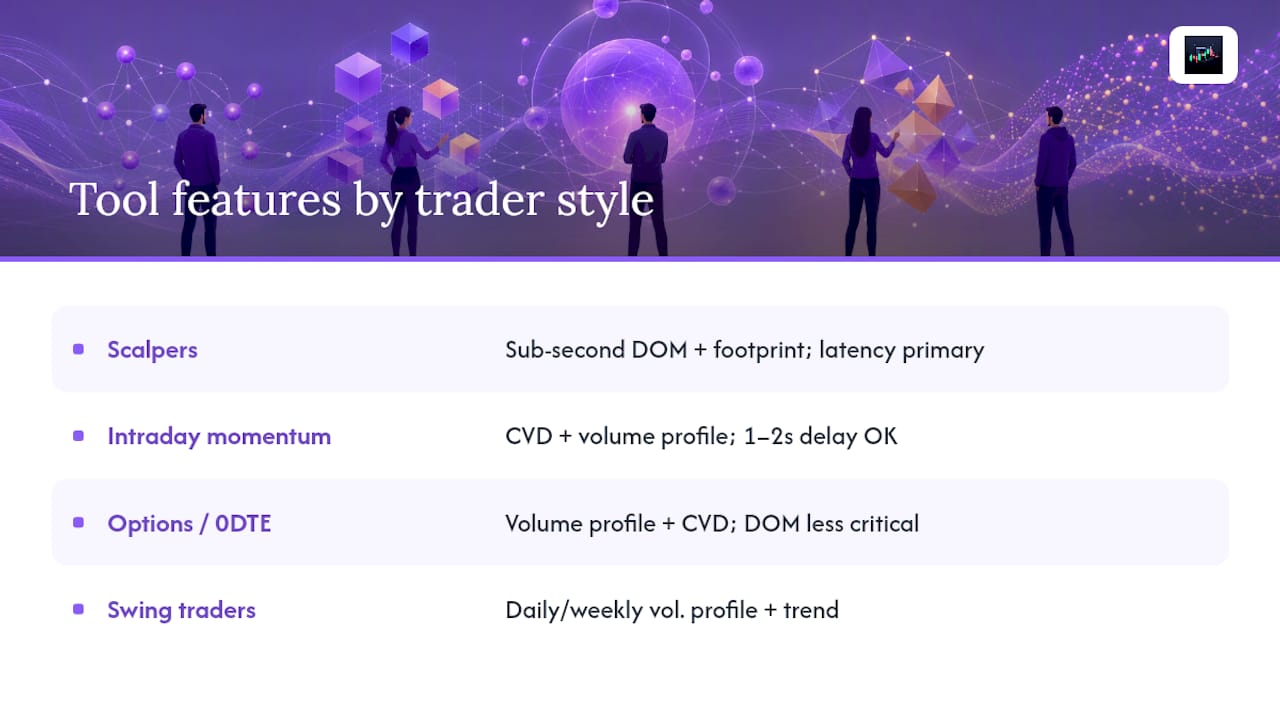
Scalpers need sub-second DOM updates and footprint charts with tick-level aggressor data. Latency is the primary filter. Everything else is secondary.
Intraday momentum traders need CVD overlays, volume profile for session reference levels, and a clean tape. A one-to-two second data delay is usually workable; missing CVD is not.
Options and 0DTE traders need volume profile and CVD to identify where institutional flow is concentrating. DOM is less critical than session-level volume distribution.
Swing traders rarely need tape-level tools at all. Trend indicators and volume profile at the daily/weekly timeframe are usually sufficient.
Questions to ask every vendor before you sign up
- What is your data source, and is it tick-level or bar-aggregated?
- What is the measured latency from exchange print to platform display?
- How does the platform classify aggressor side, and what is the error rate?
- Can I export trade logs and connect to my broker via API?
- What happens to my data if I cancel my subscription?
Pro Tip: Ask the vendor to show you a live session recording, not a curated demo. Watch how the footprint updates during a fast market. If the bars freeze or lag visibly during a spike, that is a latency problem no sales pitch can fix.
Red flags during demos and contract review
- Data described as "real-time" without a stated latency spec
- No clear explanation of aggressor-side classification methodology
- Trial terms that require a credit card with auto-renewal and no cancellation grace period
- No API access or data export at any tier
How does Discipline AI meet the order-flow checklist?
Discipline AI covers the checklist for traders who need AI-assisted order-flow signals across crypto, forex, and stocks, particularly those who want execution guidance without building a multi-screen desktop setup.
Here is how it maps to the comparison dimensions:
- Key visualizations: The platform provides market structure detection, multi-timeframe alignment, liquidity and volatility event identification, and CVD-equivalent signals. For crypto traders, liquidation tracking integrates directly into the market scanning layer.
- Platform support: iOS and Android mobile apps, making it one of the few order-flow-grade tools accessible without a dedicated trading desk. AI-powered pattern detection runs continuously in the background.
- Pricing and trial: Subscription-based via iOS and Android app stores. Trial access is available on download. Full pricing tiers are listed at the Discipline AI learning center.
- Training and support: — The platform includes structured tutorials, trade journaling with performance analytics, behavioral coaching, and AI trade autopsies that break down each completed trade.
- Integrations: — Paper trading with P&L tracking, market replay with fog-of-war simulation, and export-ready trade logs for external review.
One feature worth calling out specifically: the AI trade autopsy. After a trade closes, the platform generates a detailed breakdown of execution quality, confidence score accuracy, and where the setup deviated from the model. That feedback loop is what separates a journaling tool from a coaching system.
Pro Tip: Use Discipline AI's market replay simulator before going live on a new asset. The fog-of-war mode forces you to make decisions without knowing the outcome, which is the only honest way to test whether a setup actually works for you.
What to record and what thresholds to use
Keep a simple spreadsheet: timestamp, instrument, platform print, broker fill, delta between them. For scalping, target under 500ms delta. For intraday, under two seconds is workable. Any mismatch in aggressor classification (platform shows buy-initiated, broker fill shows a sell-side print) should be flagged and reported to support.
On customer support: send a technical question via the trial support channel within the first 24 hours. A response within four hours during market hours is a reasonable baseline. If you get a canned FAQ reply to a specific technical question, that tells you something about post-sale support quality.
Key Takeaways
Tick-level data, not bar-aggregated approximation, is the non-negotiable foundation of any order-flow tool worth paying for, and Discipline AI delivers that foundation with AI-assisted execution guidance across crypto, forex, and stocks.
| Point | Details |
|---|---|
| Tick-level data is the baseline | Any platform using bar-aggregated approximation cannot reliably classify aggressor side. |
| Three core visuals matter most | Footprint charts, CVD, and volume profile together cover microstructure, confirmation, and session balance. |
| Match tool to timeframe | Scalpers need sub-second DOM; swing traders rarely need tape-level tools at all. |
| Run a structured trial | Compare platform prints against broker fills and measure DOM latency before committing. |
| Discipline AI for AI-assisted signals | Discipline AI covers crypto, forex, and stocks with confidence scoring, trade autopsies, and mobile-first delivery. |
Order flow tools and the problem most traders skip
Most traders evaluating order-flow software spend their time comparing feature lists. That is the wrong starting point. The real question is whether the data underneath those features is actually what the vendor claims.
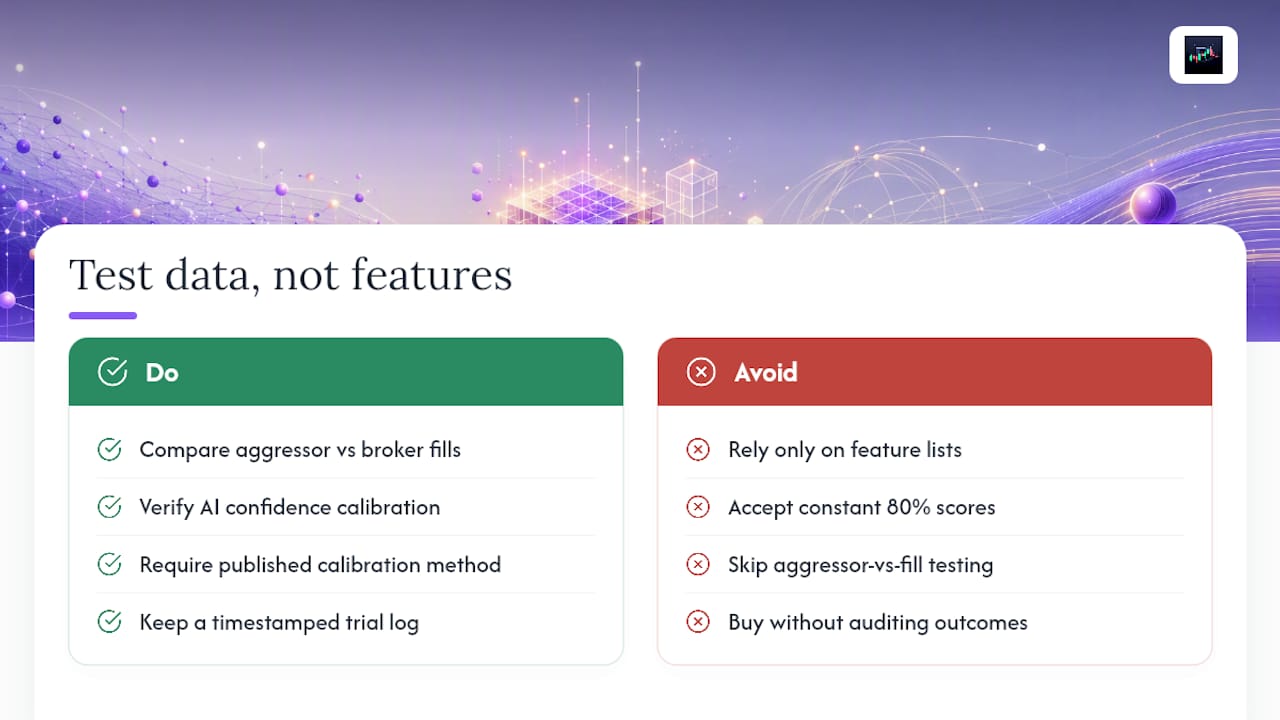
A footprint chart built on bar-aggregated data looks identical to one built on tick-level exchange feeds. The difference only shows up when you compare the platform's aggressor classification against your broker's fill data during a fast market. That is the test most traders never run, and it is why so many end up with expensive tools that do not improve their execution.
There is also a subtler problem with AI-assisted platforms: confidence scores are only useful if they are calibrated against real outcomes. A platform that shows 80% confidence on every setup is not giving you information; it is giving you noise with a number attached. The platforms worth using are the ones that publish their calibration methodology and let you audit the outcomes yourself. Discipline AI's trade autopsy feature is one of the few implementations that actually closes that loop, connecting the pre-trade confidence score to the post-trade execution quality in a way you can review and learn from.
One practical habit: keep a trial log for every platform you evaluate. Not just "did I make money?" but timestamped comparisons of platform signals against actual fills. That log is the only honest basis for a purchase decision, and it is the same data you will use to calibrate your confidence in the tool after you buy it.
Discipline AI is worth testing before you commit to any other platform
Most order-flow tools ask you to invest in a desktop setup, a data subscription, and weeks of configuration before you see a single live signal. Discipline AI skips that entirely. Download the app on iOS or Android, connect your account, and you have AI-generated trade setups, confidence scores, and market structure analysis running within minutes.
For the first 24 hours, focus on one thing: run the trial checklist from this article against a market you already trade. Compare the platform's signals against your own read of the tape. Use the market replay simulator to test setups without risking capital. Check the AI Learning Center for setup tutorials and the evidence-before-execution framework that explains how confidence scores are built and validated.
The platform covers crypto, forex, and stocks with behavioral coaching, stand-aside protection, and trade autopsies built in. No separate journaling tool required. No third-party data subscription to manage.
Download Discipline AI from the App Store or Google Play and run the 48-hour checklist before you make any other purchase decision.
Useful sources and further reading
- Best Order Flow Indicators for TradingView (2026) | TradeAlgo
- Support.apple.com
- parallels.com
- Discipline AI