
Stand aside when you cannot measure your edge or when execution conditions are unclear. In practice, that means holding fire during timeframe conflicts, thin liquidity, headline-driven volatility, or when you're running on bad sleep or a shaky connection. The sections below break each trigger into a specific test, then show how a checklist and an AI monitor can enforce the rule automatically.
TL;DR:
- Price movement without progress indicates a lack of edge, especially if frequent reclaims and failed breaks occur in the market.
- Trading during timeframe conflicts, low liquidity, or major volatility events significantly increases risk and should be avoided.
- A clear pre-trade checklist with a explicit "no-trade" rule, including liquidity and risk parameters, improves discipline and reduces impulsive trades.
- Technical failures, low momentum, or personal fatigue warrant standing aside, with strict thresholds and session reentry rituals to prevent overtrading.
- AI tools can continuously monitor for low confidence, liquidity gaps, volatility spikes, and behavioral patterns, automating stand-aside decisions and enhancing discipline.
Table of Contents
- What Market Signals Mean It's Time to Stand Aside?
- Build a Pre-Trade Checklist That Forces a No-Trade Decision
- When Should Fatigue or Tech Trouble Keep You Out of the Market?
- How AI Enforces the Stand-Aside Rule When Willpower Fails
- Why Standing Aside Beats Forcing a Trade
- Put Stand-Aside Protection on Autopilot
- Sources
What Market Signals Mean It's Time to Stand Aside?
The clearest sign your edge has disappeared is price that moves without progress. A market can grind through wide swings, reclaim levels it just broke, and still go nowhere for hours. That's an active market, not a tradable one, and ConfluenceMeter's research on stand-down conditions points to exactly this: repeated reclaims and failed breaks are quality problems, not noise you can trade around.
Timeframe conflict is the fastest gut check you have. If your five-minute chart says long and your four-hour chart says short, you're not looking at a setup. You're looking at two different stories arguing with each other, and taking either side is a coin flip dressed up as analysis. Investopedia's five-step trade test treats this kind of confluence check, across trend, volume, and volatility, as a mandatory filter before a setup even qualifies for a trigger.
Liquidity problems are the second category, and they're easy to miss because the chart still looks fine. Watch for:
- Spreads that widen well beyond their normal range for the session
- Order-book depth that thins out right at your intended entry price
- Repeated partial fills or slippage on what should be a liquid instrument
- Sudden gaps in quote updates, especially in smaller crypto pairs overnight
A setup can be technically perfect and still fail on execution. That's the trap: the analysis was right, the fill wasn't, and the loss looks like a bad call when it was really a bad market to trade in at all.
News and volatility events round out the picture. Rate decisions, CPI prints, major crypto protocol announcements, and unscheduled exchange outages all inject risk you cannot price. This is exactly the condition YourTradingCoach's framework on trading with edge describes as a neutral-bias day: when you can't identify which side has the edge, taking either side just adds variance without adding expectancy.
Pro Tip: Before every entry, run a two-second test: "Am I trading a setup, or am I trading because I'm bored and the chart is moving?" If it's the second one, stand aside.
Low-momentum sessions deserve their own mention. Weak options flow, dead volume, and a market that's simply quiet are valid reasons to stop trading, not push through. Lance Ippolito's take on trading without momentum makes the point plainly: when the flow isn't there, you're guessing instead of following money, and guessing isn't a strategy.
Build a Pre-Trade Checklist That Forces a No-Trade Decision
A checklist only works if it has a line that can say no. Most traders build checklists that confirm entries; few build ones that block them. The fix is a short, binary sequence you run before every single trade, no exceptions for "this one feels different."
- State the setup in one sentence. If you can't, you don't have one.
- Name the invalidation level. Where does the idea stop being true?
- Confirm stop placement. Is it at a structural level, or just a number that feels safe?
- Calculate position size from your risk percentage and stop distance, not from a gut number.
- Check liquidity at your entry and target zones.
- Confirm order type matches the volatility (limit in choppy conditions, market only when speed matters more than price).
- Run the urgency test. Are you entering because the setup is ready, or because you're afraid of missing it?
Bifu's pre-trade checklist research found that a single explicit "no-trade" line, something as blunt as "no trade if stop is unclear," outperforms long prose reasoning because it forces a yes-or-no answer instead of a debate with yourself. Other short rules worth pasting straight into your own workflow: "No trade if spread exceeds normal range," "No trade without a stated R:R above a minimum favorable threshold," and "No trade immediately after a scheduled news release" You can build out a fuller version of this kind of rule set with Disciplineaiapp's guide on creating trading rules that hold up.
Pro Tip: Write your no-trade rules on a sticky note taped to your monitor, not buried in a notes app. The rule only works if it interrupts you before the click, not after.
When Should Fatigue or Tech Trouble Keep You Out of the Market?
Your own state is a filter, not a footnote. Traders who track this seriously use hard thresholds instead of vague feelings. Documented triggers for standing aside include insufficient sleep, recent losing trades, or distracting personal events, based on research into personal-state limits for traders.
Technical failures deserve the same hard line:
- Platform latency spikes: stop entering new trades until it resolves.
- Data feed gaps or stale quotes: verify against a second source before trusting any price.
- Broker or exchange connectivity drops: switch to a backup feed or move to paper trading until service is confirmed stable.
Session-level guardrails catch what individual rules miss. Set a daily trade cap, force a cooling-off period after two consecutive stops, and build one small ritual (a five-minute walk, a coffee, anything that breaks the loop) before you're allowed to reenter. Block3 Finance's work on avoiding overtrading found that zooming out to a higher timeframe after a loss filters out a large share of the low-quality setups that tempt you back in too soon.
Pro Tip: Set a hard daily trade limit before the session starts, not during it. A limit you set mid-session always bends in your favor.
How AI Enforces the Stand-Aside Rule When Willpower Fails
Willpower breaks down exactly when you need it most, usually a few minutes after a loss. That's why the strongest version of a stand-aside rule isn't a rule you remember. It's one a system checks for you.
An AI trading platform can run the checks above continuously instead of leaving them to memory:
- Timeframe alignment scanning, flagging trades where lower and higher timeframes disagree
- Liquidity anomaly detection, catching spread widening or thin depth before you place an order
- Volatility spike monitoring around scheduled news windows
- Confidence scoring, where a low score functions as an automated no-trade gate rather than a suggestion you can talk yourself out of
The flow works in three steps: the system monitors conditions, flags a setup as sub-threshold, and either auto-pauses new entries or sends an alert you have to acknowledge before proceeding. Disciplineaiapp's approach to evidence-based trade analysis applies this logic directly, requiring supporting evidence before a setup clears for execution.
| AI signal | What it flags | Stand-aside action |
|---|---|---|
| Low confidence score | Weak confluence across timeframes | Pause new entries on that asset |
| Liquidity anomaly | Wide spread or thin order book | Delay entry, reassess order type |
| Volatility spike flag | Scheduled news or unusual price jump | Hold off until conditions normalize |
| Behavioral pattern alert | Recent tilt or overtrading pattern | Trigger cooling-off period |
The real value shows up over time, not on day one. Trade autopsies compare what the system flagged against what actually happened, and that outcome data is exactly what TradeSave+'s framework for building a durable trading plan recommends logging: timestamp every no-trade decision along with the failing item, then review the pattern quarterly to tighten or loosen the threshold based on real results, not gut feeling.
Why Standing Aside Beats Forcing a Trade
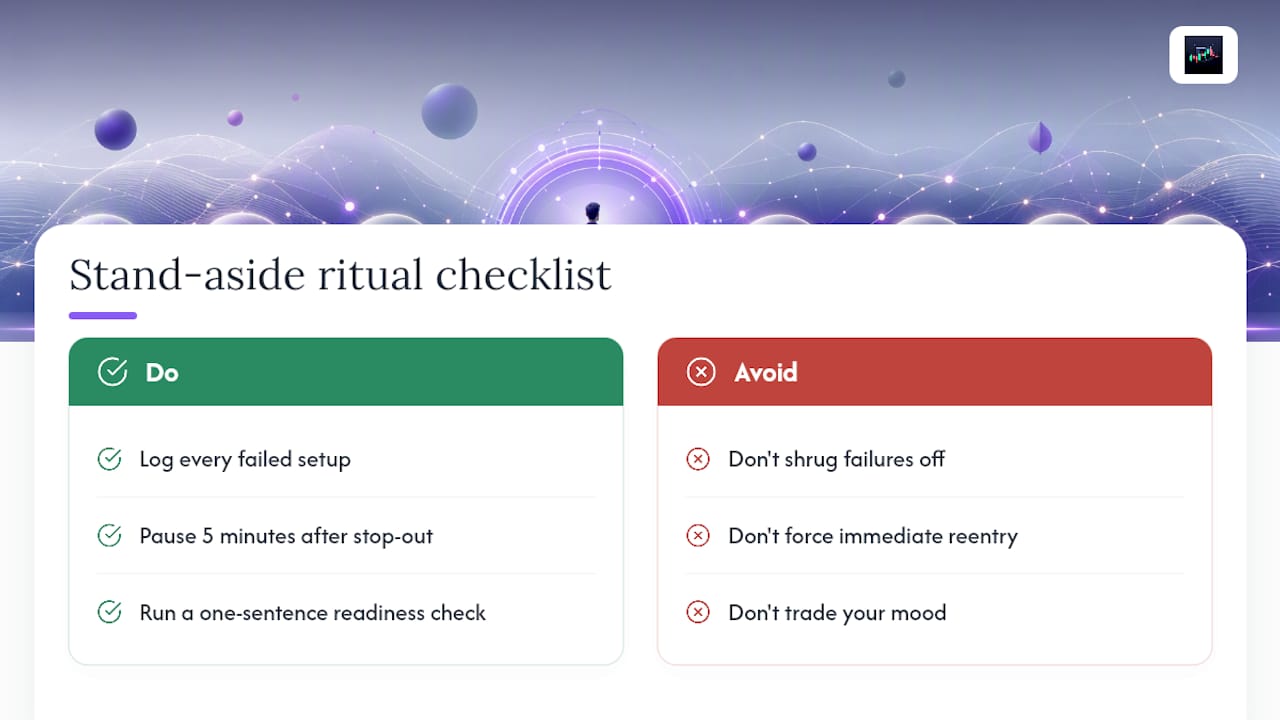
I treat every stand-aside decision as a logged event, not a shrug. If a setup fails my checklist, I write down which line it failed and move on. That single habit does more for my results than any indicator ever has.
Two small rituals carry most of the weight: a timed pause after a stop-out (five minutes, no exceptions), and a one-sentence readiness check before reentry, something as simple as asking whether I'm trading the chart or trading my mood. Neither takes long. Both catch the trades that would have hurt the most.
— Tony
Put Stand-Aside Protection on Autopilot
Manually running a checklist under pressure is where most traders slip, not in the analysis, but in the moment right before the click. The platform can help by automatically gating weak setups with confidence scores, scanning markets in real time to flag liquidity and volatility problems, and providing behavioral coaching to identify tilt patterns that lead to revenge trades.
Trade autopsies then turn every stand-aside decision and every executed trade into a data point, so your thresholds get sharper the more you use the platform instead of staying static forever. If you want to see how the checklist logic and AI setups discussed here translate into an actual workflow, the AI Learning Center walks through it step by step, alongside a practical playbook on interpreting AI-generated trade setups. Pair that discipline with solid record-keeping, and Funding Optimal's guide to tracking trading mistakes is a useful companion for the logging habit described above. Open the Learning Center and start with the stand-aside lesson before your next session.
Sources
- Trade When You See Edge. Stand Aside When You Don’t!
- Pre-Trade Checklist for Risk and Execution
- When to stand down even if the market is moving | ConfluenceMeter
- No juice, no momentum: how I know when not to trade