
Run this before every trade: a binary pass/fail gate across three phases, pre-trade, in-trade, and post-trade, where a single "no" cancels the trade. No exceptions, no "it's close enough." That one rule, enforced without negotiation, is what separates traders who survive drawdowns from traders who blow through stop-losses because the setup "felt right."
The full system breaks down like this. Pre-trade covers setup validity, stop placement, position size, and reward-to-risk before you click anything. In-trade covers what you're allowed to do (and forbidden from doing) once you're in the position. Post-trade covers the journal entry and the numbers you pull from it every day and every week.
None of this is theoretical. The SEC requires brokers to seek "best execution" on your behalf, weighing price, speed, and fill likelihood, but that obligation only covers the broker's side. Your side is the setup, the size, and the discipline to walk away when one box stays unchecked. Traders serious about measuring their own cost of trading eventually run into implementation shortfall, a standard execution-quality metric, and tools like Discipline AI now automate a lot of the tracking that used to live in a messy spreadsheet.
Here's the three-phase structure in one glance:
- Pre-trade (20 to 60 seconds): setup, stop, size, ratio, timing, news, mental state.
- In-trade (continuous): stop management, no averaging down, scaling rules, execution monitoring.
- Post-trade (daily and weekly): journal entry, implementation shortfall, win rate, rule-violation count.
Key Takeaways
A trade execution checklist works only when every item is binary, one "no" cancels the trade, and post-trade metrics like implementation shortfall convert that discipline into measurable improvement.
| Point | Details |
|---|---|
| Enforce binary gates | One "no" on any pre-trade item means no trade, with no partial passes allowed. |
| Size positions by formula | Use dollar risk divided by the distance between entry and stop, not a fixed share count. |
| Separate process from outcome | A losing trade with full checklist compliance counts as a process win in your weekly audit. |
| Measure real execution cost | Track implementation shortfall, not just slippage, to capture delay and opportunity costs. |
| Roll out in stages | Start with pre-trade and end-of-day checks only, adding pre-market and weekly audits after a few weeks. |
| Automate the routine | Discipline AI's journaling, execution scoring, and market replay tools handle the repetitive tracking behind the checklist. |
Table of Contents
- What Goes on a Pre-Trade Checklist?
- How Should You Manage a Trade After Entry?
- What Should a Post-Trade Review Include?
- What Templates Make This Checklist Easy to Follow?
- Why Do Execution Metrics and Regulation Matter Here?
- The Checklist Is Only as Good as Its Enforcement
- Put the Checklist on Autopilot With Discipline AI
- Sources
What Goes on a Pre-Trade Checklist?
A pre-trade checklist works only if every item resolves to yes or no. Nothing subjective, nothing on a sliding scale. The moment you let "kind of" count as a pass, the checklist stops protecting you and starts decorating your bad decisions with the appearance of process.
The model that holds up best under pressure is a binary gate, and TradersSecondBrain's Execution Protocol is a clean version of it: seven checks, each answered yes or no, and one no means you don't trade. That sounds harsh until you've watched a trader take a setup with five green lights and two grayish ones, and lose money on exactly the part they waved through.
Here's the sequence, in the order you should actually run it.
- Valid setup. Does this match a pattern in your playbook, not a pattern you're inventing right now because the chart looks exciting? If you can't point to a prior example that looked the same, it's not a setup, it's a guess.
- Stop defined by structure. Your stop goes below or above a real structural level, a swing low, a range boundary, a moving average that's actually been respected, not an arbitrary percentage below entry. A stop set by feel moves when you're stressed. A stop set by structure doesn't.
- Position size calculated. Use the formula: Position size = Dollar risk ÷ (Entry price − Stop price). If you're risking $200 on a trade with entry at $50.00 and a stop at $48.50, your risk per share is $1.50, so your position size is 133 shares. That number comes from math, not from "how much do I feel like buying."
- Reward-to-risk clears your threshold. Calculate the distance to your target divided by the distance to your stop before entry, not after you're already in and rationalizing.
- Session timing checks out. Are you trading during the liquidity window your strategy was built for, or are you forcing a trade into a dead session because you're bored?
- News and economic calendar clear. No major scheduled releases inside your expected holding window unless your strategy is specifically built to trade around them.
- Correlated exposure checked. Are you already loaded up on three positions that all move together? A fourth "diversified" trade in the same direction isn't diversification.
- Mental state honest check. Are you trading to make money on this setup, or trading to get back what you lost an hour ago? That's the one traders skip most and pay for most.
- Server-side stop order placed. Not a mental stop — use a stop order sitting on the exchange or broker's server as recommended in the first trading platform checklist for new traders. A stop order sitting on the exchange or broker's server the second you're filled.
- Pre-trade journal entry logged. Setup name, size, stop, target, and the time, written down before you enter, not reconstructed afterward to make the trade look smarter than it was.
Here's a quick reference for reward-to-risk thresholds by approach:
| Strategy type | Typical win rate | Minimum R:R to stay profitable |
|---|---|---|
| High-frequency scalping | 35% | 1:1 |
| Swing trading (days to weeks) | 50% | 2:1 to 3:1 |
| Trend following / breakout | 30% | 3:1 or higher |
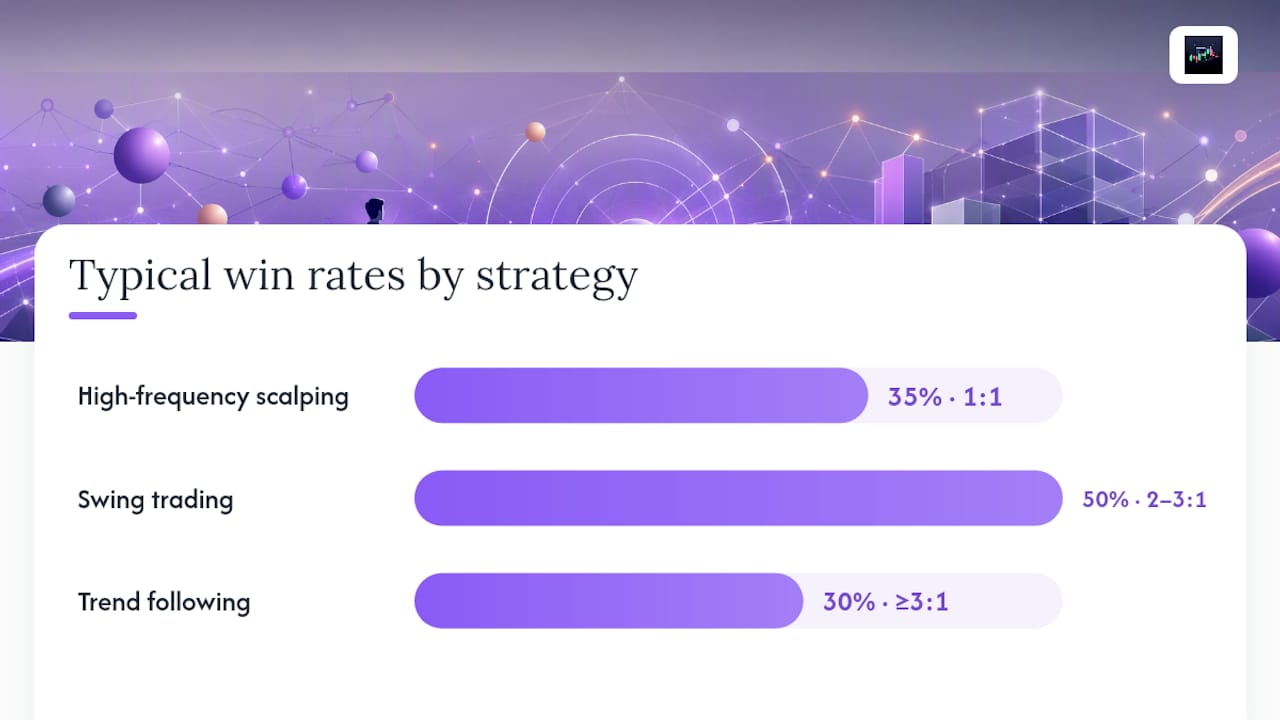
Lower win-rate strategies need bigger reward-to-risk ratios to stay profitable over a large sample. That's math, not opinion: a 35% win rate with a 1:1 ratio loses money over time; the same win rate with a 3:1 ratio is comfortably profitable.
Pro Tip: Add a mandatory 10-second pause after your checklist passes and before you click submit. It sounds trivial, but that pause gives your slower, more deliberate thinking a chance to catch a rationalization your faster, reactive brain already talked you into.
Two things make this checklist fast instead of a chore. First, do the heavy lifting before the market opens, mark your key levels, decide your bias, build your watchlist, so the live pre-trade check is just confirmation, not calculation. Doing this pre-market work shifts the cognitive load out of the pressure window, where mistakes are most expensive. Second, automate anything repeatable. A position-size calculator that does the math in two seconds beats mental arithmetic when your heart rate is up and the price is moving against your entry timing. Discipline AI's risk tools handle that calculation automatically, which matters more than it sounds like on a fast-moving session. If you're still deciding between order types for entries, a guide to market versus limit orders is worth five minutes before you build your own rules around it.
How Should You Manage a Trade After Entry?

Execution quality doesn't end at the fill. It's decided minute by minute while the position is open, and most of the damage traders do to their own accounts happens here, not at entry.
The rules that matter most are the ones that remove your ability to negotiate mid-trade:
- No averaging down. Adding to a losing position because "it'll come back" turns a defined-risk trade into an undefined-risk gamble. If the setup was worth the size you calculated, it doesn't become worth more size just because it's underwater.
- No discretionary stop widening. Your stop was set by structure before you had money on the line. Moving it because price is "almost" there is the exact rationalization the binary checklist was supposed to prevent.
- Breakeven rules apply only when pre-specified. If your plan says move to breakeven after the trade captures 1R, follow that rule exactly. Don't invent a new breakeven point because you're nervous.
- Scaling out follows a fixed allocation, not a mood. A common structure: take 50% off at 1R, move the stop to breakeven on the remainder, let the rest run to target or trail behind structure. Whatever ratio you choose, write it down before entry and follow it the same way every time.
- Trailing stops follow structure, not a fixed distance. Trail behind the most recent swing low or high, not an arbitrary dollar amount that ignores what the market is actually doing.
Execution problems aren't always about your judgment. Sometimes they're technical, and you need thresholds that trigger an automatic response instead of a debate. A spread that suddenly widens to three or four times its normal range is a signal something's wrong with liquidity, not a reason to chase a worse fill. Noticeable latency between your click and your confirmation, more than a second or two beyond what's normal on your platform, means you're trading blind for that window. Slippage on entry that exceeds your planned tolerance by a meaningful margin should flag the trade for review even if it still hit target.
Pro Tip: Set a hard rule for platform or connectivity failure before you need it: if your platform disconnects with an open position, your first move is to call your broker's trading desk directly to confirm your stop order is live on their server, not to refresh your app and hope. A stop order sitting on the exchange side survives your Wi-Fi going down. A mental stop does not.
Write your unwind protocol once, in plain steps: confirm the stop is server-side and active, contact the broker by phone if the platform is unresponsive, and never open a new position until connectivity is confirmed stable. Traders who improvise this in the moment tend to either freeze or overcorrect, and both cost money.
What Should a Post-Trade Review Include?
Every trade needs a log entry with enough detail to reconstruct exactly what happened, not just whether you made money. The fields that matter: setup name, entry price, stop price, target price, actual execution price, fees paid, slippage in dollars and in ticks, outcome in R multiples, your emotional state at entry, and a flag for whether every pre-trade checklist item passed.

That last field is the one most traders skip, and it's the one that actually tells you whether your process is working. A losing trade where every checklist item passed is a process win. A winning trade where you skipped the news check and got lucky is a process failure wearing a green number.
The metric worth learning here is implementation shortfall, which the CFA Institute treats as the standard for measuring total trade cost, because it captures more than a simple entry-price-versus-fill-price comparison. It decomposes your total execution cost into three pieces: the delay cost between when you decided to trade and when you actually placed the order, the execution cost from the difference between your intended price and your actual fill, and the opportunity cost from any part of the order that never got filled at all. A basic slippage number only tells you what happened at the fill. Implementation shortfall tells you what happened between the decision and the fill and what it cost you along the way, which is a more complete answer.
End-of-day checklist, 10 to 15 minutes:
- Fill in every journal field for every trade taken that day.
- Flag any checklist violations, honestly, even the ones that worked out.
- Write a one-line numeric summary: trades taken, win rate for the day, total R.
End-of-week audit, 30 to 45 minutes:
- Aggregate the week's win rate, average R multiple, and total checklist violations.
- Identify the single most frequent point of failure, whether that's skipping the news check or widening stops under pressure.
- Adjust one checklist threshold if the data supports it, and leave the rest alone until you have more evidence.
Here's a simple example of what a week's aggregated numbers might look like once you're logging consistently:
Don't draw conclusions from a handful of trades. A sample under 20 to 30 trades is too small to say much about your real win rate or average R, since normal variance can make a solid process look broken or a shaky one look fine for a stretch. Track checklist compliance as its own number over time, separate from your win rate, because compliance is the thing you actually control day to day. A deeper breakdown of slippage measurement is useful once you want to go past the basics here.
What Templates Make This Checklist Easy to Follow?
The checklist only works if it's fast enough to survive contact with a live, moving market. A ten-minute pre-trade review is a checklist nobody follows past week two.
A printable pre-trade card, sized to fit one screen or a single index card, should hold no more than seven to ten binary items: valid setup, stop defined, position size calculated, R:R threshold met, timing correct, news clear, correlated exposure checked, mental state checked, server stop placed, journal entry logged. Anything longer starts inviting shortcuts.
Time budgets matter more than most traders expect. ForexMechanics' toolkit lays out realistic windows that keep each phase from becoming a burden: pre-market work runs 5 to 10 minutes, the live pre-trade gate takes 20 to 60 seconds, the end-of-day review takes 10 to 15 minutes, and the weekly audit takes 30 to 45 minutes. If any of those windows is running long for you consistently, the checklist itself needs trimming, not more willpower.
Two operating modes matter here. READ-DO means you read each item and perform it live, which fits the pre-market and weekly audit, where you're doing real analysis. DO-CONFIRM means you perform the actions from memory and only use the checklist to confirm you didn't miss anything, which fits the live pre-trade gate, where speed matters and the steps should already be second nature. Mixing these up, reading through a full analytical checklist during a live entry window, is exactly what causes traders to hesitate and miss fills.
For rollout, don't try to run all four checklists at once:
- Weeks 1 to 2: run pre-trade and end-of-day only. Build the habit before adding complexity.
- Weeks 3 to 4: add pre-market prep once pre-trade compliance is consistently high.
- After week 4: add the end-of-week audit, and only once you've got enough logged trades to make the numbers meaningful.
Discipline AI's rollout guidance and the original pre-trade checklist breakdown both follow this same staged approach, because trying to adopt everything at once is the most common reason traders abandon a checklist inside the first month. Traders running proprietary firm accounts should adjust further, adding session caps and spread limits specific to their firm's rules, since a scalping or prop-firm checklist needs tighter thresholds than a swing checklist built around multi-day holds.
Why Do Execution Metrics and Regulation Matter Here?
Retail traders tend to think "best execution" is a broker problem, not a personal one. It's both. The SEC requires brokers to weigh price improvement, speed, and likelihood of execution when routing your order, and you're entitled to request your own order-routing history if you want to check how your broker actually handles your flow. That's the regulatory floor. Everything above that floor, whether your own execution is actually good, is on you to measure.
Implementation shortfall breaks your total trade cost into three pieces: delay cost, execution cost, and opportunity cost from any unfilled portion of the order. A trader who decides to buy at $50.00, waits three minutes before entering, and gets filled at $50.35 has already paid a measurable delay cost before slippage on the fill itself ever enters the picture.
That $0.35 gap between the decision price and the entry attempt is delay cost. Whatever gap remains between the intended entry and the actual fill price is execution cost. Either one, ignored long enough, quietly erodes returns that look fine on a strategy backtest and look worse once real fills are involved.
Discipline AI's execution scoring and automated journaling exist specifically to catch this kind of gap without demanding you build a spreadsheet from scratch, and its market replay feature lets you rehearse the checklist against historical price action before risking live capital. One honest caveat: these metrics need volume to mean anything. A handful of trades will show noise, not a real signal, so treat early readings as directional, not conclusive.
The Checklist Is Only as Good as Its Enforcement
Most trading advice treats discipline as a personality trait, something you either have or don't. That framing is wrong, and it's also convenient, because it lets traders blame themselves for a system failure instead of fixing the system. A binary checklist works precisely because it doesn't ask you to be disciplined in the moment. It asks you to have been disciplined earlier, when you built the checklist with a clear head, so the live decision becomes a lookup, not a debate.
Where conventional advice falls short is treating every checklist item as equally negotiable under pressure. It isn't. The stop and the position size are math. The mental-state check is judgment. Traders who blur that line start letting "I feel good about this one" override the stop-placement rule, and that's the exact failure mode the binary gate exists to prevent.
If you're starting from nothing, don't try to build the full four-phase system on day one. Get the pre-trade gate and the end-of-day journal running first. Everything else, the weekly audit, the implementation shortfall tracking, is only useful once you have enough logged trades to trust the numbers.
Put the Checklist on Autopilot With Discipline AI
Running this checklist by hand works, but it's one more thing competing for your attention during a live market. Discipline AI builds the phases directly into the trading workflow instead of leaving them on a separate card you have to remember to check. The app scores execution quality automatically, journals every trade without you filling out fields by hand, and replays historical price action so you can pressure-test your pre-trade rules before risking real capital.

The workflow is simple: run your pre-trade check inside the app, execute, and the automatic journal plus execution scoring captures everything the post-trade review needs without extra effort. Your weekly audit becomes a dashboard you glance at instead of a spreadsheet you rebuild every Sunday. Risk calculators handle the position-size math from the pre-trade gate in real time, so the numbers are ready before the pressure window even starts. If you're ready to see how the checklist runs inside an actual platform, check out Discipline AI's features or get started with the app directly.
Sources
- SEC — Best Execution: What You Need To Know
- CFA Institute — Trade strategy, execution, and cost measurement (2026 reading)
- TradersSecondBrain — Execution Protocol: A 7-Point Pre-Trade Checklist
- ForexMechanics — Trader Checklists & Weekly Workflow: Pre-Market, Pre-Trade, EOD/EOW