
Stock market replay learning is the process of manually replaying historical market sessions to practice trading decisions in a simulated, risk-free environment. The industry term for this method is "market replay training," and it sits at the center of how serious discretionary traders close the gap between knowing a strategy and actually executing it under pressure. Unlike backtesting, which runs automated calculations on past data, replay puts you in the driver's seat, bar by bar, forcing real decisions in real time. Disciplineaiapp builds its entire practice framework around this distinction, combining market replay with AI-driven behavioral coaching to address the execution failures that cost traders the most.
What is stock market replay learning, and how does it work?
Stock market replay learning is a discretionary practice method that reconstructs historical market data so traders can execute trades and make decisions as if the session were unfolding live. The key word is "manual." You watch price action develop tick by tick, read the chart, decide when to enter, and manage the trade forward. No algorithm does it for you.
The method compresses months of market exposure into focused sessions. A trader can replay a volatile earnings day, a trending session, or a choppy range-bound afternoon and practice the same setup dozens of times across different historical dates. That kind of repetition is impossible in live markets, where you get one shot per session.

Replay differs from passive chart review in one critical way: you do not already know the outcome. The price bars reveal themselves only as you advance the replay, which forces genuine decision-making rather than post-hoc rationalization. That distinction is what makes replay a skill-building tool rather than an entertainment exercise.
How does stock market replay differ from backtesting and paper trading?
The three most common trading practice methods serve different purposes, and confusing them is a costly mistake.
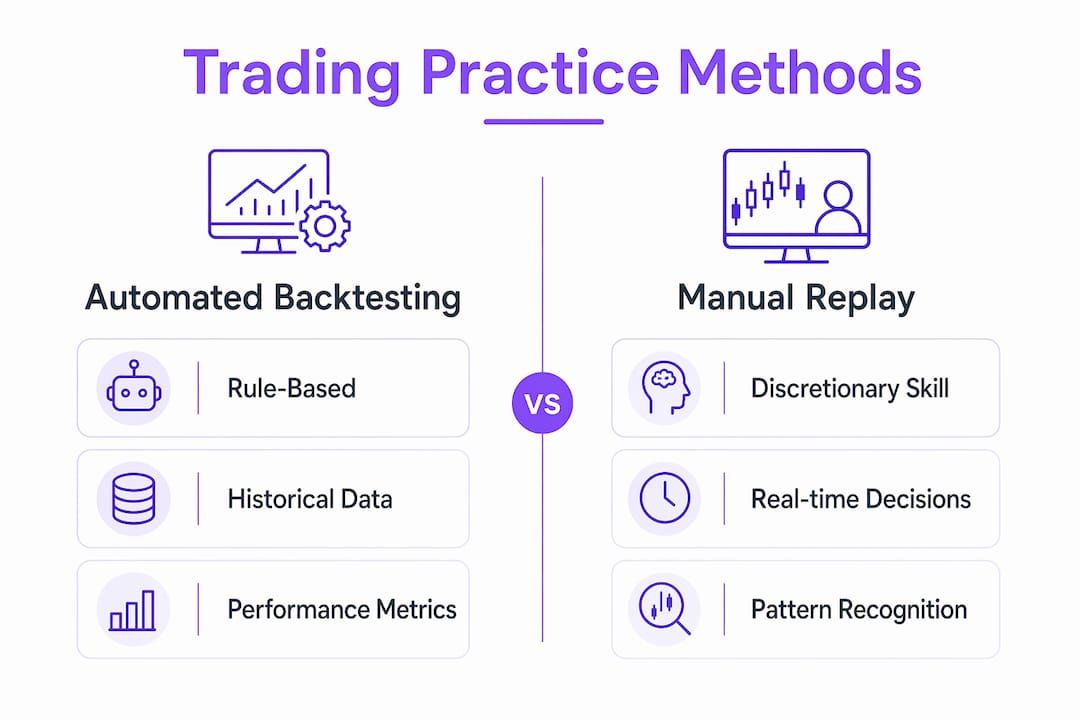
Backtesting is automated. You define a set of rules, run them against historical data, and receive output metrics like win rate, drawdown, and expectancy. Backtesting validates whether a strategy has a mathematical edge. It does not train your hands or your judgment.
Market replay is manual and interactive. You train discretionary execution and pattern recognition, the skills backtesting cannot develop. Replay simulates live, unfolding price action and forces you to make entry, exit, and sizing decisions without knowing what comes next.
Paper trading uses a live market feed with virtual money. It tests your familiarity with a broker's interface and exposes you to real-time news flow and order routing. The limitation is that you only get one session per day, so skill accumulation is slow.
The ideal training sequence runs in this order:
- Backtest your strategy to confirm it has a statistical edge across historical data.
- Replay historical sessions to build execution skill and pattern recognition at your own pace.
- Paper trade live markets to rehearse the full experience before committing real capital.
Each method builds on the previous one. Skipping replay and moving straight from backtesting to paper trading is like studying a sport's rulebook and then playing a competitive match without ever practicing the physical skills.
What are the key benefits and limitations of stock market replay training?
Core benefits
The benefits of market replay training are concrete and measurable when the practice is structured correctly.
- Risk-free repetition. You practice real decisions without financial consequences, removing the fear that distorts judgment in live trading.
- Accelerated pattern exposure. Replay compresses time, letting you see hundreds of setups in weeks rather than years.
- Execution timing. Practicing entries and exits bar by bar sharpens the instinct for when a setup is actually triggering versus when it is still forming.
- Discipline reinforcement. Committing to a trade plan before the outcome is revealed builds the habit of following rules rather than reacting emotionally.
Known limitations
Replay cannot replicate every condition of a live market. Replay tools cannot replicate the real-time emotional pressure of live markets, so traders must complement replay with live paper trading for full preparation. Replay is ideal for pattern recognition and execution speed, but not for psychological readiness under financial risk.
Additional constraints include the absence of live liquidity. Simulated fills do not reflect slippage, partial fills, or the impact of your own order size on the market. Replay is also most effective for discretionary traders focused on price action and chart patterns. Purely systematic traders get more value from backtesting.
Pro Tip: Avoid passive watching during replay sessions. Passive viewing feels productive but produces no measurable skill gain. Commit to a decision before each bar reveals itself, every single time.
The most damaging pitfall is hindsight bias. Hindsight bias is a common replay pitfall. Traders who skip forward or watch without committing decisions are not practicing. They are just watching a movie they already know the ending to.
What technical features matter in stock market replay platforms?
Platform quality determines how realistic and useful your practice sessions are. Not all replay tools are built the same.
L1 vs. L2 data depth
Basic replay platforms show only historical price bars and trade executions, which is Level 1 (L1) data. This is adequate for learning basic chart patterns and entry timing on daily or hourly charts. Serious order flow training requires Level 2 (L2) data. Without L2 data, replay is "animated charts" lacking the microstructure needed for genuine order flow training. L2 data reconstructs the full order book, showing bid and ask depth at every price level, which is what professional traders read to gauge liquidity and momentum.
Fill simulation models
How a platform simulates your order fills matters significantly. Naive price-touch fill models assume your order fills the moment price touches your limit level. That is unrealistic. Queue-position modeling accounts for the fact that other orders ahead of yours in the queue must fill first. The difference between these two models changes your measured win rate and average fill quality, which affects how accurately you can evaluate your practice performance.
Replay speed and deterministic engines
Replay practice above 3x speed reduces decision-making quality. Optimal training occurs at 1x to 3x speed with frame-by-frame control available. Running replay at 10x or faster is entertainment, not skill-building. A deterministic replay engine reproduces identical results across runs, which is critical for valid strategy adjustment. If your fills change randomly between replay runs of the same session, your practice feedback is unreliable.
Pro Tip: When evaluating a replay platform, run the same historical session twice at 1x speed and compare your fill prices. If the results differ, the engine uses random fill simulation, which will skew your learning feedback.
Professional-grade platforms typically start around $30 per month and support L2 data and broker integration. Entry-level browser tools are free and adequate for beginners learning basic chart reading.
How do you build an effective market replay learning routine?
Structure separates traders who improve from those who spin their wheels. An effective replay routine follows a repeatable format, not a casual "let me watch some charts" approach.
Session structure
Use short, focused blocks of 20–30 minutes per session, each centered on one specific setup or one specific question. "How do I manage a breakout trade when volume is below average?" is a good session question. "Let me practice trading" is not. Specificity forces deliberate attention and makes your review more useful afterward.
A productive daily practice schedule looks like this:
- Define the session goal before opening the replay. Write it down.
- Run the replay at 1x to 2x speed, making committed decisions before each bar reveals.
- Tag every error immediately after it occurs, noting what rule you broke or what you misread.
- Review the full session after completion, comparing your decisions to the actual outcomes.
- Write a brief journal entry summarizing what you learned and what you will adjust next session.
Short, specific replay sessions focusing on one setup and followed by detailed review yield better learning outcomes than marathon sessions. Three focused 25-minute blocks produce more skill development than one unfocused 90-minute session.
Commit-before-reveal as a non-negotiable rule
The commit-before-reveal process is the single most important discipline in replay training. Before advancing the replay to the next bar, you must state your decision out loud or write it down. Are you entering? Where is your stop? What is your target? Only then do you advance the bar. This workflow eliminates hindsight bias and forces the same cognitive process you need in live markets.
Pro Tip: Keep a physical notepad next to your screen during replay sessions. Writing your decision by hand before advancing the bar creates a stronger commitment than typing it, and it slows you down enough to think clearly.
Reviewing your trade replay analysis after each session is where the real learning happens. The session itself is data collection. The review is where you extract the lesson.
Key Takeaways
Market replay learning is the most direct method for building discretionary execution skill because it forces real decisions under simulated live conditions, which neither backtesting nor paper trading can replicate alone.
| Point | Details |
|---|---|
| Replay trains execution, not just strategy | Use replay after backtesting to build the manual skills a strategy requires in real time. |
| Commit-before-reveal is non-negotiable | Always state your decision before advancing the next bar to eliminate hindsight bias. |
| L2 data depth determines realism | Platforms with full order book reconstruction produce more accurate and useful practice feedback. |
| Short focused sessions outperform marathons | Three 25-minute targeted sessions beat one 90-minute unfocused session every time. |
| Replay complements, not replaces, paper trading | Follow replay with live paper trading to build the psychological readiness replay cannot provide. |
Why most traders use replay wrong
Replay is the most underused and most misused tool in a trader's development kit. I have watched traders spend hundreds of hours in replay and come out no better than when they started. The reason is almost always the same: they treat replay like a highlight reel rather than a practice field.
The traders who improve fastest are the ones who make replay uncomfortable. They pause at every decision point, write down their reasoning, and then sit with the discomfort of being wrong when the bar reveals a loss. That discomfort is the signal that learning is happening. Passive watching produces none of it.
The other mistake I see constantly is skipping the review. Traders run a session, close the platform, and move on. The session without review is like taking notes in a lecture and never reading them again. The review is where patterns in your own behavior become visible. You cannot fix what you cannot see.
Replay also works best when you treat it as a diagnostic tool, not just a practice tool. Every session should answer a specific question about your trading. When you approach it that way, your skill compounds. When you approach it as "more screen time," it does not.
— Tony
How Disciplineaiapp supports your replay practice
Disciplineaiapp is built around the exact gap replay training is designed to close: the distance between knowing what to do and actually doing it under pressure.
The platform's market replay features support commit-before-reveal workflows and detailed trade journaling directly within the replay environment. AI analytics identify emotional patterns across your replay sessions, including revenge trading tendencies and FOMO-driven entries, giving you a behavioral map of where your discipline breaks down. The AI learning tools connect your replay data to your live trading record, so the patterns you practice become the habits you keep. Traders who want structured, measurable improvement rather than random screen time will find Disciplineaiapp built for exactly that purpose.
FAQ
What is the difference between market replay and backtesting?
Backtesting automates strategy testing using historical data and produces statistical output. Market replay is manual and interactive, training your real-time decision-making skills that backtesting cannot develop.
How long should a stock market replay session be?
Sessions of 20–30 minutes focused on one specific setup produce better results than longer unfocused sessions. Three short focused blocks per day is a proven structure for skill development.
Can market replay replace paper trading?
Replay cannot replicate the emotional pressure of live markets, so it does not replace paper trading. The most effective sequence is backtesting, then replay, then paper trading before going live.
What is the commit-before-reveal method in replay training?
Commit-before-reveal requires you to state your trading decision before advancing the next price bar in replay. This eliminates hindsight bias and forces the same decision process required in live trading.
Do I need Level 2 data for effective replay training?
L1 data is adequate for learning basic chart patterns and entry timing. Serious order flow training requires L2 data, which reconstructs the full order book and reflects real liquidity dynamics.