
Headline leverage is irrelevant next to this math. Tools like Discipline AI now automate the calculation and flag violations before you click buy.
TL;DR:
- Traders should focus on calculating dollar risk per trade based on position size and stop distance, not on headline leverage levels.
- Using structural and ATR-based stops helps accommodate market volatility and avoid premature exits during normal swings.
- Isolated margin limits potential losses on a single position, while cross margin exposes the entire account, increasing liquidation risk.
- Maximum safe leverage depends on the asset's volatility and should be significantly lower than broker or exchange limits to prevent rapid account depletion.
- Automated tools like Discipline AI help enforce these risk rules consistently, reducing pressure-driven errors in leverage management.
Table of Contents
- What Does Effective Leverage Risk Management Actually Require?
- How Do You Convert Percent Risk Into Position Size?
- Where Should You Actually Place Your Stop?
- How Does Margin Mode Determine Your Liquidation Risk?
- How Much Leverage Should You Actually Use?
- What Account-Level Guardrails Stop a Bad Day From Becoming a Bad Month?
- What Do Funding Rates Add to Your Leveraged Crypto Risk?
- How Discipline AI Puts These Rules Into Practice
- Why Discipline Beats Cleverness in Leveraged Trading
- Put These Rules on Autopilot With Discipline AI
- Sources
What Does Effective Leverage Risk Management Actually Require?
Most traders blow up not because they picked a bad setup, but because they skipped a pre-trade check that takes fifteen seconds. Effective leverage risk management is really a checklist problem disguised as a math problem.
Before any leveraged trade, confirm your dollar risk: the difference between entry and stop, multiplied by position size, expressed as a percentage of account equity. These guardrails, backed by practical risk-management guidance from ForTraders, preserve account longevity better than any single trading strategy.
- Confirm the stop price exists and is entered before the order fills.
- Cap risk per trade at a small percentage of equity, never a fixed dollar amount that ignores account size.
- Use bracket or stop-limit orders instead of mental stops.
- Never average down into a losing leveraged position. It multiplies your dollar risk exactly when your thesis is failing.
Pro Tip: Write your max risk percentage on a sticky note on your monitor. The rule you have to look up under pressure is the rule you'll break.
How Do You Convert Percent Risk Into Position Size?
The formula is simpler than most traders assume: Position Size = (Account Equity × Risk %) ÷ Stop Distance. That's it. Leverage never enters the equation directly. It only determines how much margin you need to hold the position, not how much you should risk.
- Forex example. A $10,000 account risking 1% accepts $100 of risk per trade. If your stop is 25 pips away on EUR/USD, and one pip equals $10 for a standard lot, your position size is $100 ÷ (25 × $10) = 0.4 lots.
- Crypto example. Same $10,000 account, same $100 risk. Bitcoin is trading at $95,000 and your stop sits $1,900 below entry (2% structural stop). Position size = $100 ÷ $1,900 = 0.0526 BTC, roughly $5,000 of notional exposure. That's effective leverage of 0.5x, even if your exchange offers 20x.
That gap between headline leverage and effective leverage is the whole game. Sizing by dollar risk instead of available margin tends to cut effective leverage dramatically, which is exactly why traders who survive years of leveraged trading rarely use anywhere close to their max buying power. When a broker's minimum lot size makes correct sizing impossible, widen your stop distance or trade a smaller, more granular instrument instead of accepting oversized risk. A detailed leverage calculation walkthrough covers pip values and margin math for traders who want the full breakdown.
Where Should You Actually Place Your Stop?
It ignores whether the market is calm or violent, which means it either clips you out on normal noise or leaves you exposed way past your intended risk.
Structure-based stops, placed beyond a recent swing low or high, respect what the market is actually telling you. Volatility-adjusted stops go a step further using the Average True Range (ATR): a common approach places the stop at 1.5 times the 14-period ATR from entry. If ATR on a four-hour Bitcoin chart reads $800, your stop sits $1,200 away, wide enough to survive a normal swing, tight enough to keep dollar risk controlled once you size the position around that distance.
- Combine structure and ATR: use whichever stop is wider, since a tight structural stop in a high-volatility regime gets hunted constantly.
- Trail stops mechanically once a trade moves in your favor by roughly one ATR, rather than trailing on emotion.
- Use fixed stops for swing positions and trailing stops for trend trades you intend to ride.
- Prefer stop-limit orders in illiquid instruments; a plain stop-market order can slip badly during a flash move.
Pro Tip: Check ATR before every session, not once a week. Volatility regimes shift fast, and a stop distance that worked Monday can be dangerously tight by Thursday. A closer look at ATR-based stop-loss multipliers walks through sizing that math step by step.
How Does Margin Mode Determine Your Liquidation Risk?
Maintenance margin is the minimum equity an exchange or broker requires you to keep against an open position. Drop below it and you get a margin call, or on most crypto exchanges, an automatic liquidation with no warning call at all. Entering leveraged positions can amplify both gains and losses to the point where traders are forced to refill margin or get closed out, sometimes losing more than they put in.
Margin mode changes what's actually at stake. Isolated margin ring-fences a single position's collateral, so a liquidation only costs you what you allocated to that trade. Cross margin pools your entire account balance as collateral for every open position, which means one bad directional bet can drain funds you meant to keep safe elsewhere. Isolated margin limits loss to the position's allocated margin, while cross margin exposes your full balance, which is why isolated is the sensible default for single directional retail trades.
- Use isolated margin for any standalone directional bet you're not actively hedging.
- Calculate your liquidation price before entry and build in a buffer of at least 20% to 30% beyond your intended stop.
- Reserve cross margin for accounts running multiple offsetting positions where correlation risk is already managed.
How Much Leverage Should You Actually Use?
Leverage tolerance depends entirely on the asset's typical daily swing. U.S. regulators cap retail forex leverage at 50:1, but conservative traders often use closer to 5:1 or 10:1 on major pairs.
A useful formula for crypto: Max Safe Leverage = Max Drawdown Tolerance % ÷ (Daily Volatility % + Maintenance Margin Rate %). Halving that result adds a professional-grade safety margin.
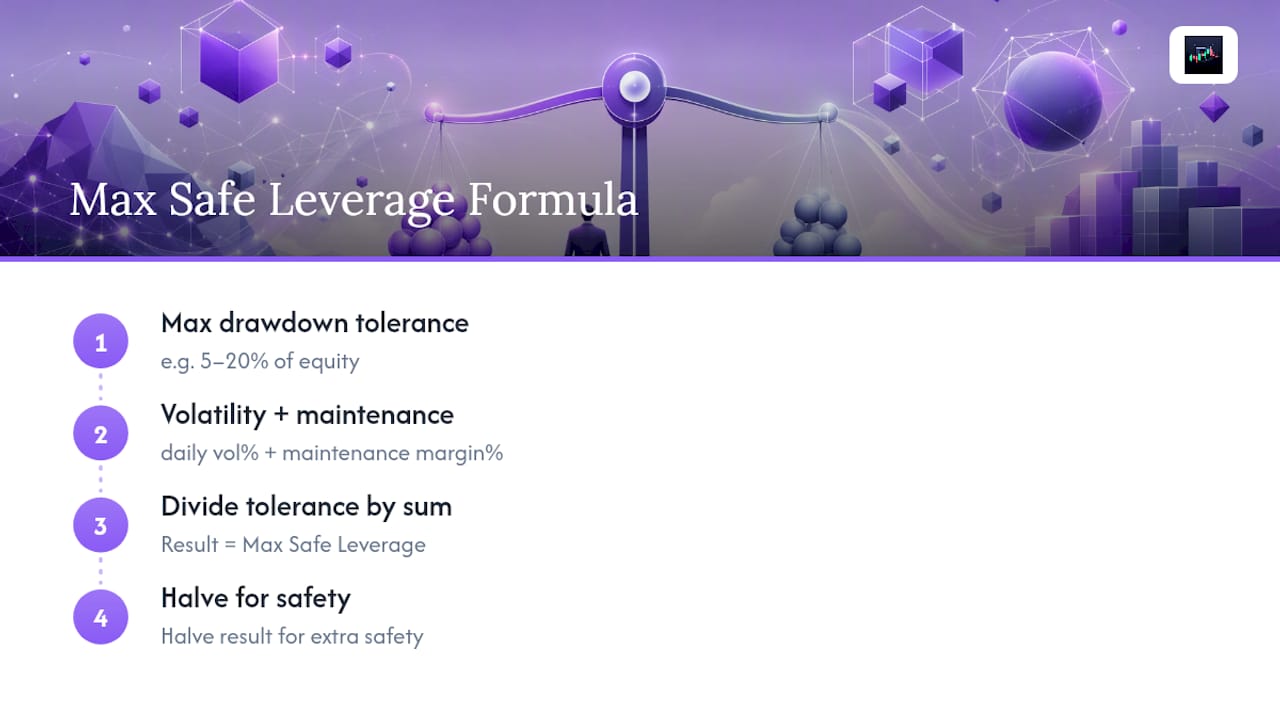
Cut leverage further the moment volatility spikes.
What Account-Level Guardrails Stop a Bad Day From Becoming a Bad Month?
Individual trade rules only work if the account-level brake actually fires. The traders who survive treat the brake as non-negotiable.
- Set the daily loss limit in dollar terms each morning based on that day's equity, and log it somewhere visible.
- Calculate max open risk by summing the dollar risk across every live position; keep the total between 3% and 5% of equity, even across uncorrelated assets.
- When the daily brake trips, stop trading immediately for the session. No exceptions, no "one more trade to get it back."
- After a breach, review your trade journal before the next session, and only resume once you can name what went wrong.
Practical rules to avoid overleveraging consistently point to this same structure: stop before entry, fixed max loss per trade, hard daily brake, capped open risk. A step-by-step risk workflow guide breaks down how to build these checks into a repeatable routine.
Pro Tip: Track breaches, not just wins. A trader who hits the daily brake twice a month is telling you their position sizing is still too aggressive, no matter how the month's P&L looks.

What Do Funding Rates Add to Your Leveraged Crypto Risk?
Perpetual futures don't expire, so exchanges use funding rates to keep the contract price tethered to spot. That funding gets paid between longs and shorts every eight hours, and it's easy to ignore until it isn't.
Baseline funding often runs around 0.01% per eight-hour period, which sounds trivial until it spikes much higher during crowded, one-sided markets. Hold a leveraged long through a period of elevated funding and that carry cost compounds against you daily, on top of any slippage from wide spreads during volatile stretches. Extreme funding also doubles as a sentiment signal: a lopsided rate usually means a crowded trade that's vulnerable to a sharp reversal.
- Check current funding before opening any position you intend to hold longer than a short period.
- Avoid long-duration leveraged holds when funding is elevated; the carry cost erodes the edge you're trying to capture.
- Consider a spot-plus-short-perpetual hedge when you want exposure without directional funding drag, a simple delta-neutral setup for capturing yield or basis rather than direction.
How Discipline AI Puts These Rules Into Practice
Every rule above is only useful if it gets checked the same way every single time, which is exactly where most discretionary traders fail under pressure. Discipline AI's position-sizing and leverage calculator applies the percent-risk formula automatically, converting your stop distance into a position size before you can override it emotionally.
- Confidence scoring and execution guidance flag setups where volatility or liquidity conditions argue for a smaller position or wider stop.
- Stand-aside protection interrupts trades that violate your own daily loss brake or open-risk cap.
- AI trade autopsies review closed trades against your stated rules, showing exactly where sizing or stop placement drifted.
- Behavioral coaching tracks patterns like averaging down or revenge-sizing across your trade history, not just a single session.
A practical workflow: run the pre-trade check inside the app, monitor live positions against your open-risk cap, then review the autopsy after close with cTrader risk management tools list for prop traders. For deeper reading on sizing crypto specifically, see the cryptocurrency position sizing guide.
Why Discipline Beats Cleverness in Leveraged Trading
The traders who last aren't the ones with the best setups. They're the ones who apply the same boring risk rule 500 times in a row without exception. Cleverness gets you one great trade. Discipline gets you a career.
The mistake I see most often isn't bad analysis, it's a trader with a perfectly good thesis who sizes the position based on how confident they feel rather than what the math says. Confidence has nothing to do with your stop distance. Build a routine: check your risk percent, journal every trade, and treat your daily loss brake as a wall, not a suggestion. Test any new rule in a simulated or demo environment before it touches real capital.
— Tony
Put These Rules on Autopilot With Discipline AI
Manually recalculating position size for every trade, tracking open risk across five positions, and remembering to check funding rates before a weekend hold is exactly the kind of repetitive math that erodes discipline under pressure. Discipline AI is built for traders who already know the rules in this article but need something that enforces them automatically, not another indicator to second-guess.
The platform's position-sizing and leverage tools apply your risk percentage the same way every time, its stand-aside protection stops trades that would breach your daily brake, and its trade autopsies show you exactly which rule slipped after a losing streak. Visit the AI Learning Center to see how the calculator, alerts, and coaching tools map to the checklist above, or check the full feature breakdown before you connect your first account.
Sources
For deeper context on the rules covered here, the CFTC's advisory on virtual currency trading risk explains regulatory concerns around leverage and liquidation. Investopedia's breakdown of forex leverage limits covers U.S. broker caps, and the crypto max safe leverage calculator offers a practical tool for the formula above.
This article is general information, not a substitute for advice from a qualified financial advisor. Consult a qualified financial professional about your own circumstances before acting on anything here.
- Customer Advisory: Understand the Risks of Virtual Currency Trading | CFTC
- How Much Leverage Is Right for Your Forex Trades? | Investopedia
- Leverage in trading: how to use it without overloading risk | ForTraders
- Crypto max safe leverage calculator — TradingCalc
- Crypto leverage trading guide | TradeAlgo