Decision fatigue is the progressive breakdown in judgment quality that hits after too many trading decisions stack up in a single session, and it shows up as sloppier entries, wider stops, and rules you'd never break on a fresh Monday morning. The fix that works right now, this session: timebox your active trading window and pre-commit to entry rules before the market opens, so fewer decisions get made in real time. Stanford research on emotion regulation and studies on glucose and willpower both point to the same root cause. Your prefrontal cortex runs out of fuel, and Discipline AI exists partly to catch you before that happens.
TL;DR:
- Traders often make 100 to 200 micro-decisions daily, depleting their mental energy and increasing the risk of impulsive or rule-breaking trades.
- Decision fatigue manifests as hesitations, bias toward holding losers, and skipped checklist steps, especially late in a session when energy is lowest.
- Pre-committing decisions, automating routine actions, and enforcing hard session limits significantly reduce decision fatigue and improve trade discipline.
- Regulating emotions through cognitive reappraisal rather than suppression conserves prefrontal resources and lessens the likelihood of bad decisions.
- Using tools like Discipline AI to automate orders, journal trades, and flag fatigue patterns helps traders maintain consistency and avoid errors caused by mental exhaustion.
Table of Contents
- What Decision Fatigue Looks Like in Trading
- Why Traders Are Especially Vulnerable to Mental Fatigue
- Session Tactics to Prevent Decision Fatigue
- Trade-Level Rules That Cut Micro-Decisions
- Post-Session Review Habits That Prevent Fatigue Decay
- How Technology Helps Enforce the Rules You Just Set
- What I've Learned From Watching Traders Fight Their Own Rules
- Put These Rules on Autopilot With Discipline AI
- Sources
- FAQ
What Decision Fatigue Looks Like in Trading
Every trade involves a cluster of choices: entry timing, size, stop placement, target, whether to add, when to exit early, whether to override the plan when price wobbles. A trader active across multiple setups and timeframes can rack up somewhere between 100 and 200 of these micro-decisions in a single day, and each one draws from the same limited pool of mental energy. Think of it as a decision-budget. You start the session with a full tank, and every choice, no matter how small, spends a little of it.
The behavioral tells that your budget is running low, according to trader-focused analysis of fatigue patterns, are worth memorizing:
- Reluctance to pull the trigger on setups that meet your own criteria
- Status-quo bias: holding a losing position simply because deciding to exit feels harder than doing nothing
- Impulsive entries that skip your normal confirmation step
- Position sizes that creep up or down without a stated reason
- Checklist items getting skipped, especially near the end of a session
Run a quick self-check every hour: are you still reading price action, or are you reacting to it? If you catch yourself rationalizing a rule break in the moment, that's the budget talking, not your edge.
Pro Tip: Set a phone alarm for the two-hour mark of any session. When it goes off, ask yourself one question: would I take this exact trade if I were doing it for the first time today? If the honest answer is no, stop trading for at least twenty minutes.
Why Traders Are Especially Vulnerable to Mental Fatigue
The prefrontal cortex handles what psychologists call System 2 thinking: slow, deliberate, rule-based reasoning. It's the part of your brain running your trading plan. The Cleveland Clinic's overview of prefrontal cortex function describes it as the seat of sustained attention and impulse control, and it happens to be metabolically expensive to keep running. When it tires, your brain defaults to System 1: fast, pattern-matching, emotionally driven judgment. That's the mode that chases a breakout because it "looks like" the last winner.
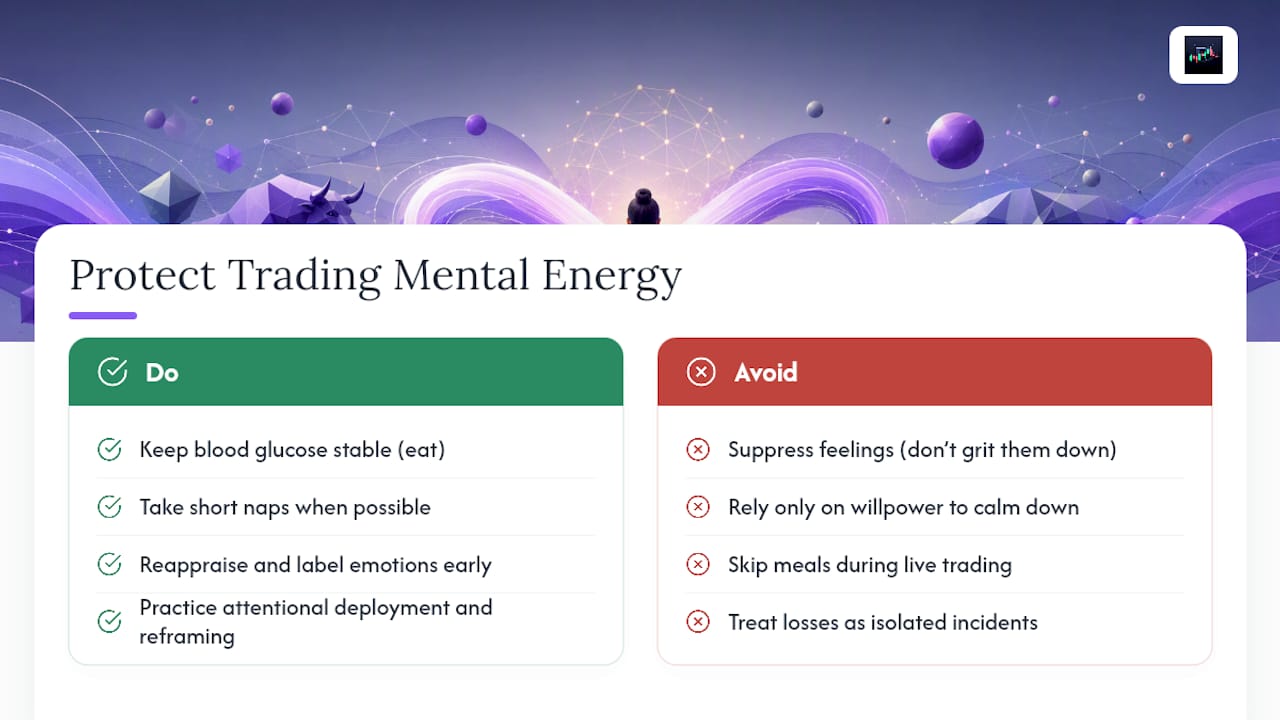
Glucose availability and sleep are the two best-documented levers for restoring that capacity. Harvard Medical School's research on sugar and the brain links stable blood glucose and short naps to measurable improvements in sustained attention and willpower. That's not a license to trade on a candy bar, but it does mean skipping meals during a live session is a bad idea for anyone managing real risk.
Here's the part most trading psychology content misses: how you regulate emotion matters as much as whether you regulate it at all. A meta-analytic review published in PMC found that antecedent-focused strategies, meaning reappraisal and labeling a feeling before it drives a decision, cost far less cognitive energy than suppression, which is just gritting your teeth and pushing the feeling down. Suppression actually taxes the same prefrontal resources you need for trade decisions, so "just staying calm" through willpower alone quietly drains the tank faster. Field studies of traders back this up: higher performers tend to use attentional deployment and cognitive reframing rather than brute-force emotional control, and these are skills that can be trained.
One overlooked wrinkle: emotional carry-over. A loss at 10 a.m. doesn't stay contained to that trade. It taxes the same regulatory system you'll need for the 11 a.m. setup, which is why a string of small losses often precedes one genuinely bad decision.
Session Tactics to Prevent Decision Fatigue
Most of what drains a trader's decision-budget is preventable before the market even opens. The goal is to shrink the number of live judgment calls you make, not your total trading activity.
- Pre-commit the hardest decisions the night before. Set a maximum number of entries, a daily loss limit in dollars or percentage terms, and a ranked watchlist. Deciding these in advance means you're executing a plan, not negotiating with yourself at 9:45 a.m.
- Timebox your active window. Your first two to four hours after market open are typically your sharpest. Protect them. Schedule a break every ninety minutes and set a hard cutoff time you don't move, regardless of how the session is going.
- Automate anything routine. Bracket orders, fixed position-sizing formulas, and platform-level automation remove dozens of micro-decisions before they ever reach your conscious attention.
- Treat energy like a trading input. Sleep, meal timing, and hydration aren't wellness fluff here. They're inputs to your prefrontal cortex's fuel supply, the same way margin is an input to your position size.
- Build enforcement into the system, not into your willpower. A behavioral gate, like a rule that locks new entries after two losses, works because it doesn't rely on you noticing you're depleted. Traders who pre-commit and automate routine choices report fewer fatigue-driven errors and cleaner execution than those relying on in-the-moment discipline.
Pro Tip: Write your daily loss limit on a sticky note and put it on your monitor bezel, not in a settings menu. A rule you have to actively navigate to find is a rule you'll talk yourself out of.
Trade-Level Rules That Cut Micro-Decisions
Session-level structure matters, but the real leak often happens trade by trade. Every open position invites a fresh round of "should I adjust this," and that's where fatigue does its quiet damage.
- Run a three-item pre-entry check before every trade: does the setup match your criteria, is the size correct for your risk plan, and is the stop placed where your plan says it goes. If any answer is no, the trade doesn't happen, no discussion.
- Use bracket orders so entry, stop, and target get decided once, at the calmest possible moment, rather than negotiated live while price is moving against you.
- Set a no-modification window, such as no stop edits for the first fifteen minutes after entry. Most damaging stop-loosening happens in exactly that window, when a trader convinces themselves the market "just needs a little more room."
- If you're going to add to a position, say the reasoning out loud before you click, not after. Something like: "Price broke the level with volume, and I'm adding a quarter unit at my original stop." If you can't state it cleanly, you're not adding to a plan, you're chasing.
- Only adjust a stop when your written plan explicitly allows it, such as trailing behind a new structure level. An adjustment made because you're uncomfortable isn't a rule, it's fatigue wearing a rule's costume.
Bracket orders paired with a no-modification window remove the most common source of slippage and execution error in fast-moving markets, largely because they eliminate the exact moment where tired judgment tends to intervene. For more on tightening entries specifically, see how to reduce trading hesitation without chasing and seven rules to reduce impulsive trade entries.
Post-Session Review Habits That Prevent Fatigue Decay
Profit and loss tells you what happened. It doesn't tell you why, and it's a terrible teacher because a good process can lose money on any given day while a bad one gets lucky. That's the case for grading your process separately from your results, sometimes framed as the 1% rule: judge whether you improved your execution by a small, measurable margin, not whether the account went up.
- Build a journal template with four fields: a screenshot of the setup, your stated rationale, an emotional tag (calm, anxious, frustrated, rushed), and a discipline score from one to five.
- Classify each decision as A, B, or C. An A-decision followed the plan exactly. A B-decision bent a rule with a stated reason. A C-decision broke the plan with no defensible logic. Clustering of C-decisions late in a session is a decision fatigue signal, not a one-off mistake.
- Set an if-then circuit breaker. For example: two losses in a row triggers a mandatory twenty-minute break before any new entry. This works better than trusting yourself to notice you're depleted, since depletion often isn't something you feel accurately in the moment.
- Target one micro-improvement per week, not a full overhaul. Annotating trades and tagging emotional state consistently is what surfaces these micro-patterns, since they're invisible while you're live in the market.
Pro Tip: If three or more C-decisions show up in one session's journal, don't just note it. Move your hard session cutoff thirty minutes earlier tomorrow. Adjust the system, not just your resolve.
How Technology Helps Enforce the Rules You Just Set
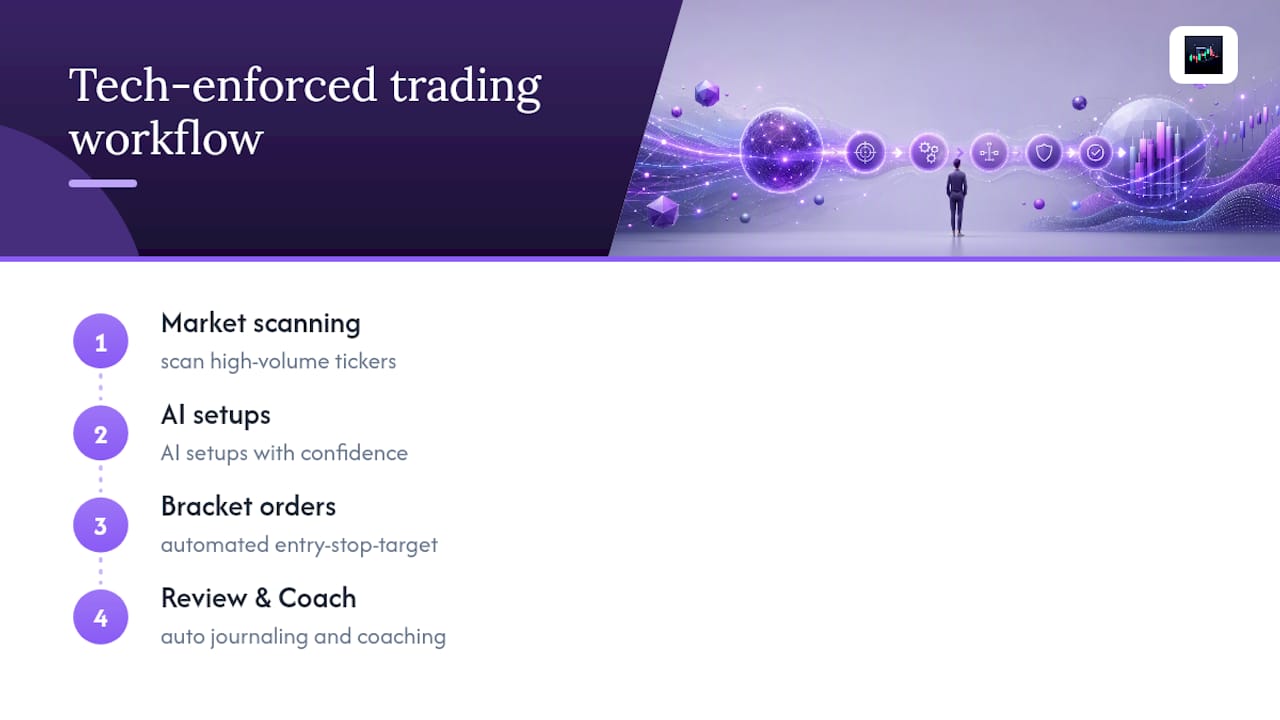
Rules are easy to write and hard to hold onto by 2 p.m. That's the actual gap most trading psychology advice never closes: everyone knows they should timebox and automate, but almost no one has a system that enforces it when their own judgment is the thing that's compromised. This is where a tool like Discipline AI fits into the workflow rather than replacing it.
The platform's market scanning handles the highest-volume decision category first, meaning you're not manually scanning dozens of tickers and burning your budget before you've placed a single trade. AI-generated setups with confidence scores turn "should I take this" into a faster, more structured judgment call instead of an open-ended one. Once you accept a setup, automated bracket orders lock in entry, stop, and target in one motion, closing off the exact mid-trade modification window that tends to cause damage. Automated trade journaling and behavioral coaching then handle the review step, flagging patterns like C-decision clustering without you having to manually tag every trade after a long session. Read more on how AI supports trading psychology.
What I've Learned From Watching Traders Fight Their Own Rules
The traders who hold up under fatigue aren't the ones with the most willpower. They're the ones who stopped trusting willpower and built a system that doesn't need it. The single most useful habit I've seen work, across every strategy and timeframe, is a one-line mental cue repeated before every trade: "Is this decision on the plan, or is this me negotiating?" That question alone catches most of the damage before it happens, because fatigue rarely announces itself. It just quietly lowers the bar for what counts as a good enough reason.
— Tony
Put These Rules on Autopilot With Discipline AI
Discipline AI is built around the exact gap this article keeps circling back to: knowing the rules isn't the same as enforcing them when you're tired. The platform's automated bracket orders lock in your entry, stop, and target in one decision instead of three separate live judgment calls, and its trade journaling tags every session automatically so C-decision clustering shows up without you having to build a spreadsheet at midnight.
Confidence scoring and stand-aside protection do the job your depleted prefrontal cortex can't always do reliably by hour four: flag when a setup doesn't meet the bar, and flag when you shouldn't be trading at all. If you want a structured, guided path to building these habits, The Disciplined Trader is a one-time $79 program built around exactly this kind of rule-based discipline. Or start with the app itself: Discipline AI's Pro plan runs $8.99 per month, $79.99 per year, or $199.99 as a one-off, all detailed on the pricing page. Download the app and let it catch the trades your energy level shouldn't be deciding.
Sources
- James Gross — Stanford SPLe
- Emotion regulation literature review — PMC
- Forex-basics
- Sugar and the brain — Harvard Medical School
- Emotions and trading performance — Wiley Online Library
FAQ
Why Do Most Day Traders Lose Money?
Most losses trace back to inconsistent execution rather than a bad strategy on paper. Decision fatigue is a major driver of that inconsistency: traders start the session following their rules and drift into overtrading, rule-bending, and impulsive entries as their decision-budget depletes over the hours.
How Do You Fix Decision Fatigue as a Trader?
Reduce the total number of live decisions you have to make. That means pre-committing entry rules before the session, automating routine choices like bracket orders and position sizing, and enforcing a hard session cutoff instead of trading until you "feel" tired, since depletion often isn't accurately felt in the moment.
What Is the 3-5-7 Rule in Trading?
It's a risk-management guideline some traders use: risk no more than 3% of capital on any single trade, keep total exposure across all open positions under 5%, and target a risk-reward ratio near 1 to 7. It's a position-sizing framework, not a fatigue-management tool on its own, though pairing it with pre-committed limits reduces live decision points.
Can You Really Make $1,000 a Day Day Trading?
It depends entirely on account size and risk tolerance, and no amount is guaranteed on any given day. Chasing a fixed daily dollar target is actually one of the more common decision fatigue traps, since it pushes traders toward oversized positions or extra trades late in a depleted session just to hit a number.
Does Automation Actually Reduce Trading Stress?
Automating entries, stops, and journaling removes dozens of small live judgment calls that otherwise drain your decision-budget across a session. Tools like Discipline AI apply this directly through automated bracket orders and behavioral tracking, which is part of why platforms built around rule enforcement, not just signal generation, tend to hold up better across a full trading day.