
Place your stop where the trade thesis breaks, not where it feels comfortable. That means beyond the nearest swing low or high, past a support or resistance level, with a volatility buffer sized to the Average True Range (ATR) on your timeframe. Then work backward: size the position so that distance equals 1% to 2% of your account, never the other way around.
TL;DR:
- Most traders should find and mark their invalidation point before entering a trade and size their position based on risk distance, not the other way around.
- ATR-based stops are most effective when combined with structure and adjusted for each trading style, with multipliers ranging from 1.5 to 3 times ATR depending on the holding period.
- Using a trailing stop can better lock in profits during a trend, especially when the stop moves based on ATR or moving averages after the position moves in your favor.
- Disciplining stop-loss placement relies more on psychological discipline, such as placing stops beyond structure and journaling exits, than on finding a perfect method.
- Liquidity and order type choices significantly impact fill prices; in illiquid or volatile markets, stop gaps and slippage can cause actual exits far from the planned levels.
Table of Contents
- What are the best stop-loss methods and when should you use each?
- How do you calculate the right position size for your stop distance?
- How do you set an ATR-based volatility buffer?
- When should you use a trailing stop instead of a fixed one?
- What mistakes wreck stop-loss discipline, and how do you fix them?
- Can automation help you stick to your stop-loss rules?
- Why is stop-loss discipline mostly psychological?
- How do liquidity and slippage affect stop-loss execution?
- How should stop placement differ for stocks, forex, and futures?
- What actually matters most in stop-loss placement?
- Sources
What are the best stop-loss methods and when should you use each?
Most traders default to one method and stick with it forever, which is a mistake. The right stop-loss method depends on the instrument, the timeframe, and how much noise the asset typically produces.
Percentage stops are the simplest: set the stop a fixed percent below entry, commonly used by beginners or illiquid stocks where reliable chart structure is unavailable. The weakness is obvious. A flat percentage ignores what the chart is actually telling you, so it often sits either too tight for a volatile name or too loose for a quiet one.
Support and resistance stops anchor to the level that would invalidate your idea. If you're long above a support shelf, the stop goes below that shelf, plus a buffer, not exactly on it. Placing a stop right at the obvious level is asking to get clipped by the exact traders who watch for that level. A practical primer on stop-loss placement covers this buffer logic in more detail.
Moving-average stops use a 20-day or 50-day moving average as a dynamic invalidation line. As the average shifts, so does your stop. This works well for swing trades in trending markets, since it automatically tightens as a trend matures and loosens during quiet consolidation.
ATR stops size the buffer to current volatility rather than to a fixed dollar or percent amount. Multiply the ATR reading by a factor. Common multipliers run moderate multiples for day trades and higher multiples for swing positions. Our ATR stop-loss guide breaks down the math with more worked examples.
Pattern-based stops go just beyond the point that invalidates a chart pattern. A triangle breakout fails if price closes back inside the triangle; a flag fails if it breaks the opposite trendline. Set the stop past that boundary, not at your entry price.
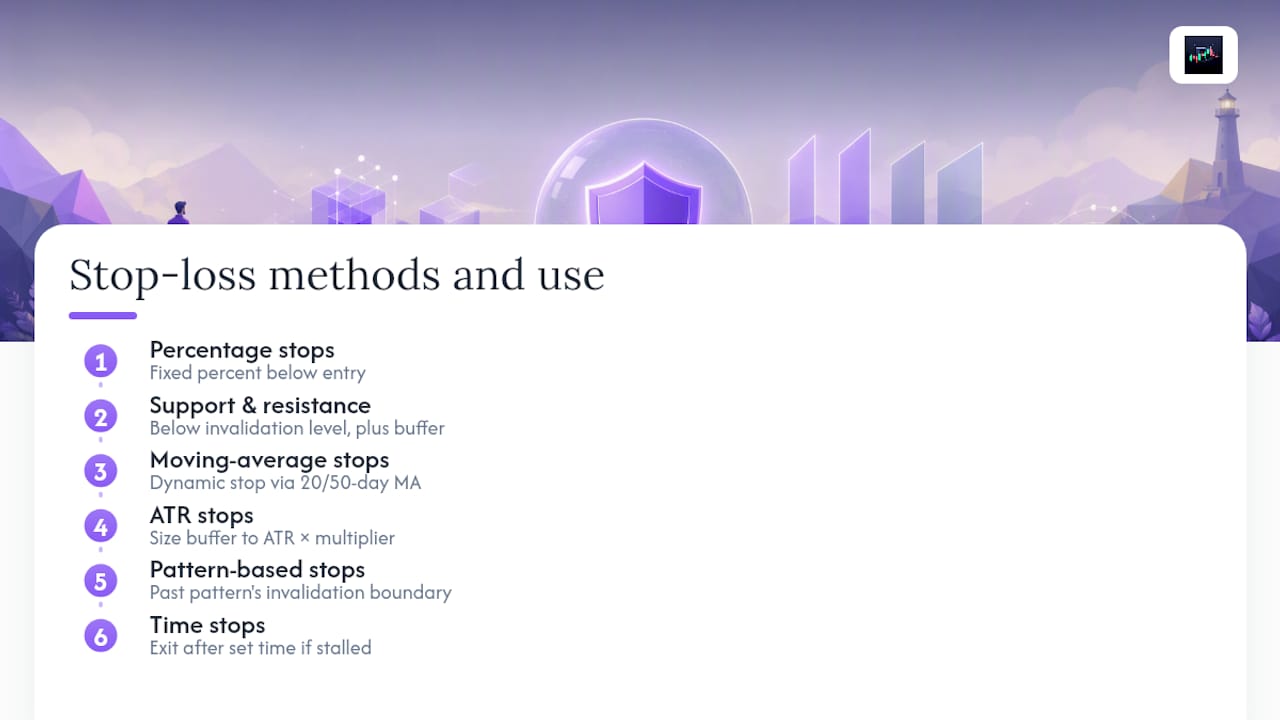
Time stops aren't tied to price at all. If a setup is supposed to resolve within a few candles and it hasn't moved, exit regardless of where the price sits. This pairs well with breakout trades that either work fast or stall out and chop sideways.
How do you calculate the right position size for your stop distance?
Two steps, in this order, every time. Skipping step one and sizing off a gut feeling is how accounts blow up.
- Find the invalidation level. For a long trade, that's the recent swing low or the support zone your entry depends on holding. For a short, it's the swing high or resistance ceiling above you. Mark it on the chart before you enter, not after.
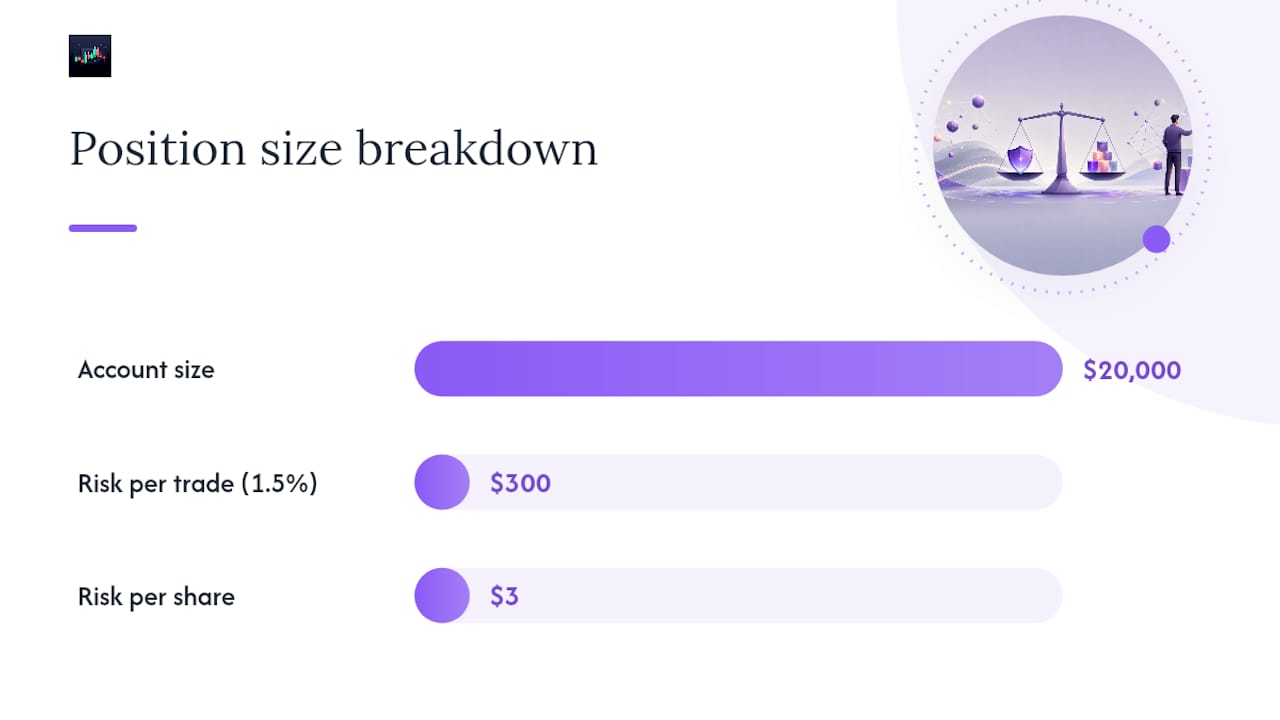
- Measure the distance and calculate size. Subtract the stop price from your entry price to get risk per share (or per unit, per contract). Then apply the formula: position size = (account size × risk percent) / risk per share.
Here's the math in practice. Say you have a $20,000 account and you're risking 1.5% per trade, which is $300. Your entry is $50, your stop is $47, so risk per share is $3. Divide $300 by $3 and you get 100 shares. That's your entire position, sized to the stop, not the other way around.
Pro Tip: Never work backward from "how many shares do I want to buy" to "where should my stop go." That sequence guarantees you'll rationalize a stop that doesn't match the chart.
One order-type note worth flagging: a standard stop order guarantees an exit but not a price, while a stop-limit guarantees price but not an exit. In fast-moving or thin markets, that gap can cost you a filled order entirely. Confirm which type your broker uses by default before you rely on it in a fast tape.
How do you set an ATR-based volatility buffer?
ATR measures the average price range over a set lookback period, usually 14 candles, and it's the standard way to quantify how much a given asset actually moves on a normal day. A comparison of stop-loss placement methods found that combining structure with an ATR buffer cuts down false stop-outs compared with a flat percentage stop, since the buffer flexes with real volatility instead of ignoring it.
Multiplier ranges by style:
- Scalping: 1× to 1.5× ATR, since holding periods are short, and you want a tight leash.
- Intraday swing trades: 1.5× to 2× ATR, enough room to survive normal midday chop.
- Multi-day swing trades: 2× to 3× ATR, because overnight gaps and multi-session noise need more breathing room.
A quiet large-cap stock with a daily ATR of $1.20 might use a 2× multiplier, putting the buffer at $2.40 past the swing low. A volatile crypto asset with an ATR of $800 on a $20,000 token needs a proportionally wider buffer, or the stop gets hit by ordinary noise within hours. The combined rule: find your structural stop level first, then add the ATR buffer on top of it rather than treating ATR as a standalone number floating in space.
When should you use a trailing stop instead of a fixed one?
Fixed stops don't move once set (aside from moving to breakeven or in your favor). Trailing stops follow price at a set distance, letting winners run while locking in gains as the trade develops. Use fixed stops on new positions where the thesis hasn't proven out yet; switch to trailing once the trade has moved meaningfully in your favor, often once price clears your initial risk distance.
- Fixed trailing stops move by a set dollar or point amount as price advances.
- Dynamic trailing stops adjust based on ATR or a moving average, tightening automatically as volatility contracts.
- Recommended trailing distances usually mirror your ATR multiplier from entry, commonly 1.5× to 2× ATR behind the current price.
- Watch platform mechanics: some trailing stop implementations require your platform connection to stay active, and execution can lag during fast moves.
A trade that enters at $100, rallies to $115, and trails a stop 2× ATR behind that peak locks in most of the gain even if price reverses hard the next session.
What mistakes wreck stop-loss discipline, and how do you fix them?
Here's a seven-rule checklist worth pinning above your desk:
- Place stops beyond structure, never exactly on the level everyone else is watching.
- Size to risk first, then let position size fall out of the stop distance.
- Never move a stop further away once it's set. Moving it closer to lock in gains is fine; moving it away to "give the trade room" is how small losses become account-ending ones.
- Default to hard stops, not mental ones you promise yourself you'll execute.
- Avoid round-number stops like $50.00 flat, since crowded levels attract stop-hunting liquidity.
- Use time stops on setups meant to resolve fast.
- Journal every stop-out so you can see whether your placement method is actually working over dozens of trades.
Pro Tip: Copy this into your trading plan: "I place stops beyond structure with an ATR buffer, size to 1 to 2 percent risk, never widen a stop once set, and journal every exit." A structure-first sizing approach is consistently cited as the fix for the single most common cause of account blow-ups: poor exits, not bad entries.
Can automation help you stick to your stop-loss rules?
Manually recalculating ATR, checking chart structure, and doing position-sizing math on every trade is exactly where discipline breaks down under pressure. Software that runs these calculations automatically removes the moment of hesitation where traders talk themselves into a worse stop.
Some experimental research even explores machine-learning approaches to dynamic stop-loss placement for short-term trades, though these methods remain early-stage and need careful validation before real capital rides on them.
Discipline AI approaches this from the practical end: it flags market structure and volatility conditions, runs position-sizing calculators tied to your risk percent, and logs every trade automatically so you can see whether your stop placement is actually working over time. It also includes stand-aside protection, which flags setups that don't meet your own rules before you click the button. For traders who want the workflow built into the platform rather than done by hand, the Discipline AI trade analysis tools run this evidence-first check before execution.
Why is stop-loss discipline mostly psychological?
The math behind stop placement is simple. Sticking to it under pressure is the hard part. Most blown stops aren't caused by bad math, they're caused by a trader watching a losing position and convincing themselves the stop was wrong.
That's loss aversion at work: the pain of realizing a loss feels sharper than the relief of avoiding a bigger one, so traders widen stops, remove them entirely, or "just this once" give a trade extra room. Every one of those decisions violates the rule that stops move in your favor only.
The fix isn't willpower, it's removing the decision point. Set the stop when you enter, before you have any emotional stake in the outcome, and treat moving it as a rule violation rather than a judgment call. Some traders write the stop price on a sticky note or set a hard order immediately rather than a mental one, specifically because a mental stop gives your emotions a vote it shouldn't have.
Journaling every stop-out, win or loss, also breaks the pattern. Reviewing a string of trades where you honored your stop and the account survived a rough patch does more to build discipline than any amount of reading about risk management. Reviewing the trades where you moved a stop and watched the loss double does even more.
How do liquidity and slippage affect stop-loss execution?
A stop order only guarantees a trigger, not a fill price, and the gap between the two widens as liquidity thins out. In a deep, heavily traded stock, a triggered stop usually fills within pennies of your target. In a thin small-cap, an illiquid options contract, or a crypto pair during low-volume hours, that same stop can fill several percent away from where you expected.
Gaps make this worse. If a stock gaps down overnight past your stop price, your order fills at the next available price, not your stop level, sometimes far below it. This is one reason percentage-based stops on individual small-cap stocks can be riskier than they appear on paper.
Stop-limit orders solve the price problem but create a new one: if price blows through your limit without pausing, the order never fills at all and you're left holding a losing position with no exit. There's no universally correct choice between the two. Fast, liquid markets favor plain stop orders since fill risk is low. Thin or highly volatile markets sometimes call for stop-limits, accepting the small chance of no fill in exchange for price certainty. Before relying on either during a volatile session, it's worth checking how your specific broker handles order routing and fill priority, since practices vary by platform.
How should stop placement differ for stocks, forex, and futures?
The underlying logic stays the same across instruments. Find the level that breaks your thesis, add a volatility buffer, size to risk. The execution details change quite a bit.
Stocks trade with defined market hours, so overnight and weekend gap risk is real. A stop set tight against a support level can get gapped straight through at the open, filling well below your intended exit. Wider buffers on earnings weeks aren't optional if you're holding overnight.
Forex trades nearly 24 hours across sessions with wildly different volatility. The Asian session often has a fraction of the range of the London or New York overlap. An ATR buffer calculated during a quiet session and left unchanged into a high-volatility session will be too tight, almost by design. Pip-based stops need recalculating as sessions shift.
Futures carry contract-specific tick values and margin requirements that change your effective risk per point. A one-point stop on the E-mini S&P means something very different in dollar terms than a one-point stop on a smaller-tick contract. Always convert your stop distance into actual dollar risk per contract before sizing, since the price-unit math alone can mislead you.
What actually matters most in stop-loss placement?
Most articles on this topic treat stop placement as a single decision. It isn't. It's two decisions bolted together, where to invalidate and how much to risk, and the second one gets ignored far more often than it should.
The overrated part of this conversation is the search for the "best" method. Percentage, structure, ATR, moving average: none of them beats the others in isolation. What actually separates traders who survive from traders who don't is whether the stop distance was set before position size, and whether the stop moved only in one direction after that. I'd argue the ATR buffer matters less than people think and the discipline to never widen a stop matters more than almost anyone admits.
The practical fix is boring: measure the invalidation point, add a volatility buffer, size backward from that distance, and journal the result. Tools that automate the arithmetic, including platforms like Discipline AI, remove the moment where tired judgment overrides a rule that was correct when you wrote it down. That's the whole game. Not a better formula, just fewer moments where you talk yourself out of the one you already have.
— Tony
Sources
For deeper background on the methods covered here: Investopedia's stop-loss strategy guide covers foundational placement methods, Pablo Espinal's comparison of seven stop-loss methods breaks down ATR and structure combinations, FXCM's trailing stop explainer details dynamic order mechanics, and the CFTC offers broker verification resources for U.S. traders.
- How to Set Effective Stop-Loss Orders: Strategies and Tips — Investopedia
- Where to Actually Place Your Stop Loss — 7 Methods Compared — Pablo Espinal