
Use a fixed-percentage risk rule, commonly 1% of account equity per trade, and size every position with one formula: position size equals account equity times risk percent, divided by stop distance. Layer in ATR-based stops for volatility awareness, and treat the Kelly criterion only as a ceiling, never a target. A tool like Discipline AI can automate the math and log every decision so the rule actually gets followed.
TL;DR:
- Using fixed-percentage risk at 0.5% to 1% per trade helps you survive long losing streaks and scale positions as your account grows.
- Incorporating ATR-based sizing adjusts position size for market volatility, preventing overexposure during turbulent periods.
- Treat the Kelly criterion as a risk ceiling rather than a target, and only use it once you have a substantial sample size of verified trading data.
- Planning your scale-ins before entering a trade ensures you don’t exceed your risk limits while adding to winning positions.
- Automating position sizing and logging with tools like Discipline AI promotes consistent discipline and better trade record-keeping.
Table of Contents
- What Are the Main Position Sizing Methods?
- Fixed-Percentage Position Sizing: The Default Method
- Volatility-Adjusted Sizing: ATR and Inverse-Vol Methods
- Kelly Criterion and Optimal F: Sizing by Statistical Edge
- Pyramiding and Scale-Ins Without Blowing Your Risk Cap
- A Practical Sizing Worksheet You Can Reuse
- How to Choose the Right Method for Your Trading Profile
- Common Position Sizing Mistakes and a Pre-Trade Checklist
- How Discipline AI Puts These Rules Into Practice
- What Actually Separates Traders Who Survive From Those Who Don't
- Automate Your Sizing Rules With Discipline AI
- Sources
What Are the Main Position Sizing Methods?
Every position sizing method answers the same question differently: how much capital should this one trade risk? The families below cover almost every approach professional and retail traders actually use.
- Fixed-percentage (fixed fractional): risk a set percent of equity per trade, the default for most retail traders.
- Fixed-dollar: risk the same dollar amount regardless of account size or trade setup.
- Fixed units: trade the same number of shares, lots, or contracts every time, regardless of stop distance.
- Volatility-adjusted (ATR-based): scale size to an instrument's average true range so risk stays consistent across assets.
- Kelly criterion and Optimal F: size positions based on statistical edge, win rate, and payoff ratio.
- Pyramiding and scale-ins: add to winning positions in planned increments rather than entering full size at once.
- CPPI and TIPP: portfolio-insurance style methods that adjust exposure based on a floor value, more common in fund management than day trading.
Stocks and forex traders lean on fixed-percentage and ATR sizing. Futures and crypto traders often blend ATR sizing with fixed units because contract sizes are chunkier. The next sections walk through the math for each, starting with the one you should probably be using right now.
Fixed-Percentage Position Sizing: The Default Method
Fixed-fractional sizing, more commonly called fixed-percentage risk, is the starting point Investopedia recommends for most traders, and for good reason: it scales automatically as your account grows or shrinks, which fixed-dollar and fixed-unit methods don't do.
The formula: position size = (account × risk %) ÷ stop distance. Stop distance is the dollars, pips, or points between your entry and your stop loss. The stop comes first, from chart structure or volatility, not from how many shares you'd like to own. Size is the output, never the input.
Pro Tip: If you're calculating size before you've marked a stop, you're doing it backwards. Find the invalidation point first, then let the formula tell you the size.
Three quick examples:
- Stocks: $50,000 account, 1% risk = $500. Stop is $2 below entry. Position size = $500 ÷ $2 = 250 shares.
- Crypto: $10,000 account, 1% risk = $100. Stop distance is $400 on a Bitcoin swing trade. Position size = $100 ÷ $400 = 0.25 BTC.
- Futures: $25,000 account, 0.5% risk = $125. Stop distance is 25 ticks at $5 per tick ($125 per contract). Position size = $125 ÷ $125 = 1 contract.
Risk bands matter more than most new traders realize. A 0.5% risk-per-trade rule is conservative and built for survivability through long losing streaks. 2% is aggressive, and it compounds fast in both directions. A trader risking 2% who hits ten losses in a row is down roughly 18% of the account; the same streak at 0.5% costs under 5%. That gap is why most professional risk frameworks cap single-trade risk well below 2%.
Volatility-Adjusted Sizing: ATR and Inverse-Vol Methods
Fixed-percentage sizing has a blind spot: it doesn't account for how much an instrument actually moves. That's where ATR-based sizing comes in.
The formula: size = risk $ ÷ (N × ATR), where N is a multiplier, typically between 1.5 and 2.5, applied to the Average True Range. A tighter N (1.5) keeps stops close and increases size; a wider N (2.5) gives the trade more room to breathe but shrinks the position accordingly.
Converting ATR to dollars just means multiplying the ATR value by the dollar value per point, tick, or pip for that instrument. Once you have that dollar figure, the math is identical to the fixed-percentage formula, just with a volatility-derived stop distance instead of a chart-based one.
- Choose N based on timeframe: shorter timeframes often use tighter multipliers, swing trades use wider ones.
- Recalculate ATR before every trade. Volatility regimes shift, and yesterday's ATR can be stale within days.
- At the portfolio level, some traders scale total exposure to a volatility target, keeping overall portfolio swings consistent across a mix of calm and turbulent assets.
Pro Tip: ATR sizing smooths your equity curve, but it can also mute returns during strong directional trends, since it trims size on the very trades that end up running the furthest. Think of it as a stabilizer, not a return booster.
Kelly Criterion and Optimal F: Sizing by Statistical Edge
Kelly and Optimal F size positions based on your actual statistical edge rather than a flat percentage. Kelly needs two inputs: your win probability and your average win-to-loss ratio. Feed those into the formula and it spits out the theoretically optimal fraction of capital to risk per trade.
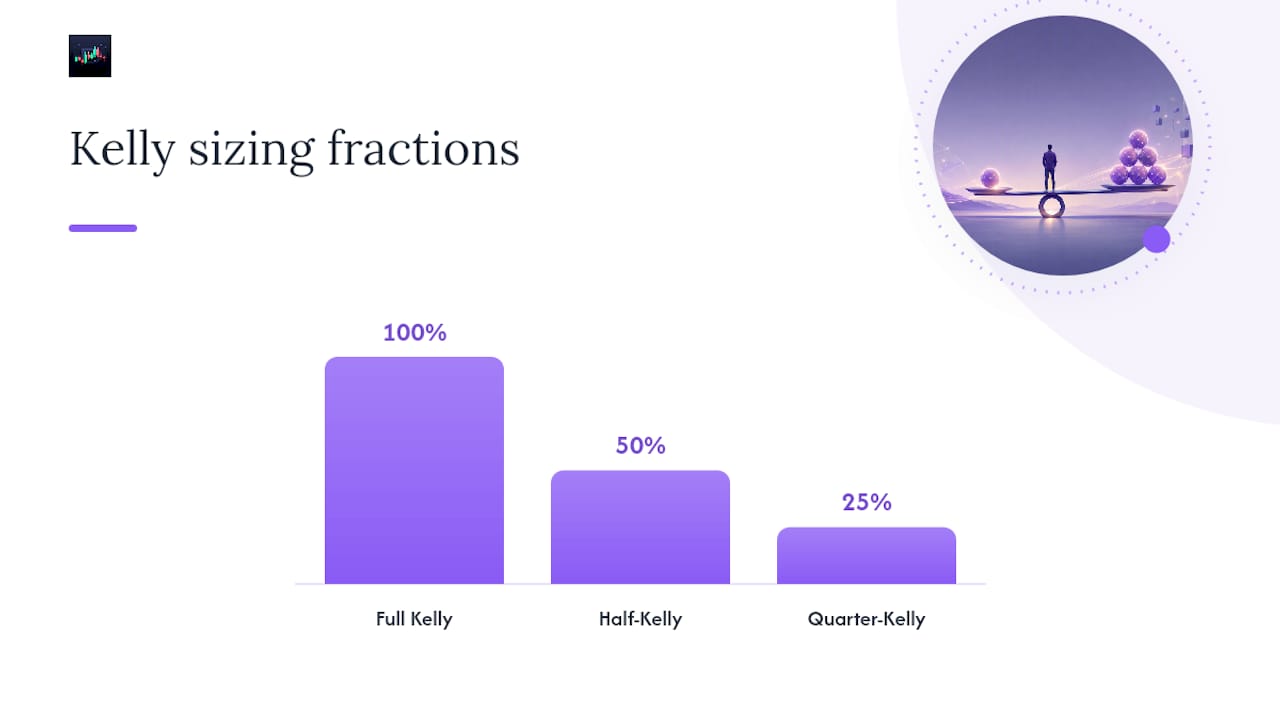
The problem is that full Kelly is brutal in practice. That looks great on a spreadsheet and terrible on a real equity curve, because full Kelly assumes your edge estimate is exact and stays constant. It rarely does.
That's why combining a base risk-per-trade rule with a Kelly-derived ceiling, often half-Kelly or quarter-Kelly, works better than using Kelly outright. Half-Kelly cuts the theoretical growth rate only slightly while cutting variance dramatically.
- Never trust a Kelly output from fewer than 50 to 100 trades of real data.
- Optimal F works similarly but optimizes against your worst historical drawdown, and it demands the same rigorous backtesting before you trust it.
- Treat Kelly as a governor on size, not a recipe. Fixed-percentage or ATR sizing should still set your working number.
Read more on Kelly criterion inputs and conservative application before trying to apply it live.
Pyramiding and Scale-Ins Without Blowing Your Risk Cap
Adding to a winning position feels good, but stacked entries create stacked risk if you haven't planned for it. The rule: build the entire ladder before you place the first order, not after the trade starts working.
- Decide your total risk budget for the trade upfront, matching your per-trade cap (say, 1%).
- Split that budget across entries, a common pattern is 40/30/30 or 50/30/20, with the first clip carrying the most weight.
- Move your stop up (or down, for shorts) as each new clip goes in, so earlier clips become progressively risk-free.
- Confirm that the sum of all open risk across the ladder never exceeds your original 1% cap, even mid-build.
This is fundamentally different from averaging down, which adds risk to a losing idea. Pyramiding only adds to strength, and the moving stop is what keeps aggregated risk from silently doubling.
A Practical Sizing Worksheet You Can Reuse
Before every trade, run through the same five fields. Consistency here is what separates disciplined sizing from guesswork.
- Account equity right now (not last week's balance)
- Risk percent for this trade (0.5%, 1%, or your chosen band)
- Stop distance from entry to invalidation
- Dollar risk (equity × risk %)
- Position size (dollar risk ÷ stop distance, converted to shares, lots, or units)
For forex, pip value depends on lot size, so convert pip distance to dollars first, then divide. For crypto, fractional coin sizing is normal, no need to round to whole units. When a calculated futures size lands between whole contracts, use micro contracts or micro-lots instead of rounding up into extra risk. See more worked crypto and forex examples for additional scenarios.
How to Choose the Right Method for Your Trading Profile
The right position sizing method depends on four things: account size, how much statistical evidence you have behind your edge, the volatility of what you trade, and your own psychological tolerance for drawdown.
- Small account, unproven strategy: fixed-percentage at 0.5 to 1%, no leverage stacking, no Kelly until you have real sample size.
- Established strategy, mixed-volatility instruments: fixed-percentage combined with ATR-based stops for consistency across assets.
- Verified edge, 100+ trade sample: consider a conservative Kelly ceiling (quarter to half-Kelly) layered over your existing risk-per-trade rule.
- Multi-asset portfolio: add a portfolio-level volatility target so one turbulent asset doesn't dominate total swings.
The rollout that works in practice: start with fixed-percentage sizing and ATR-based stops, paper-trade it for a stretch, journal every entry and exit, then only introduce a Kelly ceiling once your win rate and payoff ratio are backed by real numbers, not a hunch.
Pro Tip: If you can't explain why your stop is where it is without mentioning your account balance, you've sized the trade backwards. Structure sets the stop; risk percent sets the size.
Common Position Sizing Mistakes and a Pre-Trade Checklist
The costliest mistake is calculating size before placing the stop, since it means the "stop" gets fit to a comfortable position size instead of real chart structure. Close behind: ignoring volatility, using the same fixed unit lot on every trade regardless of instrument, over-leveraging because margin allows it, and forgetting to aggregate risk across multiple open positions.
- Mark the stop from structure or ATR first, always.
- Calculate dollar risk before position size, never the reverse.
- Add up total risk across every open trade, not just the new one.
- Set a daily loss limit and treat it as a hard stop for the day.
- Recheck leverage against actual dollar risk, not just available margin.
A daily loss limit with an automated cutoff removes the temptation to override your own rules after a rough morning.
How Discipline AI Puts These Rules Into Practice
Manually recalculating position size for every trade, across every instrument, is where most traders quietly drop the discipline. Discipline AI builds the sizing rules covered above directly into the platform's workflow.
- Built-in risk calculators apply the account times risk percent, divided by stop distance formula automatically.
- ATR-based suggestions adjust stop distance and size recommendations per instrument and timeframe.
- Confidence scores flag setups worth sizing up versus setups that deserve a smaller, cautious clip.
- Automated trade journaling logs every sizing decision alongside the outcome.
- AI trade autopsies review closed trades to show where sizing helped or hurt the result.
The workflow: compute size with the worksheet, log it to the journal, then let the platform track aggregated exposure and daily loss limits across every open position. For crypto specifics, the guide on sizing crypto trades without overleveraging covers the instrument-specific traps.
What Actually Separates Traders Who Survive From Those Who Don't
Most traders don't blow up because they picked the wrong sizing formula. They blow up because they abandoned a decent formula the first time it felt too small during a hot streak or too painful during a losing one. The math in this article is not complicated. Sticking to it when your gut says otherwise is the entire game.
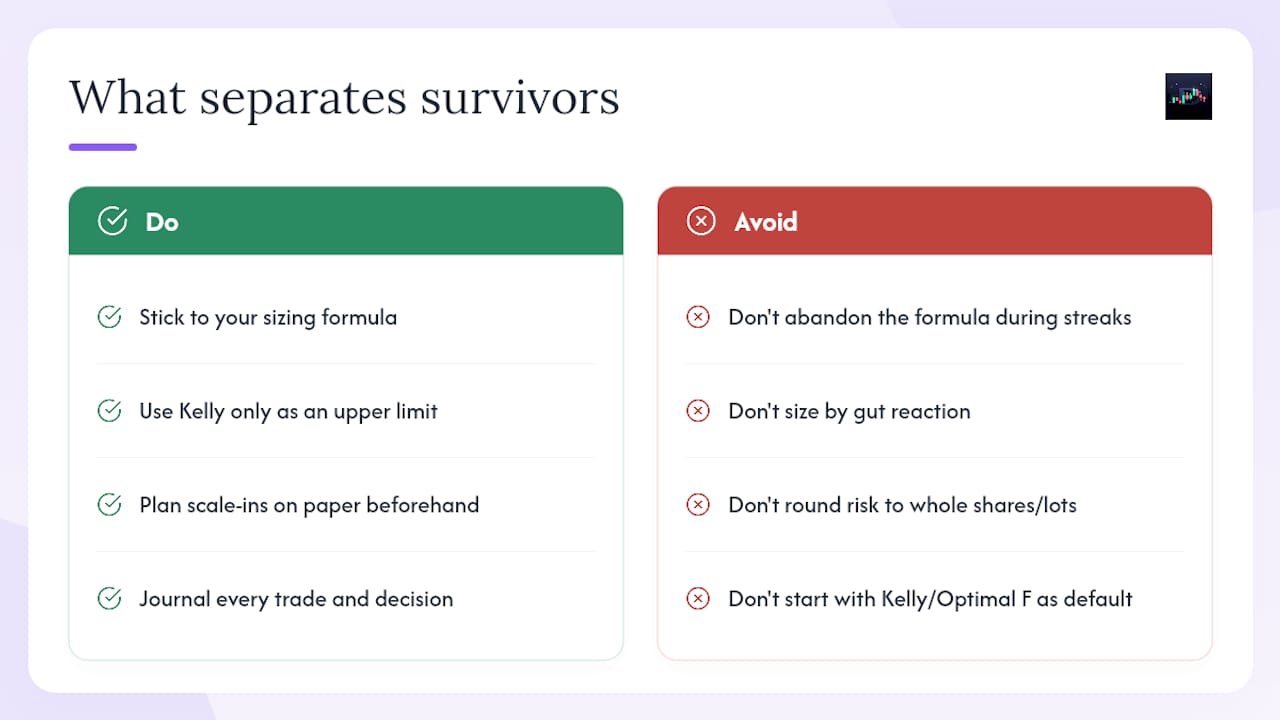
My honest bias: skip the temptation to jump straight to Kelly or Optimal F because they sound sophisticated. Use Kelly as a ceiling once you have the sample size to trust it, not as your starting framework. Plan your scale-ins on paper before you're in the trade, and use micro contracts or fractional units rather than rounding your risk up to fit a whole share or lot.
Journal everything. The traders who improve fastest are the ones who can look back and see exactly why a position was sized the way it was, not just what happened after.
— Tony
Automate Your Sizing Rules With Discipline AI
Discipline AI is the practical shortcut for traders who know the formulas but don't want to run them by hand on every setup. Instead of pulling up a calculator, checking ATR manually, and hoping you remember to log the trade afterward, the platform handles the risk math, suggests ATR-adjusted stops, and journals the result automatically.

The confidence scoring and AI trade autopsies mean you're not just sizing correctly once, you're building a record that shows whether your sizing rules are actually working over time. That feedback loop is what turns a good formula into a consistent habit. If you're serious about applying fixed-percentage sizing, ATR-based stops, and a Kelly ceiling without doing the arithmetic manually before every trade, check out the Discipline AI platform and see how the calculators and journaling tools map onto the rules covered here.
Sources
- Manage Trading Risk: Effective Position Sizing Techniques
- How to Size a Position — Risk-Based, Kelly, and Vol-Targeted Sizing Compared
- Position Sizing Strategies and Techniques in Trading
- Position Sizing Deep Dive - TradeOlogy Academy