
Confidence weighted sizing means scaling your position size in direct proportion to your model's calibrated confidence score, tempered by volatility, market regime, and hard risk caps. A trader working from AI trade signals should risk more when the model's stated probability of success is high and less when it's marginal, but never so much that a single bad calibration cycle wrecks the account.
TL;DR:
- Confidence-weighted sizing improves risk-adjusted returns and reduces drawdowns, with validation showing better Sharpe and Sortino ratios compared to flat sizing.
- Use conviction tiers or continuous z-score methods to map model confidence to position size, ensuring extreme confidence does not lead to disproportionate bets.
- Adjust size based on market regime and volatility, shrinking positions in choppy markets and enlarging them during trending periods within specified multipliers.
- Continuously calibrate confidence scores, monitor live performance, and cut risk when model reliability metrics decline below predefined thresholds.
- When managing multiple signals, divide exposure by the number of active signals to prevent risk stacking in correlated bets.
Table of Contents
- Why Should Position Size Reflect Model Confidence?
- What Are the Best Methods for Mapping Confidence to Position Size?
- How Should Volatility and Market Regime Change Your Size?
- How Do You Implement Confidence Weighted Sizing in Live Trading?
- How Do You Verify That Confidence Weighted Sizing Actually Works?
- Quick Reference: Formulas and Tier Examples
- What Discipline Actually Looks Like When Sizing by Confidence
- How Discipline AI Turns Confidence Scores Into Sizing Decisions
- Sources
- FAQ
Why Should Position Size Reflect Model Confidence?
Position size is really a function of two things: edge and uncertainty. Edge is the expected advantage a signal gives you. Uncertainty is how much you should trust that estimate. A model that's right 65% of the time with a tight, well-tested probability distribution deserves a bigger bet than one that's also right 65% of the time but built on 40 historical trades and a shaky feature set.
This is exactly the logic behind fractional Kelly sizing, which discounts the theoretical Kelly bet size to account for the fact that your edge estimate is just that, an estimate, not a known constant. Flat sizing ignores this distinction entirely. Every trade gets the same risk allocation whether the model is barely above a coin flip or firing on all cylinders.
The payoff for weighting by confidence shows up in the numbers. One validation study on confidence-weighted position sizing found a measurable Sharpe ratio improvement when size scaled with model confidence instead of staying flat. A separate ScienceDirect analysis of an explainability-driven risk policy reported a Sharpe of 2.11 and a Sortino of 2.98 in its backtest, with drawdowns held under 4%, when confidence signals informed both entries and sizing.
What actually earns your trust in a sizing system:
- Backtest comparisons showing risk-adjusted returns improve when size scales with confidence, not just raw win rate
- Calibration checks confirming a "70% confidence" signal actually wins around 70% of the time
- Consistent behavior across market regimes, not just the bull run where the model was trained
What Are the Best Methods for Mapping Confidence to Position Size?
There are two practical schools of thought here, and most experienced traders end up using a blend of both.
1. Conviction tiers. This is the simplest approach and the easiest to audit. Bucket signals into low, medium, and high conviction, then assign a fixed risk multiplier to each bucket. High-confidence signals get a larger multiplier. It's blunt, but it's transparent, and transparency matters when you're trying to catch a broken model early.
2. Continuous z-score mapping. For a smoother curve, calculate a z-score from the model's predicted probability: z = (p minus the base rate) divided by the square root of p times (1 minus p). Feed that z-score through a normal cumulative distribution function to generate a scaling factor between 0 and 1, then apply it to your base size. This method, drawn from AFML-style bet-sizing techniques, naturally saturates near the extremes so a 99% confidence reading doesn't blow past a 90% reading by an absurd margin.
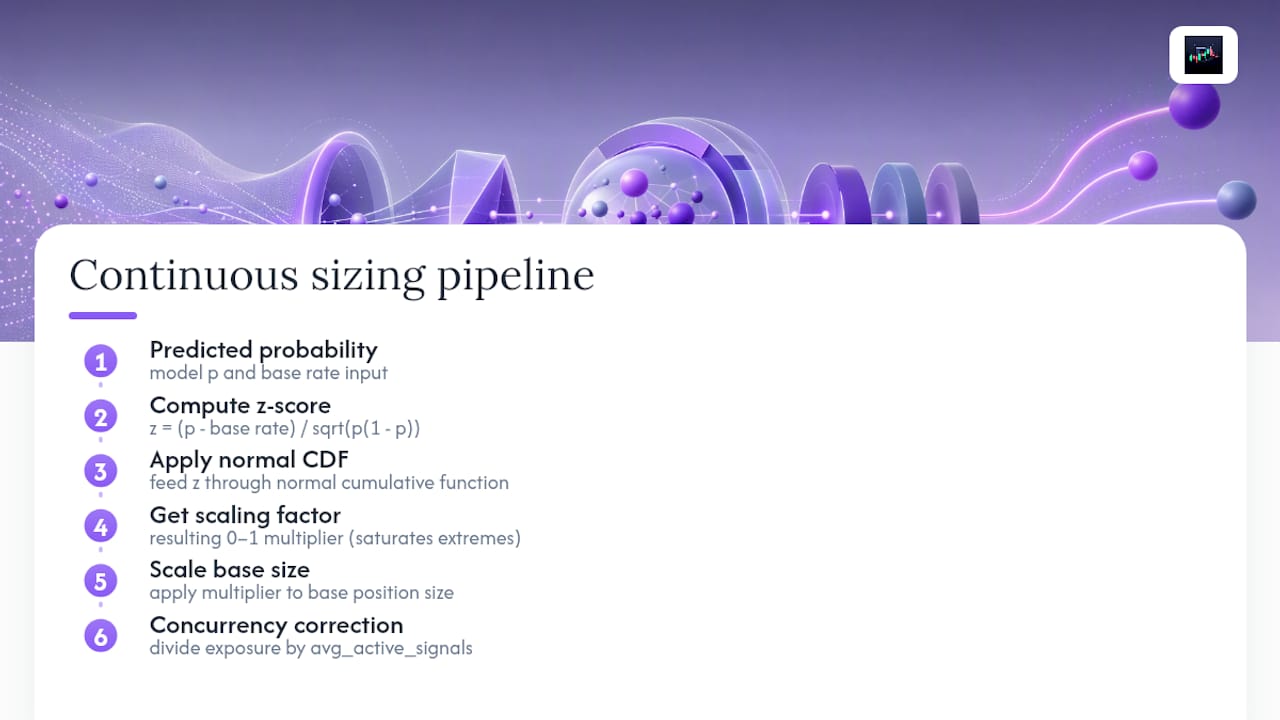
3. Concurrency correction. When multiple signals are live at once, dividing exposure by the average number of active signals (avg_active_signals) keeps your total portfolio risk from creeping up just because five setups fired in the same session.
That single rule, backed by MQL5's bet-sizing research, often cuts effective transaction costs more than any indicator tweak.*
How Should Volatility and Market Regime Change Your Size?
A high-confidence signal in a violently choppy market is not the same bet as a high-confidence signal in a smooth trend, even if the model assigns both the same probability. This is where confidence weighted sizing needs a second layer: volatility and regime adjustment.
Start by measuring realized volatility for the instrument and computing a volatility scalar: target volatility divided by the greater of realized volatility or a small floor value, capped at some reasonable maximum. This equalizes dollar risk across instruments with wildly different swing sizes, so a calm large cap stock and a wild altcoin don't get treated identically just because both signals hit the same confidence threshold.
Vol-scaling in plain terms: A stock that moves 1% a day and a token that moves 8% a day carrying the same 75% confidence score should never get the same dollar risk. Inverse-volatility scaling forces the token's position to be smaller so both trades carry comparable dollar exposure, not comparable share or coin counts.
Layer in a regime multiplier on top of that:
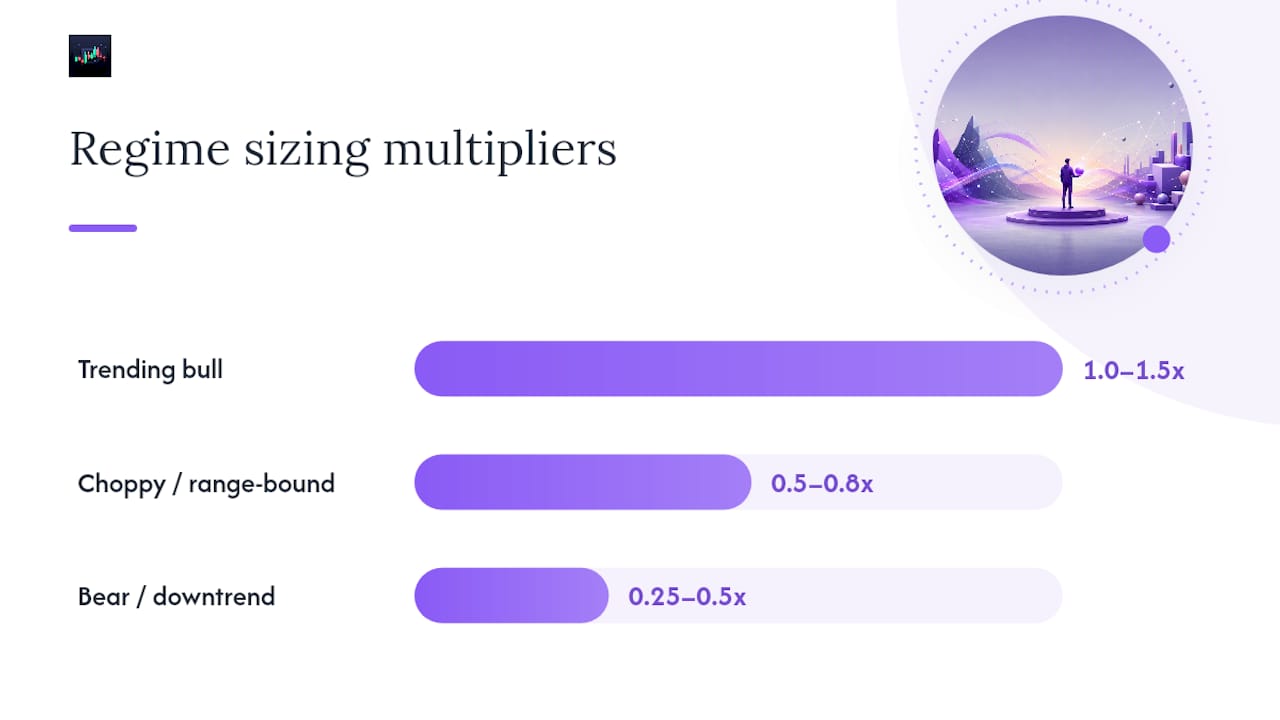
- Trending bull conditions: multiplier range of roughly 1.0x to 1.5x
- Bear or downtrend conditions: dial back to 0.25x to 0.5x
- Choppy, range-bound conditions: stay conservative at 0.5x to 0.8x, since regime-aware sizing rules consistently show chop as the regime where false confidence does the most damage
Put together, a workable final formula looks like this: final size equals base size times confidence multiplier times volatility scalar, with appropriate caps applied last.
How Do You Implement Confidence Weighted Sizing in Live Trading?
Moving this from spreadsheet to live execution takes a specific sequence, not a leap of faith.
- Calibrate first. Before scaling anything, verify your model's confidence scores are honest. Build a reliability diagram, calculate a Brier score, and apply Platt scaling or isotonic regression if the raw outputs are skewed.
- Build the sizing engine. Implement the bet_size_probability function, the avg_active_signals concurrency correction, and step_size discretization together, since AFML-style implementations treat these as one connected system, not separate patches.
- Respect execution limits. Minimum lot sizes, slippage budgets, and broker-specific increments will clip or block low-confidence trades, and liquidity research on position sizing shows this is a real constraint, not an edge case.
- Monitor continuously. Run a live dashboard tracking hit rates by confidence bucket, calibration drift over time, and automated alerts when reliability slips.
Escalating the baseline after a winning streak is how disciplined systems quietly turn reckless.*
How Do You Verify That Confidence Weighted Sizing Actually Works?
A sizing rule that looks great on a clean backtest and falls apart live is worse than useless. It's a false sense of security.
Run backtests that include realistic transaction costs, concurrency limits, and actual fill assumptions rather than fills at the mid price. Then split those results by confidence bucket and check risk-adjusted metrics, Sharpe and Sortino, ideally cross-referenced against a general risk-adjusted return framework, for each tier separately. A system where the high-confidence bucket doesn't meaningfully outperform the low-confidence bucket is telling you the confidence score isn't earning its keep.
Walk-forward testing matters more here than in flat-sizing systems, because confidence weighting can quietly overfit to a specific volatility regime. Layer in a fractional Kelly sanity check against your live sizing outputs, and stress-test with correlated drawdown scenarios where several positions move against you simultaneously.
Set a hard stop rule in advance: when your rolling Brier score or calibration curve degrades past a defined threshold, cut sizing back to flat risk until the model is retrained and reverified. Never let sizing stay aggressive on a model you can no longer verify.
Quick Reference: Formulas and Tier Examples
For a fast implementation, use this z-score snippet: z = (p - base_rate) / sqrt(p * (1 - p)), then map z through the normal CDF to get a scaling factor between 0 and 1.
Apply step_size discretization at 0.05 increments so small probability shifts don't trigger constant re-trades, and clip every final size to your broker's lot-step minimum before submission.
What Discipline Actually Looks Like When Sizing by Confidence
Calibrated sizing rules only work if you actually follow them when it's uncomfortable. The hardest moment isn't building the z-score mapping, it's resisting the urge to size up after three consecutive wins without rechecking that the model's calibration hasn't drifted. Concentration and correlation checks matter just as much as the confidence score itself. Five "high confidence" crypto signals firing at once aren't five independent bets if they're all riding the same market move.
— Tony
How Discipline AI Turns Confidence Scores Into Sizing Decisions
Building a confidence weighted sizing system from scratch means writing calibration code, backtesting infrastructure, and a live monitoring dashboard before you place a single trade. The platform provides infrastructure including trade setups with confidence scores, execution guidance, and performance analytics designed to show whether model confidence matches real outcomes over time.

The platform's AI Learning Center walks through probability calibration and position sizing methods step by step, while internal guides like position sizing examples for crypto and forex give you tier templates you can adapt instead of building from zero. Discipline AI's trade journaling and behavioral coaching also flag the exact mistake most traders make with confidence weighting: sizing up after a hot streak instead of after a genuine calibration check. If you want a working sizing system rather than a spreadsheet project, start with the AI Learning Center and set up your first confidence-based rule this week.
Sources
- ml-model-validation (GitHub)
- ScienceDirect article on XAI-driven hybrid portfolio management
- Position Sizing: Translating Research… | Zylo Quant
- MetaTrader 5 Machine Learning Blueprint (Part 10): Bet Sizing for Financial Machine Learning - MQL5 Articles
FAQ
How Do I Handle Multiple Overlapping Signals?
Divide your intended exposure by the average number of active signals (avg_active_signals) so overlapping high-confidence bets don't stack into an outsized total portfolio risk.
How Often Should I Recalibrate My Confidence Scores?
Recalibrate whenever your rolling Brier score or reliability diagram shows meaningful drift, and treat any sustained calibration degradation as a signal to cut sizing back to flat risk immediately.