
An AI trading coach is a decision-support and behavioral-review tool that studies your trade history, journal entries, and rule adherence to show you what to repeat, stop, or test next. It does not guarantee profits or generate autonomous signals. Its main job is to turn your past trades into structured feedback so you catch the habits that quietly erode your results, with options like Discipline AI built around that review loop.
TL;DR:
- A useful coach should track average win and loss size, holding times, rule violations, slippage, and latency rather than relying on win rate alone.
- A study of over 28.5 million trades involving more than 81,000 traders documented loss aversion, including taking small gains while holding losses.
- Change only one behavior or rule each week; changing stops, position size, and entry criteria together prevents you from identifying which adjustment affected results.
- Before connecting an account, confirm read only access, review data permissions, and avoid guaranteed return claims; a coaching tool should not place trades.
- Discipline AI's Pro plan costs $8.99 monthly, $79.99 annually, or $199.99 once, while The Disciplined Trader costs $79 one time.
Table of Contents
- What an AI Trading Coach Actually Does: Inputs, Features, and Outputs
- Where AI Coaching Helps Most: Behavioral Failure Modes and the Metrics to Track
- How to Use an AI Trading Coach Effectively
- What to Check Before You Trust or Subscribe to an AI Trading Coach
- How Discipline AI Maps Onto This Workflow
- Connecting an AI Coach to Your Trading Platforms
- Types of AI Models Used in Trading Coaching
- What Successful Use of an AI Trading Coach Looks Like
- Cost and Subscription Models for AI Trading Coaches
- A Candid Look at What AI Coaching Can and Cannot Do
- Try Discipline AI for Behavioral Trade Review
- FAQ
- Sources
What an AI Trading Coach Actually Does: Inputs, Features, and Outputs
An AI trading coach works like a feedback loop built around your own trading data rather than a crystal ball. You feed it your trade history, order fills, written rules, risk parameters, and journal notes, and it looks for patterns you would struggle to spot on your own, especially across dozens or hundreds of trades.

The quality of what comes out depends heavily on what goes in. A coach that only sees closed positions misses the context of why you entered, what your plan was, and whether you followed it.
Typical inputs a coach uses:
- Trade history and order fills, including entry, exit, size, and timestamps
- Written trading rules and risk parameters you have defined in advance
- Journal entries noting your reasoning, emotions, or market read at the time
- Broker execution metadata such as fill price versus requested price
Typical outputs you should expect:
- Trade reviews that flag deviations from your stated plan
- Rule-adherence scores tracked over time
- Behavioral flags for patterns like early exits or oversized positions
- Confidence calibration on setups, shown as a score rather than a promise
- Periodic autopsies that summarize recurring strengths and weaknesses
The distinction that matters most is coaching feedback versus automated execution. A coaching tool reviews and advises. It does not place trades for you. The best implementations keep a human in the loop at every decision point and explain their reasoning in plain language rather than handing you an opaque score and asking you to trust it.
Where AI Coaching Helps Most: Behavioral Failure Modes and the Metrics to Track
Most trading losses trace back to a small set of repeat behaviors rather than bad analysis. Loss aversion and the reflection effect push traders to lock in small wins quickly while letting losing trades run, hoping for a reversal. Overconfidence after a winning streak often leads to oversized positions or more frequent trades than the original plan called for. Volatile sessions tend to trigger impulsive entries or early stop removal, exactly when discipline matters most.
A large-scale study of over 28.5 million trades from more than 81,000 traders documented these prospect-theory behaviors directly, which is why a useful coach tracks more than win rate.
Metrics worth tracking every week:
- Win/loss holding-time ratio, since holding losers longer than winners signals loss aversion
- Risk-reward ratio per trade, compared against your stated plan
- Rule-violation rate, counting entries or exits outside your written criteria
- Slippage and latency, to separate execution quality from strategy quality
- Average win versus average loss, tracked as a ratio over time
One sourced insight worth sitting with: Research on prospect theory in trading found that coaching built only around celebrating profitable outcomes can reinforce the exact habits that hurt long-term performance, like taking small gains too early while letting losses run unchecked.
When a coach flags a pattern like repeated stop removal during drawdowns, the useful response is specific: reapply the original stop rule for the next ten trades, or cut session risk in half until the violation rate drops.
How to Use an AI Trading Coach Effectively
The biggest misuse of an AI trading coach is letting it become another excuse to trade more. Used well, it should slow you down at the exact moments you are most likely to act on impulse.
A workable weekly routine looks like this:
- Define your rules and risk limits in writing before connecting any data.
- Import or connect your trade history, journal, and broker execution data.
- Complete a short pre-session plan naming your setups and maximum risk for the day.
- Run each potential trade through the coach's setup check before entering.
- Record a short post-trade note while the reasoning is still fresh.
- Review the weekly autopsy for recurring behavioral flags.
- Adjust exactly one behavior or rule at a time, never several at once.
Changing one variable per week is the only way to know which adjustment actually worked. Traders who change their stop placement, position size, and entry criteria simultaneously have no way to attribute the result.
Use the coach's prompts as intentional friction, not as noise to dismiss. A confirmation step before a leveraged or oversized trade exists to interrupt the exact impulse that causes damage. Regulatory commentary on execution risk specifically recommends added prompts at order placement to reduce careless mistakes, and that friction works only if you let it slow you down instead of clicking through.
Separate execution quality from directional accuracy in your own review. A trade can be the right call and still lose money to slippage, latency, or a missed fill, and conflating the two makes it harder to know what to actually fix.
Pro Tip: Set your reporting cadence before you start: daily behavioral flags, weekly autopsies, and a monthly trend review, so you are never reacting to a single bad session.
What to Check Before You Trust or Subscribe to an AI Trading Coach
Marketing claims in this space move faster than the regulation around them, so a short vetting pass before you subscribe to anything saves real money.
- Confirm the product separates coaching and self-review from financial advice, and treat any guaranteed-return claim as an immediate red flag.
- Check for explicit disclosures on data access, broker permissions, and what happens to your trade data once it is connected.
- Ask how confidence scores are calibrated and whether that calibration is explained in a way you can actually audit.
- Require evidence of execution-quality measurement, including slippage, missed fills, and latency, tracked separately from strategy performance.
- Be skeptical of backtests without a clear sample period or out-of-sample testing, since a curve-fit result on past data tells you little about future performance.
- Watch for testimonials presented as proof and one-click workflows that never add friction before risky trades.
FINRA's guidance on AI in the securities industry specifically names transparency, auditability, data sensitivity, bias, and hallucination risk as the core concerns regulators track, and those same four items make a reasonable checklist for anyone picking a coaching product. Separately, FINRA's investor-facing guidance on AI and investment fraud warns that products advertising guaranteed or quick AI-driven profits are a known fraud pattern worth checking against registration and disclosure records before you trust them.
How Discipline AI Maps Onto This Workflow
Discipline AI is one concrete example of a platform built around the behavioral-review loop described above, aimed specifically at crypto, forex, and stock traders who want structured feedback rather than more signals.
- AI-generated trade setups come with confidence scores, so you see a calibrated estimate rather than a flat recommendation.
- Execution guidance and position-sizing tools separate the decision to enter from the mechanics of how much risk that entry carries.
- Automated trade journaling and performance analytics capture the data a coach needs without manual logging.
- Behavioral pattern tracking with adaptive coaching flags recurring issues like rule violations or oversized risk.
- AI trade autopsies review recent sessions in the format the workflow above recommends.
- Stand-aside protection is designed to add friction before trades that look like impulse decisions rather than planned setups.
These features line up with the vetting checklist in the previous section: calibrated confidence, auditable feedback, and journaling that supports a real weekly review. As with any product that connects to your trading data, confirm exactly what broker permissions and data access you are granting before linking a live account, and treat this section as an editorial example rather than a verified performance claim.
Connecting an AI Coach to Your Trading Platforms
Most AI coaching tools work alongside your existing broker or exchange rather than replacing it. The typical setup connects through an API key, a read-only account link, or manual import of trade history, depending on how much access you are comfortable granting.
Read-only access is worth asking for specifically. It lets the coach analyze your fills and performance without being able to place or modify orders, which keeps the coaching function cleanly separated from execution. FINRA's guidance on AI governance treats this kind of access boundary as a meaningful risk control, not just a convenience setting.
Multi-asset traders should check whether a coach can ingest data across crypto, forex, and equities in one place, since fragmented coaching across separate tools for each asset class makes weekly pattern review far harder. A single consolidated journal and autopsy view across assets tends to surface behavioral patterns, like overtrading after losses, that would otherwise hide inside separate platforms.
Before connecting anything, confirm whether the integration is read-only or carries order-placement permissions, and never grant more access than the coaching function actually requires.
Types of AI Models Used in Trading Coaching
Coaching platforms generally rely on a mix of model types rather than one technique applied everywhere. Pattern-recognition models, often trained on historical price and order-flow data, look for structural patterns like trend shifts, volatility clusters, or liquidity events. Natural-language models handle the explanatory side, turning a detected pattern into a plain-language note about what happened and why it might matter.
Classification models sit behind most rule-adherence scoring, comparing your actual trades against your stated rules to flag deviations. Confidence calibration, meanwhile, depends on probabilistic models that estimate how reliable a given setup or flag actually is, rather than presenting every output with equal certainty.

The combination matters more than any single model. A system that can detect a pattern but cannot calibrate its confidence in that detection, or explain it in a way you can audit, leaves you trusting a black box. FINRA's observations on AI agents specifically call out transparency and predictability as the markers of a well-governed system, over polished-sounding but unverifiable output.
What Successful Use of an AI Trading Coach Looks Like
Published, independently verified performance case studies for individual AI trading coaching products are not publicly available in a form that would support specific claims, and any number presented as a guaranteed or typical outcome deserves skepticism. What is better documented is the behavioral pattern that separates traders who benefit from this kind of tool from those who do not.
The traders who see real gains from coaching tend to use it for what it actually does well: catching repeat rule violations, measuring execution quality separately from strategy quality, and holding themselves to a written plan session after session. The failure mode is treating a confidence score as a prediction rather than an estimate, then sizing a position as if the AI had removed the uncertainty instead of just quantifying it.
Structured accountability scoring, the kind that creates an auditable trail between your stated rules and your actual trades, is the mechanism worth focusing on rather than any single success story. Research on systematic accountability scoring makes a similar case for public companies: a traceable record of claims versus delivered outcomes tends to surface problems that narrative alone hides, and the same logic applies to your own trade history.
Cost and Subscription Models for AI Trading Coaches
AI trading coaching tools are typically sold as mobile app subscriptions, often with a free tier or trial that unlocks more advanced analytics and journaling at a paid tier. Pricing structures usually include a monthly option, a discounted annual plan, and sometimes a one-time lifetime purchase for traders who want to avoid recurring billing.
Discipline AI follows that pattern with its Pro plan, available at $8.99 per month, $79.99 per year, or $199.99 as a one-off purchase. A separate offering, The Disciplined Trader, is priced at $79 as a one-time purchase.
When comparing subscription costs across any coaching tool, weigh the price against what you are actually buying: journaling and analytics alone are a different value proposition than calibrated confidence scoring and behavioral autopsies bundled together. A lower monthly price with no execution-quality measurement or rule-adherence tracking may cost you more in repeated mistakes than a slightly higher tier that actually closes the feedback loop.
A Candid Look at What AI Coaching Can and Cannot Do
The strongest case for AI trading coaching is not prediction, it is accountability. A tool that forces you to review every trade against your own written rules, every week, without fail, does something most traders never do on their own. That consistency is where the real edge sits, not in any single calibrated score.
The honest limits matter just as much. AI models can hallucinate explanations that sound confident but do not hold up, miscalibrate confidence scores on thin data, or quietly reinforce outcome-only thinking if the underlying metrics only reward wins. None of that is a reason to avoid the tools. It is a reason to treat every flag as a hypothesis to test, not a verdict to accept.
Use AI coaching to reveal the pattern. Then apply your own disciplined test before you change how you trade.
— Tony
Try Discipline AI for Behavioral Trade Review
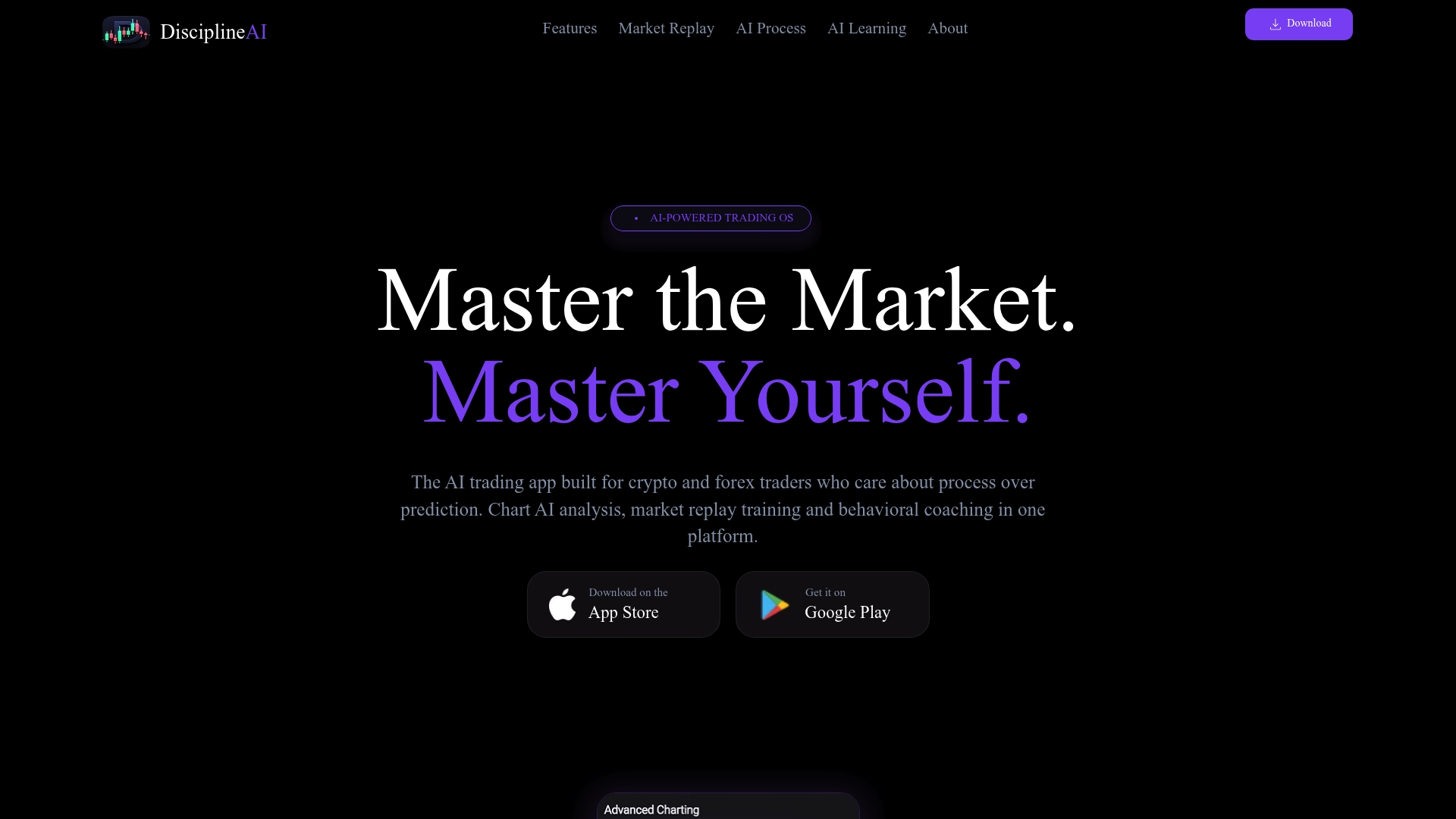
If the workflow described above sounds like what your trading is missing, we built Discipline AI around exactly that loop: trade setups with confidence scores, automated journaling, rule-adherence tracking, and weekly autopsies designed to close the gap between your plan and your actual trades.
- Before connecting a live account, review what broker permissions and data access the connection actually requires.
We built this for traders who want structured feedback, not a black box, so start with the plan that fits your trading volume and see how the review loop fits your routine.
This article is general information, not a substitute for advice from a qualified financial advisor. Consult a qualified financial professional about your own circumstances before acting on anything here.
FAQ
What is an AI trading coach?
An AI trading coach is a decision-support tool that reviews your trade history, journal notes, and rule adherence to flag behavioral patterns and execution issues. It is not an autonomous system that guarantees profits or trades on your behalf.
How does an AI trading coach improve trading discipline?
It works by scoring how closely your actual trades match your written rules, then surfacing recurring violations like oversized positions or early stop removal. Research on prospect theory in trading shows these behavioral patterns are common and measurable, which is what a coach is designed to track over time.
Is AI trading coaching safe to trust with my trade data?
Safety depends on the specific product's disclosures around data access, broker permissions, and whether it separates coaching from financial advice. FINRA warns against AI products making guaranteed-return claims, so check registration and methodology before connecting a live account.
What does Discipline AI cost?
Discipline AI's Pro plan is available at $8.99 per month, $79.99 per year, or $199.99 as a one-time purchase. A separate offering, The Disciplined Trader, is priced at $79 as a one-time purchase.
Can an AI trading coach replace a trading strategy?
No, a coach reviews and scores your existing strategy and rule adherence rather than generating a strategy for you. Pairing it with a position-sizing calculator can help you apply consistent risk budgeting alongside the behavioral feedback.